
NEW WESTMINSTER · AIRFLOW, VENTING & REPAIR SCOPE
Fireplace Repair New Westminster: cold air near the hearth does not identify a failed part. Tell Efficient Heating Service where you notice it and whether the fireplace also has an operating fault. We can discuss assessment, the documented vent system, supported components and the work your enquiry needs.
Reviewed October 4, 2026
Fireplace Repair New Westminster: find where the cold air is noticed
Cold air near a fireplace needs a location, not an immediate parts order. Tell Efficient Heating Service whether you notice it at the appliance front, beside the enclosure or during a change in operation. A New Westminster assessment can distinguish an appliance concern from work involving the surrounding building.
Near the trim or lower openings
Describe the exact area where you already noticed the cold air. A lower grille, a joint beside decorative trim and the edge of the surrounding wall are different locations. Do not take the front apart to narrow it down. An existing photograph with the location marked is useful.
Some openings serve room-air circulation. Treating every opening as a leak can lead to an unsuitable attempt to close it. Keep the installed arrangement intact while the model and complaint are reviewed.
At the wall, floor or chase
Say whether the concern is in the adjacent wall, at a skirting joint or around a boxed enclosure. Include the relationship to the fireplace rather than reporting only that the room feels cold. A building-envelope issue can sit near a functioning appliance without being an internal fireplace fault.
Access to a concealed space may involve another trade or the property manager. The initial enquiry should identify that possibility before an appliance-only repair is assumed to cover the entire wall.
Alongside a start or shutdown complaint
If the burner also behaves abnormally, report that as a separate observation. Give the sequence you have already experienced, such as a shutdown followed by a cold room. A room cooling after heat stops does not explain why the appliance stopped or identify a failed valve.
Avoid repeated attempts to recreate a suspected fault. The booking conversation can use the history you have without asking you to operate an appliance whose condition concerns you.
Use ordinary descriptions: “beside the left edge of the wall opening” is more informative than “the vent is bad.” Keep any earlier contractor diagnosis separate from your own observation. The assessment needs to establish the source and the relevant repair scope before deciding on a component.
Direct vent and B-vent: the installation type changes the question
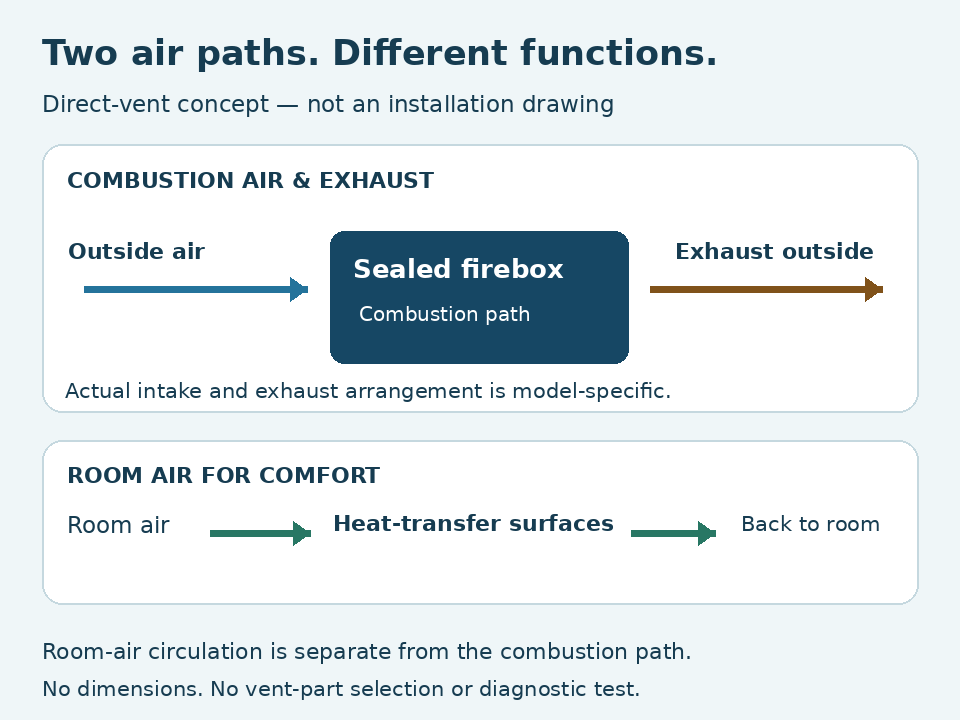
Confirm the documented venting type before interpreting an airflow complaint. A direct-vent appliance takes combustion air from outside and sends exhaust outside through its approved system. A natural-vent or B-vent model uses room air for combustion. Neither description identifies the source of every cold spot around a fireplace enclosure.
| Air function | What the distinction means |
|---|---|
| Combustion air in a direct-vent system | The fire receives outside air through the documented vent arrangement. Confirm that the appliance and installation actually use this design; decorative appearance cannot establish it. |
| Combustion air in a B-vent system | Room air supplies combustion, with exhaust routed through the vent. That difference matters when the installation is assessed and room alterations are discussed. |
| Room-air circulation for comfort | A convection passage or fitted blower moves room air around heat-transfer surfaces. This function is distinct from the combustion-air and exhaust route. |
Heat & Glo explains these venting distinctions in its manufacturer guide to fireplace venting. Use that overview to understand the terminology, then use the actual appliance documentation for assessment. A general diagram cannot approve a particular cap, pipe combination or concealed installation.
The phrase “sealed combustion” describes the combustion arrangement. It does not establish that every joint in the surrounding house wall is airtight. Equally, a cold room does not prove that combustion air is entering the living space. Keep appliance operation and building comfort as separate questions until their relationship is checked.
A visible exterior termination can help identify where an installed system ends. Share an existing safe ground-level photograph if available; do not climb onto a roof, remove a cap or open a chase for the enquiry. The full route and the model’s permitted configuration still need professional consideration.
Report wind and room changes without turning them into a diagnosis
Weather patterns and room alterations provide useful history for an airflow assessment. Record associations you already noticed, including windy days, replacement windows or changes to extraction equipment. They do not prove a particular cause. Avoid improvised tests, blocked openings or adjustments intended to reproduce or overcome a suspected venting problem.
What happened outside?
Explain whether the complaint has been occasional or persistent, and whether you recall windy conditions at the time. That history can guide questions about the installed termination and exposure. It cannot establish that the solution is a different cap or that the current cap is defective.
Do not add an improvised shield, mesh or cover. A vent termination belongs to an approved system. The manufacturer information and the actual installation must guide any proposed change.
What changed inside?
Tell us about known window work, a kitchen extraction change or alterations to the fireplace enclosure. Include approximate timing and whether the fireplace complaint started before or after the work. A sequence is useful evidence; it is not confirmation that one change caused the other.
No homeowner fan-and-window experiment is needed to complete the enquiry. The appliance type and the professional assessment determine how relevant room-air conditions should be investigated.
A change in where you sit, a moved sofa or a new use for a previously quiet room can also change what you notice. Report the location and how you use that part of the room. That context helps describe the comfort issue without promising that a fireplace part will resolve it.
If two people report different experiences, keep both descriptions. One may notice a cold edge while another describes loss of heat after shutdown. Combining them into a single “draft problem” can hide a separate operating fault. A clear booking note allows the assessment to address each concern on its own terms.
For a normally operating appliance that needs routine care, our gas fireplace service information explains the maintenance route. For an airflow complaint, ask explicitly whether the proposed attendance covers the reported concern. Cleaning and a defined fault investigation should have clear scopes.
Which parts belong in an airflow repair proposal?
An airflow-related repair may involve a documented vent component, an appliance sealing item or a separate building detail. These are different scopes. Ask which finding supports each proposed part, whether it belongs to your installed model and what fitting includes. A generic sealing product is not a universal fireplace remedy.
-
Approved vent components
A terminal, connector or other vent item must be compatible with the appliance’s documented system and the installation being assessed. A cap that looks similar is not enough. Ask which exact component is proposed, what finding warrants it and whether access beyond the appliance front is needed.
-
Appliance seals and closure components
If an assessment identifies a sealing fault within the appliance, the proposal should name the affected location and supported replacement. A decorative trim gap, a glass assembly seal and a vent joint are not interchangeable descriptions. Keep the location visible in the quote rather than accepting “seal fireplace” as the entire scope.
-
Room-air blower components
A blower repair can address a diagnosed circulation function. It does not automatically repair combustion venting or a leak in the house enclosure. Ask what symptom the blower work is expected to restore and what remains outside that work, especially when the original complaint was cold air beside the wall.
-
Controls and fuel components
A cold spot alone is not evidence for replacing a valve, ignition module or sensor. If an operating fault leads to one of these parts, ask for the identified failure and the applicable replacement. The quote should connect the component to the diagnosed function, not to an assumed explanation for every symptom.
-
Building-envelope materials
Work on the surrounding construction may belong to another trade and require appliance-related coordination. Do not fill openings with expanding foam, tape or insulation as an experiment. Materials, clearances, required air passages and access need to be considered before a building detail is altered near the fireplace.
Separate component availability from the repair decision. We do not publish a live stock list here. Confirm the proposed part, current supply position, fitting scope and any additional attendance before authorizing an order. An assessed need for a part does not itself mean that the complete repair can be finished on the first visit.
If the investigation points toward replacement instead, compare the complete project with the defined repair. A new appliance can involve a different vent system or changes to the opening. The fireplace installation information provides the appropriate enquiry path when that becomes the proposed outcome.
Regency, Enviro and Heat & Glo: check the model’s air path
A Queensborough fireplace showroom lists Regency, Enviro and Heat & Glo, providing local examples for this discussion. Their model resources illustrate different airflow arrangements. Confirm your own appliance before applying an example. A showroom offering does not establish neighbourhood market share, our dealer status or immediate availability of replacement parts.
Regency U31: a B-vent example
Regency identifies the U31 gas insert as B-vent. This makes it a useful counterexample to the assumption that every gas insert uses outside combustion air. The applicable model revision and installed vent arrangement matter when an airflow concern is assessed.
Report the nameplate information you can safely access and any available manual. Do not transfer direct-vent instructions to a U31 simply because both appliances fit an existing fireplace opening. Our Regency repair service page gives a brand-specific enquiry route.
Enviro Q1L: two air functions in one installation
The Enviro Q1L manual describes outside combustion air for its direct-vent design. It separately describes room-air circulation at the front of the appliance and warns against blocking or modifying those openings. Those two functions should remain distinct when discussing a cold-air complaint.
This example does not identify every Enviro installation. Use the documentation for the actual unit, including its revision. Report where you notice air movement without covering a grille or adjusting the vent system to see whether the sensation changes.
Heat & Glo: identify the vent design before choosing a remedy
Heat & Glo’s venting explanation distinguishes direct-vent sealed combustion from natural-vent systems. Its overview also explains that the termination route depends on the appliance design. An exterior wall exit in one home does not justify changing another unit to the same arrangement.
For a Heat & Glo enquiry, provide the installed model and the operating concern along with the cold-air location. The relevant manual and installation determine the next questions. General brand familiarity cannot establish a supported replacement vent part.
The local reference is BC Fireplace Service’s Queensborough showroom at 816 Boyd Street. Its listed range supplies local context only. If your appliance is another make, include its name in the enquiry; this page’s examples are not a claim that these three brands dominate New Westminster homes.
New Westminster neighbourhoods: describe the address and the room
Your neighbourhood helps organize the enquiry, while the actual building and fireplace determine the assessment. New Westminster includes riverfront addresses, established residential areas and varied apartment, townhouse and detached-home settings. Describe the room, floor and existing access information. The local examples below are prompts, not diagnoses assigned to a neighbourhood.
River addresses
- Queensborough
- For a detached home or townhouse here, distinguish the fireplace enclosure from the wider exterior wall. Mention whether the concern is beside the room opening or associated with a burner problem. The address does not establish either diagnosis.
- Downtown
- In an apartment or mixed-use building, identify the suite and the room involved. Ask which parts of the installation are within the suite and which may involve building access. A unit-level enquiry should not assume access to a concealed common area.
- Quayside
- If the room faces the river, report any weather association you have already noticed without treating that orientation as the cause. Describe the cold-air location and appliance behaviour separately. A river-facing address is context, not evidence of a failed termination.
Central rooms and established homes
- Brow of the Hill
- For a compact apartment or a larger home, explain whether the concern is localized at the fireplace or extends across the room. Include the wall location and room use. This helps avoid framing a general comfort problem as a specific fireplace component failure.
- Uptown and Moody Park
- If work elsewhere in the suite or house changed windows or extraction equipment, include that history. Note approximate timing without performing a new test. The appliance type must be confirmed before drawing conclusions about how room changes relate to combustion air.
- Queen’s Park
- Where an established home has a fireplace set into older construction, distinguish known alterations from assumptions about the original chimney. If protected finishes or property restrictions apply, raise them before access is arranged. The neighbourhood name alone does not establish a restriction.
- Glenbrooke North
- For a family room with a boxed fireplace chase, photograph the whole arrangement from an ordinary safe position. Mark the location of the cold sensation in the image. Do not open the enclosure to make the first enquiry more detailed.
- Glenbrooke South
- If the fireplace sits near a floor or wall joint, describe that junction as well as the appliance front. Keep the repair request specific. A building detail beside the hearth may need a different scope from an internal seal or vent component.
East and west home settings
- Sapperton and McBride
- If a renovation changed the room layout, tell us what is documented and what remains uncertain. Include the fireplace position and the complaint you noticed afterwards. The assessment should establish the relevant installation details before a repair is linked to that renovation.
- Massey and Victory Heights
- For a sloping-site home or a room on a lower level, provide the fireplace floor and the exterior termination location if already known. Site layout helps discuss access. It does not determine the vent configuration or approve an alternative route.
- West End
- Where an existing masonry opening contains a gas insert, ask for the model’s vent classification to be confirmed. An insert can have a different air supply from another unit in a similar opening. The brick surround is not enough to identify it.
- Connaught Heights
- For a townhouse or detached property, explain whether the reported concern belongs to one fireplace enclosure or several areas of the home. A wider comfort complaint may involve additional assessment. Agree on the appliance scope before assuming it covers the whole house.
The City’s residents-association directory and heritage research resources provide local naming and building-history context. The groupings here are reading aids, combining broader areas and smaller local names; they are not a claim about a fixed number of municipal districts.
No part recommendation follows from the neighbourhood alone. Two fireplaces in the same block can use different combustion-air systems, and two buildings with similar fronts can provide very different repair access. Use the address to arrange attendance and the appliance evidence to define the work.
Match the access plan to an apartment, townhouse or older house
An airflow assessment may need information beyond the visible fireplace front. Explain the building format and which locations are accessible, including property-management involvement. Apartments, townhouses and older houses raise different access questions. Agree on the initial scope before expecting an appliance visit to include concealed construction or shared building work.
Apartment or strata-controlled installation
Ask the property manager about the arrangements that apply to access beyond your suite. A termination, enclosure or concealed route may require information or access you cannot provide personally. Do not assume that every nearby vent or building opening serves your own appliance.
Share relevant information about the installation, not unrelated residents’ details. If the enquiry needs common-area access, identify that dependency before attendance is promised. A repair quote should explain whether building coordination forms part of the work.
Townhouse with an exterior chase
Describe the room and the visible enclosure arrangement. Let us know if access involves another level, an exterior area or a space managed under property rules. The photograph of the fireplace front may not show the entire installation, so avoid treating it as complete evidence of the vent route.
If a contractor previously worked on the enclosure, provide the relevant description of that work. An assessment can then distinguish what is known from what remains concealed. Do not remove cladding or insulation in preparation for the first visit unless the agreed professional scope specifically calls for it.
Established detached home with an insert
Keep the history of the house separate from the documentation of the gas appliance. The original chimney and a later gas insert do not necessarily share an unchanged configuration. Ask which installation records apply to the current unit and how the existing route will be assessed.
Where a property has identified heritage constraints, include those actual constraints in the access discussion. Do not infer them merely from the neighbourhood or age of the brickwork. Any work involving finishes should have a defined scope and the appropriate property authorization.
A useful access discussion ends with three practical answers: what can be assessed initially, what additional access might become necessary, and who arranges that access. This gives the owner a clearer decision than an open-ended promise to “fix the draft” without establishing what installation can be examined.
Get an estimate that separates fireplace work from wall work
Ask what the initial assessment charge covers and how any later work will be quoted. A vent-component repair, an appliance seal replacement and building-envelope work can have different parts, labour and access requirements. A clear New Westminster estimate should identify the assessed issue and separate confirmed work from further investigation.
Read the proposal in four lines
- Finding: the location or operating fault identified, plus any uncertainty that still needs investigation.
- Fireplace scope: supported parts, fitting, relevant completion checks and appliance access included in the work.
- Building scope: any work outside the appliance, the responsible trade and property-management coordination if applicable.
- Price and dependencies: the current charge, supply status, additional attendance and any unresolved access requirements.
Ask what happens if the first visit identifies a construction issue rather than a failed fireplace part. The assessment can still be useful, but the next proposal should reflect that finding. A homeowner should be able to see why a quoted component addresses the diagnosed concern.
No universal dollar figure is published here. The required access, installation and remedy have not yet been assessed. Before agreeing to attendance, confirm the current initial charge and its limits. Before approving later work, ask for the revised total and the circumstances that could change it.
A lower parts price is not enough to compare two proposals. Check whether both include the same fitting, access and completion scope. If one covers a component at the front and another includes work along the vent route, the figures describe different jobs. Clarifying that difference makes the decision more useful than a bare price comparison.
If appliance work and wall work will be carried out by different providers, ask how the sequence will be coordinated. Required openings and appliance access should not be lost during finishing. Each provider’s scope needs to be explicit, including what is checked before the affected area is closed.
Questions about cold air, vent parts and the cost of investigation
Questions focus on choices owners face when noticing cold air near a gas fireplace. The answers explain useful distinctions for arranging assessment and reading a proposal. They do not diagnose a particular installation. Provide the observed location, documented model and available access information when discussing your own New Westminster property.
Does sealed combustion mean the wall around my fireplace is airtight?
No. Sealed combustion describes the appliance’s combustion-air and exhaust arrangement. It does not certify every joint in the surrounding wall or chase. Describe the cold location separately so an assessment can distinguish the fireplace system from the nearby building construction.
Is a chilly lower grille a reason to fill it with foam?
No. A grille or opening may serve a required room-air circulation function. Filling it without identifying that function can create a hazardous condition. Leave it as installed and request assessment of the location you noticed, rather than experimenting with tape, foam or insulation.
Do all gas inserts draw their combustion air from outdoors?
No. The documented venting type determines the combustion-air arrangement. Regency’s U31 provides a B-vent example, while Enviro’s Q1L documentation describes direct vent. The opening or decorative surround cannot establish which system your own insert uses.
Does a complaint that occurs on windy days prove I need a new vent cap?
No. A weather association is history for the assessment, not a parts diagnosis. The installed model, approved vent system, route and termination need consideration. Do not fit a generic cap or wind shield based only on when the complaint occurs.
Should I buy a blower to cure cold air beside the fireplace wall?
Only a diagnosed blower problem supports that repair. A blower serves room-air circulation; it does not automatically remedy an enclosure leak or combustion-vent issue. Ask which function the proposed component will restore before connecting its cost to your cold-air complaint.
Why should I mention a new kitchen extractor if the fireplace is in another room?
A known extraction change can be relevant installation history, particularly when assessing a model that uses room combustion air. Mention the timing and the symptoms you already noticed. This does not prove causation or require you to recreate the situation with a homeowner pressure test.
If another suite feels a draft, does that mean our fireplaces share a vent?
No. Similar complaints in nearby suites do not identify a shared vent arrangement. Each appliance and its documented route need identification. Report the other observation as relevant building context without treating it as proof that your fireplace connects to the same system or needs the same repair.
Who repairs a wall leak when the fireplace itself has no identified fault?
That may require an appropriate building trade rather than an appliance component replacement. Ask for the identified location, what the fireplace assessment established and how surrounding work will respect the appliance requirements. The next scope should follow the finding instead of inventing a fireplace fault.
Can the quote show vent parts and enclosure work as separate amounts?
Ask for that separation when both scopes are proposed. It should show the appliance-related remedy, the building work, access dependencies and who carries out each part. Confirm the combined cost and coordination before approving work; a single unexplained “draft repair” total is less useful.