
WEST VANCOUVER · FLAME, LIGHT & FINISH
Fireplace Repair West Vancouver: describe the feature you want restored. Efficient Heating Service can discuss gas operating faults, fitted decorative lighting and supported component repairs. Tell us the installed format and the change you noticed; we will clarify the assessment route and current charge. Reach our team at 778-798-4343 or use the repair enquiry form.
Existing appliance assessment · Reviewed October 4, 2026
Fireplace Repair West Vancouver: name the feature that stopped working
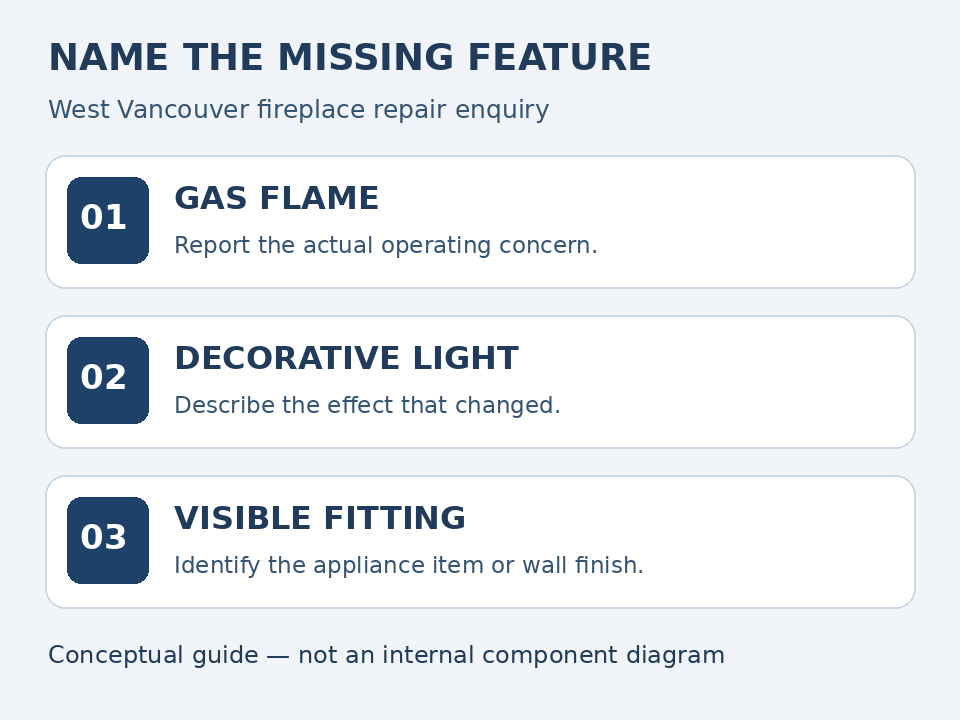
Describe the missing function first: a gas flame, decorative lighting or a damaged component. Efficient Heating Service can discuss the assessment appropriate to your West Vancouver fireplace and confirm current charges. A feature failure needs identification before a repair recommendation; the appearance of the complete fireplace cannot identify a part.
The gas fire does not perform normally
Lead with the operating problem when the burner will not start, stops unexpectedly or behaves abnormally. Say whether the concern involves the actual flame rather than an illuminated fuel bed. Mention visible damage, new soot or an unusual ignition event promptly. Those observations change the priority of the enquiry.
The decorative effect has disappeared
If the flame has appeared unchanged but an installed light is dark, flickering or missing a colour, describe that feature separately. The observation helps define the complaint; it does not establish that continued operation is safe or prove that a lamp alone has failed.
A visible fitting needs attention
Identify whether you mean a removable trim, the fitted safety barrier, an interior panel or the building’s stone and cabinetry. These belong to different work scopes. A loose screen or damaged glass needs professional attention; do not remove a barrier to improve the view.
We welcome enquiries about an ordinary single-window fireplace as well as a feature appliance. You do not need a designer installation to request repair. Explaining the missing function simply makes the first conversation more useful, whether the fireplace has a traditional log display or a long contemporary opening.
For an illustrative enquiry, you might write: “Our living-room fireplace has two viewing sides. The gas fire has not shown a change, but the lighting that used to illuminate the stones is now dark. We would like that feature assessed.” This example explains how to describe a concern; it is not a claim about a customer repair we completed.
Report only what you already know from ordinary use. Do not restart a malfunctioning appliance repeatedly, move its interior media or open an electrical compartment to gather evidence. The relevant model instructions and a professional assessment determine the next action.
Linear, corner, peninsula and see-through: describe the installed format
A viewing arrangement describes the shape of the fireplace, not its component layout. Identify which faces you can see and where the lost effect appears. The model documentation establishes the appliance configuration. Multiple windows do not by themselves establish separate burners, separate control systems or more than one repair booking.
A linear opening
“Linear” commonly describes a wide landscape viewing format. A long opening may include a concealed burner, decorative media and lighting, depending on the product. Its visible length is useful context, but it cannot select a replacement lighting assembly or establish the burner design.
Describe the effect’s location in everyday terms: above the display, beneath the media, at one end or across the full opening. Keep the original component names for the assessment. You do not need to decide whether the feature is an uplight, downlight or another manufacturer-specific arrangement before contacting us.
A corner or three-sided fireplace
Explain which viewing faces form the corner and whether the concern is visible from one face or all of them. Right-corner and left-corner versions may have different documented configurations. A photograph showing the room arrangement can complement the model information without proving which internal part is defective.
Reflections can make a feature look different from another angle. Describe that difference without changing the media to make the views match. A professional can distinguish a viewing effect from an actual component or operating fault.
A see-through or tunnel arrangement
Say which rooms or spaces share the view. The two sides may belong to one appliance; do not infer two independent fires from two windows. If the same feature looks missing from both spaces, include that observation in a single description of the installed unit.
A second viewing face also makes room access relevant. Tell us if the other side is in a bedroom, study or separately occupied space. This lets the attendance discussion account for access without assuming that every task requires opening both faces.
A peninsula or room-divider installation
Describe the exposed end and the long viewing faces, and identify the room containing the ordinary controls. Do not describe a furniture-like enclosure as a freestanding appliance unless that is the documented product type. The surround’s appearance and the appliance classification are different information.
If you are uncertain about the format, a wider room photograph is more helpful than an invented product description. Keep people, personal documents and security details out of the image. Photographs support planning; they do not replace inspection of the fireplace.
Interior and exterior viewing arrangements need accurate identification too. A window facing a patio does not establish that the appliance is an approved indoor-outdoor model. Mention the location and leave the product classification to its documentation. Outdoor equipment should not be assumed to use the same assemblies as a similar-looking indoor model.
A dark lighting feature is an observation, not a lamp diagnosis
Decorative illumination and the gas burner perform different tasks, when they share a handset or enclosure. A lighting complaint can concern the light source, its supply or its control arrangement. Assessment should establish the fitted feature and failed function. Never substitute a household lamp or bypass connections inside a fireplace.
-
Describe the effect that existed
Explain whether the feature illuminated the logs, shone through the media or produced a coloured background. Say if it was fitted when you obtained the fireplace or added later, if that history is known. “There used to be a warm light over the logs” is clearer than “the whole fireplace has no power.”
-
Separate colour, brightness and flame
A missing colour, uneven illumination and a complete loss of lighting are different reports. State the change you noticed rather than describing all of them as a failed burner. Include any gas operating concern separately and first if it affects safe use.
-
Identify an independent lighting control
Some fitted arrangements have a separate control for illumination; others integrate supported lighting functions into an appliance control. Tell us about a dedicated lighting handset or wall control if you know it exists. Do not assume that an icon proves the hardware is installed or that two controls can operate every feature interchangeably.
-
Keep the complaint within ordinary observation
A brief description of a change already seen is enough to start the enquiry. Avoid touching hot surfaces, reaching below the glass or exposing wiring. A fault that smells electrical, produces smoke or is associated with visible damage needs prompt professional guidance rather than further trials of the lighting effect.
A partial lighting failure can be important to the owner even when the room’s main attraction is the flame. Restoring the original decorative effect may be the requested outcome. The estimate should say what function will be restored and whether the assessment has identified a repair supported for the actual installed system.
Conversely, an attractive lighting effect does not demonstrate that a gas burner has started. Illuminated glass or logs can be mistaken for a small flame, especially in a bright room or through reflective panels. Describe whether you are reporting the decorative effect or actual combustion; do not use an illuminated display as proof of gas operation.
A website photograph or showroom display is useful for design inspiration, but it may show a newer model, another media package or a different lighting option. Compare against the features documented for your own appliance. A repair should restore a supported function, while changing the display’s design needs a separately described proposal.
Montigo, Valor and Ortal: three different feature arrangements
Montigo, Valor and Ortal are listed by a North Shore showroom, providing locally relevant examples of feature fireplaces. Their formats and lighting arrangements differ. Confirm the installed version when asking about repair. A local brand listing establishes availability in a showroom range, not household market share or our dealership status.
Montigo Distinction: distinguish the lighting effect from the fire
Montigo’s D4815 product information lists a concealed burner, reflective interior glass and multicolour LED uplighting. It also lists appliance controls and other features. These are distinct functions within the fireplace; a complaint about the illuminated media should specify which effect has changed.
The single-sided D4815 example should not be used as a parts identification for a see-through version or another production revision. Report the fitted product rather than selecting an assembly by the visible length of the opening. Ask whether the assessment can establish the relevant lighting arrangement before parts are ordered.
Our Montigo repair enquiry page provides an additional contact route. The manufacturer’s D4815 feature list explains this particular example.
Valor LX2: corner and three-sided versions need their own identification
Valor describes the LX2 in corner and three-sided formats and lists decorative overhead lighting. Its product page distinguishes engine configurations and associated interior packages. Those distinctions matter when the owner describes a viewing-side or display concern.
For an LX2 enquiry, say which format is installed and whether the missing effect concerns the illumination, visible interior or gas operation. A three-sided view does not justify assuming three separate lighting assemblies or three independently controlled burners. Use the documented configuration when the repair scope is developed.
Read the Valor LX2 configurations and feature information for the manufacturer’s description. Other Valor products can have different features.
Ortal: internal lighting belongs to the specified installation
Ortal presents internal lighting among the options for its feature fireplaces and offers several viewing styles. Its manufacturer information distinguishes installed arrangements, including components that can affect electrical requirements. Avoid treating every Ortal enclosure as the same system.
State whether your enquiry concerns a fitted lighting feature, another accessory or actual gas operation. The exact model and option package determine the documentation needed. Confirm the available assessment route for your unit before making a parts or attendance commitment.
The Ortal linear fireplace feature overview and manufacturer’s configuration FAQs give primary product context. They do not establish the fault at your property.
Maxwell Fireplace’s North Shore showroom range includes these manufacturers. This provides a reason to discuss them here without inventing which brand West Vancouver residents own most often. Please name the fireplace you actually have, even if it is outside these three examples.
Manufacturer-specific service requirements should be confirmed for the fitted appliance. An enquiry does not imply that Efficient Heating Service is an authorized dealer for every listed brand or that every accessory is stocked. We can discuss the unit and clarify whether the requested assessment or repair is available.
Fireplace parts: specify what restores the original feature
A feature repair can involve an approved light source, an electrical assembly, a control component or an interior fitting. The proposal should identify the failed function and the replacement. Ask what is included, what must be assessed first and whether access or reinstatement requires another trade before approving an order.
- Light source or lighting assembly
-
The part description should distinguish an individual supported light source from a complete assembly. A unit that appears similar online may have different dimensions, connections or temperature suitability. Ask how the proposed item was matched to the installed lighting package, rather than choosing the brightest replacement available.
Do not fit a generic LED strip, household bulb or decorative furniture light inside a gas fireplace. The documented application matters. If an original assembly is unavailable, ask about a manufacturer-supported remedy and its effect on the original feature before accepting a substitute.
- Power supply, driver or associated connection
-
A dark display does not establish which component has failed. Where the fitted arrangement contains a separate power supply or driver, the assessment needs to distinguish that item from the light source and control. The quote should identify the assessed component without presenting several speculative replacements as a confirmed diagnosis.
Connection repairs require an appropriate professional scope too. Reaching into the appliance, bridging contacts or adapting a connector to make an online part fit can compromise the supported arrangement. A consumer description of the fault should not become an instruction to alter wiring.
- Lighting control or switching component
-
The control system determines which lighting functions are available. A replacement should preserve supported operation for the actual installed version. State whether the desired result is a restored on-off response, a supported dimming function or a fitted colour-selection feature.
A control with more buttons is not necessarily an upgrade for the appliance. Any proposed change beyond the original feature should be described and checked separately. Keep the replacement rationale clear enough to understand which function the component restores.
- Interior panel, media package or trim
-
A damaged or missing interior fitting needs its own item description and model context. Reflective panels, approved media and removable trims are different products. Appearance matters, but colour and approximate size do not establish interchangeability.
Ask whether the proposed work restores the documented display or changes it to an approved alternative. Do not reposition logs, add glass media or obscure a light fitting to reproduce a brochure photograph. These changes can affect more than appearance and need the appropriate product instructions.
- Gas operating component
-
If the reported problem concerns combustion or ignition, the lighting discussion must not distract from that failure. Gas operating parts need a diagnosed fault, a supported part and the relevant completion checks. An LED effect cannot be repaired into a remedy for an unrelated gas problem.
When two concerns coexist, ask for each to be identified in the scope. Restoring the gas operation and restoring decorative lighting may be separate outcomes with different components, access requirements and supply dependencies.
Availability is confirmed for the particular item during the enquiry; this page is not a live stock catalogue. Ask about supply timing, the basis for compatibility, any return conditions and the attendance needed after the part arrives. A promise about the whole fireplace should not be inferred from availability of one component.
West Vancouver neighbourhoods: the property decides the repair plan
West Vancouver includes apartment settings, detached homes and distinctive residential architecture. The installed fireplace and its surroundings decide the useful access questions. Provide the address, building type and viewing arrangement. Neighbourhood context helps plan attendance; it does not establish the brand, age, failure cause or responsibility for any building component.
-
Ambleside
If your fireplace is in an apartment, identify the unit and any attendance arrangements with the building. A long viewing opening can still belong to one appliance. State whether the missing feature is decorative illumination or gas operation, rather than asking for a general electrical visit without appliance context.
-
Hollyburn
For a suite with a fireplace set into a shared interior wall, describe the room containing its service-facing side. Building arrangements need confirmation for that property. A similar fireplace in another unit is useful background only; it does not establish identical lighting packages or give permission to use a neighbouring unit for comparison.
-
Dundarave
In a house or apartment with an older conventional fireplace, explain whether the lighting effect was originally fitted or introduced later, if known. The neighbourhood name does not imply a modern linear model. We need the installed product and complaint, not an assumption based on the style of the street.
-
British Properties
If a feature fireplace forms part of a living-dining divider, tell us which spaces share its viewing faces. Include any room-access limitation in the booking discussion. A large home or custom enclosure does not itself establish a specialist part number, additional burner or a need to replace the complete appliance.
-
Caulfeild
For a fireplace surrounded by existing timber detailing, stone or built-in storage, describe the visible installation without dismantling it. Access planning should preserve required appliance clearances and service provisions. The assessment must determine the appropriate route; the property design is not a reason to improvise access through finishes.
-
Altamont
If the installation is in a detached home with a substantial feature wall, separate the appliance repair from work on that wall. Mention a room divider, raised hearth or close-fitting cabinetry when present. These details help discuss access but do not justify predicting difficult removal before the actual arrangement is reviewed.
-
Horseshoe Bay
State whether the unit is indoors, part of a documented indoor-outdoor arrangement or a separate outdoor appliance. A view toward the harbour or patio does not determine the product category. Include relevant access and attendance details, and confirm that the requested repair concerns the appliance actually installed at the address.
-
Park Royal area
For an apartment or mixed-use building near Park Royal, explain which residential space contains the fireplace and which viewing format is installed. Arrange any building access requirements with the appropriate contact. Do not assume that a lobby fireplace and a suite fireplace share the same service responsibility or equipment.
The District’s account of West Vancouver’s neighbourhoods and residential design documents the area’s varied building history, including apartment development and West Coast modern houses. It supports describing different settings, not assigning an appliance fault to a postal area.
These are practical address examples, not an exhaustive neighbourhood boundary map. The list includes a broader local area as well as named neighbourhoods. Supply the actual address when contacting us; a nearby landmark helps orientation, while assessment availability and attendance arrangements need confirmation for the property.
A feature fireplace can be present in an older house following an alteration, while a new building may contain a conventional unit. Keep the building’s age and the fireplace’s documented identity separate. This avoids selecting a manual or component solely from the home’s architectural style.
Repair costs and service access: make the proposal easy to approve
Ask for the assessment charge and a proposal separating the identified repair, required access, parts supply and any finish reinstatement. A wide or multi-sided fireplace is not automatically a costly replacement. The assessed component and installation determine scope. Confirm dependencies and current prices before approving attendance or a component order.
-
Set the outcome
Describe the result you want: an original lighting feature restored, a supported display fitting replaced or a gas operating fault investigated. Avoid accepting a proposal that refers only to “fix fireplace” when it is unclear whether the decorative effect or burner is included.
An ordinary maintenance enquiry is different from a feature repair. Our gas fireplace service information provides the maintenance route. If a function has failed, make that failure explicit rather than assuming that routine cleaning includes its diagnosis and replacement.
-
Identify the documented service route
Tell us about the visible surround and room arrangement. A professional assessment should establish the manufacturer’s intended access route and any limitation in the installed finish. A wide opening does not prove that stone must be removed, and a frameless appearance does not prove that every component is reachable from the room.
Do not lift a heavy slab, detach the glass or cut a panel ahead of the visit. If another trade is needed, ask what task it must perform, when it must happen and who reinstates the finish. Appliance access and building alterations should be clearly assigned.
-
Authorize the assessed item
Once the component and remedy are identified, request a part description that connects the item to the missing function. Ask whether the price covers a complete assembly or a supported individual component. The most useful comparison is between proposals restoring the same feature with the same included work.
A parts-only price and a fitted repair price answer different questions. Check fitting labour, any additional attendance, applicable taxes and the explanation of completion. Current figures should come from the specific proposal rather than a generic city price list.
-
Resolve supply and attendance dependencies
Ask whether the proposed part is available now and what supply information is confirmed. If an order or additional attendance is necessary, make the sequence clear before approving it. A single visit should not be promised before the fault, component and access are understood.
For an apartment, agree any building arrangements needed for the actual scope. For a home with restricted room access, explain who can make the service area available. These details help avoid a visit that cannot complete the agreed assessment.
-
Confirm what completion means
The repair explanation should connect the completed work to the original complaint and the relevant documented operation. For a lighting repair, clarify which fitted lighting functions were checked. Any gas-related work needs its own appropriate completion scope; restored illumination alone is not evidence that unrelated operation was assessed.
If replacement of the whole appliance is proposed, request the reason and the new installation scope. Our gas fireplace installation information is the related enquiry route. Keep a supported feature repair and a proposed redesign as separately understandable choices.
| Proposal item | What to clarify |
|---|---|
| Assessment | The reported function being investigated, attendance charge and whether any quoted repair follows separately. |
| Component | The identified item, supported compatibility and the feature the replacement is intended to restore. |
| Access | The appliance service route, any separate building work and responsibility for returning the finish to its agreed condition. |
| Supply and completion | Confirmed supply information, required visits, fitting scope and the explanation of the completed repair. |
9 questions about feature fireplace repairs in West Vancouver
These answers address the difference between lighting, flame and viewing format, plus practical questions about supported parts and access. They help you prepare a clear repair enquiry rather than diagnose the appliance. The fitted product documentation and assessment determine the remedy. Discuss additional building or smart-home scope explicitly before approval.
The coloured media still glows, but I cannot see a flame. Is the gas fire working?
Illuminated media is not proof of a burning gas flame. Some feature fireplaces include decorative lighting distinct from combustion. Describe the missing flame as the operating concern and the visible lighting as a separate observation. Do not repeat ignition attempts to prove the difference; seek guidance for the fitted appliance.
One LED colour has disappeared. Does the whole lighting system need replacement?
Not necessarily. A missing colour describes the symptom, but it does not identify the failed component or the supported remedy. Assessment needs to establish the installed lighting arrangement and the affected function before recommending an individual item or a complete assembly. Confirm the scope rather than ordering from the colour symptom alone.
Can I use a dimmable household bulb to restore a fireplace downlight?
Do not select a household bulb simply because it fits or is dimmable. A fireplace lighting component must be suitable for the documented application and installed arrangement. Ask for a supported item matched to the assessed feature. Leave access and replacement to the appropriate professional scope.
My see-through fireplace has two windows. Should I book two separate repairs?
Two windows can belong to one see-through appliance. Explain both viewing spaces and the concern at each face, and identify the installed model. The assessment determines the work and access required. Do not assume a separate burner or an additional appliance from the second window alone.
Can a wall dimmer control the decorative lighting inside every gas fireplace?
No universal compatibility should be assumed. The fitted lighting system and manufacturer documentation determine its supported control arrangement. An ordinary wall dimmer may be unsuitable. Describe the control you already have and ask about a documented remedy; do not connect a new dimmer or modify the appliance wiring yourself.
Will a small lighting repair require removing my stone feature wall?
That cannot be decided from the symptom or an online photograph alone. The documented appliance service route and installed finish must be reviewed. Ask whether the component can be accessed as intended, whether any separate building work is necessary and who would reinstate the finish before authorizing removal.
I want a warmer decorative light colour. Is that the same job as repairing a failed light?
A preference for a different effect is a design enquiry rather than proof of a failure. Explain whether the existing function has stopped or whether you want to change it. Any proposed colour or lighting-package change needs documented compatibility and a clear scope separate from restoring the original feature.
Can a smart-home scene be included when checking a repaired lighting feature?
Mention an existing integrated scene during the enquiry and explain which response it is supposed to provide. Confirm whether the repair scope includes that supported interface or only the appliance-side function. A scene name does not establish compatibility, and appliance repair should not imply changes to unrelated home-automation equipment.
What should the repair record say when only the decorative lighting was repaired?
It should identify the reported lighting problem, assessed component, completed work and the relevant fitted functions checked. The record should make clear what else was included in the assessment. A restored decorative effect should not be presented as evidence that every gas, venting or building component was repaired or checked.