
Updated: 27 September 2026
Boiler installation Delta: agree the whole job first
Boiler installation in Delta should begin with a clear scope: the heating and hot water you need, the equipment being supplied, the work around it, and who handles permits. Call Efficient Heating Service to discuss your existing system, installation requirements and an assessment.
Call 778-798-4343 Request a Delta installation assessment
Replacing a boiler can involve more than removing one appliance and connecting another. The right proposal explains how the new equipment will work with your radiators, baseboards or radiant floors, and what happens to any connected hot water tank.
- System choice: compare a heating boiler, a boiler with an indirect tank, or a combi that also supplies domestic hot water.
- Price: ask for a written total with equipment, labour, permits and supporting work identified. An appliance price alone does not describe the installation cost.
- Timing: confirm equipment availability, any other trades needed, and the expected heating and hot water interruption before agreeing on a start date.
- Location: provide your Delta address and neighbourhood, including Annieville, Sunbury, Scottsdale or Sunshine Hills, so the assessment starts with the correct property.
- Completion: agree on startup testing, the explanation of your controls, and the documents you will receive.
If you are still deciding whether replacement is necessary, start with boiler repair in Delta. A fault diagnosis can establish whether the appliance itself needs replacement or whether a separate system problem needs attention.
Start with the heating and hot water arrangement
Choose the system arrangement before choosing a brand. A heating boiler serves the space heating circuit; an indirect tank can add stored domestic hot water. A combi supplies heating and on demand hot water from one appliance, with capacity checked against your household’s actual requirements.
A wall mounted condensing boiler can be a suitable replacement for an older gas boiler, but the assessment must include the connected heating system. Heat loss, operating temperatures, water flow and controls matter alongside the appliance rating. Copying the old boiler’s input is not a sizing method.
For a combi, discuss how many hot water outlets may run together and the required temperature rise. For a boiler with an indirect tank, review storage and recovery needs. A compact appliance does not remove the need to design the water heating arrangement.
Model families to discuss
These examples distinguish equipment types. They are not a ranking of brands installed in Delta, a stock list, or a recommendation for every home.
| Manufacturer and family | Arrangement to check | What the proposal should identify |
|---|---|---|
| Viessmann Vitodens 100-W | B1HE heating boiler or B1KE combi | Exact model, heating output range, and domestic hot water arrangement |
| Navien NHB-H or NCB-H | NHB-H heating boiler or NCB-H combi | Selected capacity, compatible piping and controls, and hot water performance where applicable |
| Bosch Greenstar | Heating-only or combi version | Exact product version, installation requirements and local supply availability |
For an existing appliance, our Viessmann and Navien repair guides can help you prepare the model and fault information for a conversation. Replacement selection still needs a property assessment.
For a broader explanation of the available arrangements, see our boiler installation overview.
Who handles boiler installation permits in Delta?
For regulated gas installation work in Delta, Technical Safety BC is the relevant permitting authority. The installation proposal should identify the licensed contractor handling that work and its permit. Separate plumbing, electrical or building requirements must also be checked against the actual scope of your project.
The City of Delta’s gas and electrical permit page directs owners to Technical Safety BC. TSBC’s gas alteration guidance confirms that replacing gas equipment requires the appropriate permit before the work starts. Keeping the boiler in the same location does not remove that requirement.
Check the work beyond the gas appliance
Delta states that installing, altering or repairing plumbing requires a plumbing permit. Its building and renovating guidance also addresses building alterations and electrical work. Ask which requirements apply to your installation, particularly if it changes water connections, wiring, walls or the use of a room.
A gas permit does not settle every other approval. The responsible contractor should confirm the relevant requirements with the authority handling each part of the work. The written scope should identify who applies, whether fees are included, and who coordinates required inspections or assessments.
Keep the permit reference with the model details and installation documents. You should be able to connect the paperwork to the work completed at your address.
Make the supporting work visible in the proposal
A useful installation proposal names the work outside the boiler casing. It should explain connections to the heating circuit, venting, condensate disposal, controls and any hot water equipment. Each item needs a clear status: included, retained after assessment, excluded, or subject to an identified further check.
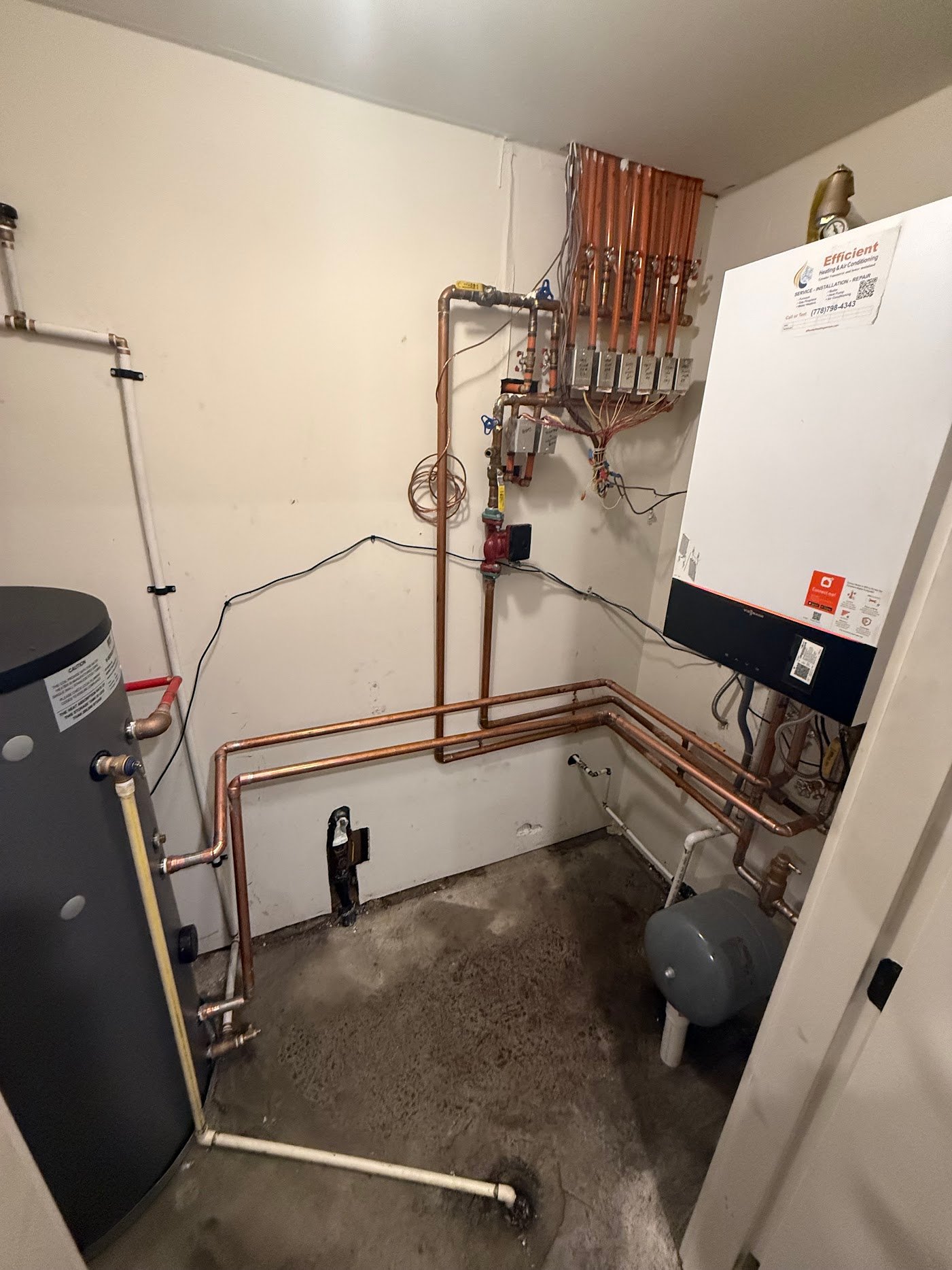
Look beyond the boiler casing
This photograph shows a wall-mounted boiler beside a tank, with copper distribution piping, zone controls and an expansion vessel. These visible components help explain why an installation assessment includes the surrounding system.
- Piping and zones: identify the circuits and how each responds to a call for heat.
- Tank connections: confirm how the proposed installation will provide domestic hot water.
- Pressure components: assess the expansion arrangement and related controls.
A photograph helps start that discussion. The component condition, sizing and compatibility still need to be checked at the property.
The following table is a practical discussion guide. It does not mean every installation needs every component replaced.
| Part of the job | Detail to settle before approval |
|---|---|
| Boiler and removal | Exact model and fuel; removal and disposal of the old equipment |
| Heating connections | Piping changes, isolation points and the suitability of retained circulators and zone valves |
| Pressure control | Assessment of the expansion tank and pressure control components, with any required changes identified |
| Air supply and exhaust | Approved materials, routing and termination for the selected appliance |
| Condensate | Disposal route and system water requirements, including any specified treatment equipment |
| Electrical and controls | Power connection, thermostat compatibility and the trade responsible |
| Domestic hot water | Retained tank, new indirect tank or combi connections; any work on the water supply |
| Finishing and completion | Penetration sealing, any excluded decorating, cleanup, testing and handover |
Circulators and zone valves
A circulator moves water through the heating circuit. A zone valve opens or closes flow to a controlled area. Their suitability depends on the proposed piping, flow requirements and control arrangement. Ask whether existing devices will be retained, adapted or replaced, and how the finished system will be tested.
Expansion tank and pressure control
The expansion tank accommodates the heating water’s expansion. The fill arrangement and relief valve serve different pressure functions. The scope should include an assessment of these components and any required changes. Replacing the boiler does not by itself establish that every existing pressure control component is suitable.
Condensate and system water
A condensing installation needs a suitable condensate arrangement. The heating water must also meet the selected manufacturer’s requirements. Identify any cleaning, flushing or water treatment in the scope, with the method chosen for the appliance and existing circuit. A generic chemical treatment should not be assumed suitable for every product.
Coordinate the trades before setting the installation date
An installation date is useful only when the required work can happen in the right order. Agree who coordinates the gas work, electrical changes, plumbing and any building work. Confirm dependencies before disconnecting the existing appliance, especially where the boiler also supplies the household’s hot water.
For a straightforward replacement, one contractor may arrange the relevant work. A larger renovation may involve your builder and separate trades. Either way, you need one clear contact for the schedule and a named responsibility for each part.
- Heating contractor: confirms the selected equipment, installation scope and startup requirements.
- Other trades: confirm any electrical, plumbing or building work assigned to them, including their own approvals where applicable.
- Owner or building representative: arranges access and communicates restrictions affecting the work area.
- Utility, if involved: confirms any changes to its service or metering through the appropriate process.
Discuss who will check whether the gas supply can support the proposed equipment. If a utility change is needed, establish that dependency before promising an installation date. This is different from altering gas piping inside the property.
For example, a boiler replacement during a kitchen renovation may need coordination with a changed gas appliance load and work elsewhere in the home. Listing both projects during the assessment helps the contractor identify what must be checked together.
Agree how changes to the work will be handled
Some conditions become clear only after access improves or equipment is removed. Before work begins, agree how additional findings will be explained, priced and approved. A written change should identify the reason, the proposed work and any effect on permits, the installation date or the final cost.
Avoid leaving important assumptions inside a phrase such as “standard installation.” Ask what that means for your property. A proposal can identify an access limitation or an item awaiting assessment without pretending it has already been resolved.
Suppose an assessment cannot fully establish the condition of a concealed pipe section. The proposal should record that limitation and explain what will happen if the pipe needs attention. That is more useful than discovering later that the parties understood the original price differently.
If the work changes, the contractor must also review the permit implications. TSBC’s gas installation process explains how changes to the permitted scope or value are handled.
Ask for a clear distinction between a necessary correction and an optional improvement. You can then decide with the reason, cost and consequence in front of you. Any urgent action needed to leave the equipment safe should also be explained and documented.
Arrange an assessment in North Delta
Provide your street address as well as your neighbourhood when arranging a visit. North Delta includes established areas such as Annieville, Sunbury, Scottsdale and Sunshine Hills. The address establishes the property and access arrangements; the neighbourhood name alone cannot tell us which boiler or heating system is installed.
We can discuss installation requirements in Annieville and Sunbury, around the Nordel Social Heart, and in Scottsdale, Sunshine Hills, Sunshine Woods, Cougar Canyon and Westview. Mention the nearest major street if it helps identify access, then provide the full address when booking.
Delta also includes Ladner and Tsawwassen. Tell us which community you are in at the start of the conversation so the visit relates to the correct property. Do not assume the boiler type, pipe condition or installation requirements from the age or reputation of a neighbourhood.
If you found us while looking for a boiler installer near you, the useful next step is to describe the work: a failed appliance, a planned replacement or a renovation. Include whether the existing boiler also supplies domestic hot water and whether other trades are already involved.
What should the completed installation demonstrate?
A completed installation should demonstrate that the boiler and connected system operate as intended. Manufacturer startup checks, heating zone operation and domestic hot water performance need attention where applicable. Ask for the commissioning information, an explanation of everyday controls, and the relevant permit and completion documents.
Commissioning is the installer’s technical startup and verification work. The selected appliance’s instructions determine the required checks and settings. For a gas boiler, those may include combustion verification, operating pressures, circulation, venting and the response of controls and safety devices.
The system should also be checked beyond the appliance. Does each intended zone respond to its control? Does the agreed hot water arrangement operate correctly? Have any remaining limitations been explained? An illuminated display alone does not answer those questions.
Keep three kinds of information
- Equipment details: model, serial number, manuals and the applicable warranty information.
- Installation record: startup results, relevant control settings, retained components and any agreed follow-up work.
- Regulatory documents: permit reference and the completion or assessment records appropriate to the work.
These records serve different purposes. TSBC uses a risk assessment process to decide whether a physical inspection is needed; a safety officer does not visit every permitted installation. Its guidance on completion documents explains the documents used when an inspection is or is not performed.
Ask for maintenance requirements for your exact appliance before the handover ends. Our boiler service in Delta page explains the separate maintenance visit and what to discuss when booking it.
Questions before approving a Delta boiler installation
Before approving the installation, settle the questions that affect responsibility, price and completion. Confirm the permit arrangements, the treatment of excluded work and the records you will receive. These answers should relate to your written proposal and property, rather than a general promise about boiler replacement.
Does a replacement in the same position still need a gas permit?
Yes. Replacing regulated gas equipment is an alteration under TSBC’s guidance, even when the new boiler occupies the same position. Ask the licensed contractor responsible for the work to confirm the appropriate permit before installation begins.
Can one gas permit cover every part of the renovation?
No. A gas permit concerns the regulated gas work described in it. Plumbing, electrical and building work have their own requirements. Ask the contractor or builder to identify which approvals apply to each part of your project and who is responsible for them.
What should I do if a quote says “permits by owner”?
Ask for clarification before approving the quote. Establish which permit is meant, who is eligible to obtain it, and who takes responsibility for the regulated work. Do not treat that phrase as an instruction to apply for a homeowner permit on behalf of a hired contractor.
Will an inspector visit every boiler replacement?
Not necessarily. TSBC determines the need for a physical assessment through its process. Ask for the permit reference and applicable completion documentation. The absence of an on-site visit does not remove the contractor’s obligations or replace the appliance’s required startup checks.
Is commissioning the same as closing the permit?
No. Commissioning checks and sets up the appliance and connected system. Permit completion addresses the regulatory process for the work. Ask what technical records and regulatory documents you will receive, and whether any assessment or follow-up item remains outstanding.
Can I buy the boiler myself and hire someone to install it?
Discuss this with the intended installer before buying. They need to assess the exact model, its suitability, required accessories and installation conditions. Agree who handles supply problems, missing components and warranty responsibilities. An equipment purchase does not guarantee that an installer will accept the job.
Who handles a gas meter change if one is needed?
Ask the heating contractor to identify whether the proposed installation needs a utility capacity review. Work on the utility’s equipment is separate from the contractor’s installation scope. Confirm who contacts the utility, any applicable charges and the scheduling dependency before booking the replacement.
How should unexpected work be approved?
Agree on a contact and approval process in advance. Request an explanation of the finding, the proposed correction and its effect on price and timing. Record the agreed change in writing, including any permit implications, so both parties understand the revised scope.