
Updated September 27, 2026
Boiler Installation Tsawwassen: Start with the Interruption Plan
Boiler installation in Tsawwassen starts with two practical questions: how long will your heating be unavailable, and will your taps lose hot water too? The answers depend on your existing system and the replacement design. Confirm both interruption windows before agreeing to the installation date.
Efficient Heating Service can help you discuss a boiler replacement around your home’s heating, hot water and daily routine. Whether you are in Beach Grove, English Bluff or Pebble Hill, start with what your current boiler serves and when you need those services available.
Call 778-798-4343 Request a Tsawwassen installation assessment
- Heating: expect an interruption while the boiler connection is changed and the system is made ready for operation.
- Hot water: a combi boiler or boiler-fed tank ties your showers to the changeover. An independent water heater may remain usable, subject to shared connections.
- Timing: ask for the expected heating and hot-water restoration times separately from the overall project duration.
- Cost: request a written scope covering the appliance, connecting work, required components, commissioning and any agreed temporary arrangements.
- Choosing a system: heat-only and combi options serve different needs. Your heating load and household hot-water demand should guide the choice.
If the immediate question is whether a fault can be corrected, start with boiler repair in Tsawwassen. A failed component does not automatically make replacement the next step.
Will you lose heating, hot water or both?
A boiler change normally interrupts the heating circuit it serves. Domestic hot water depends on the arrangement: a combi boiler supplies it directly, an indirect tank relies on the boiler to reheat, and a separate water heater may operate independently. Shared supply connections still need checking.
The tank beside your boiler is the important clue to discuss, but its appearance alone does not establish how it works. An indirect cylinder stores domestic hot water heated through a connection to the boiler. A separate gas or electric water heater has its own heat source.
| Existing arrangement | What the changeover can affect | What to confirm before work starts |
|---|---|---|
| Heat-only boiler and independent water heater | Space heating; hot water may remain available | Whether work also interrupts a shared gas line, cold-water supply or electrical connection |
| Boiler with an indirect hot-water tank | Space heating and the tank’s ability to reheat | When tank reheating resumes and when usable hot water is expected |
| Combi boiler supplying heating and taps | Both services from the appliance | Separate checks for heating operation and domestic hot-water delivery before normal use |
| Conversion from boiler and tank to a combi | Both services, plus changes to domestic-water piping | The sequence for removing the tank and reconnecting hot water |
A tank may retain some hot water after its heat source stops. That is not a dependable promise of showers through the job: available volume, temperature, usage and isolation work all matter. Ask for the installation plan to state which taps and appliances you can use during each stage.
Also distinguish hot water from the household cold-water supply. A heating shutdown does not by itself mean every tap must be off throughout the project. Plumbing tie-ins may require a separate water shutdown, which belongs in the same schedule.
How long should you allow for the boiler changeover?
There is no reliable installation duration based on a Tsawwassen address or boiler brand alone. A straightforward replacement and a conversion with new piping have different schedules. Ask for three estimates: total time on site, time without heating, and time without usable domestic hot water.
Those estimates answer different questions. The crew may need access before a working boiler is disconnected. Heat can only return after the new installation reaches the required readiness checks. Cleanup, documentation or another agreed visit may sit outside the main interruption window.
| Planning milestone | The useful question |
|---|---|
| Before disconnection | Can any preparation be completed while the existing system remains safely in service? |
| Heating shutdown | When is the planned start, and what work must finish before heat can restart? |
| Hot-water interruption | Does this follow the heating shutdown, or is it a separate window? |
| Expected restoration | Is this the time the appliance can operate, or when rooms and stored water should have recovered? |
| A delay or overnight stop | Who will update you, what options have been agreed, and are there additional charges? |
For example, replacing a boiler while retaining an independent water heater can create a different household disruption from removing both appliances for a combi conversion. Neither schedule should be copied from a neighbour’s installation without checking the connections and scope.
Vent changes, concealed pipework, equipment availability, electrical work and problems found during disconnection can affect the sequence. Ask which conditions are already confirmed and which remain assumptions. If your heating has already failed, explain that at the first call so the discussion starts with your current loss of service.
Which boiler types and brands belong on your shortlist?
Choose the heating and hot-water arrangement before narrowing the brand shortlist. A heat-only condensing boiler, a boiler with an indirect tank, and a combi can create different installation and operating requirements. The selected model must suit the heating load, distribution system and household hot-water demand.
IBC, Navien and Rinnai appear in local contractors’ boiler offerings. When comparing them, discuss the exact model, replacement-parts support and who will maintain it. Familiarity with a brand is useful, but the equipment still needs to work with your heating zones and hot-water arrangement.
| Product family to discuss | Arrangement | A question that matters for the changeover |
|---|---|---|
| IBC SL G3 | Heating boiler; domestic hot water can be provided through a suitable indirect-tank arrangement | Can the existing tank and heating connections be retained in the proposed design? |
| IBC SFC | Combi boiler | What domestic-water piping changes are needed if a separate tank is removed? |
| Navien NCB-H | Combi boiler | Does the chosen model meet the expected simultaneous hot-water demand at the relevant temperature rise? |
| Rinnai I-Series Plus | Heat-only and combi options | Which exact variant is quoted, and how will it serve the existing heating zones? |
| Viessmann Vitodens 100-W | B1HE heating and B1KE combi variants | Does the proposal identify the correct heating or combined-service model? |
These are product families to evaluate, not a promise that every model is in stock or suitable for your installation. Compare the exact model and connections in the proposal. “Condensing” describes how the appliance recovers heat; “combi” describes its combined heating and domestic-hot-water function.
If you already own one of these appliances, our Navien boiler diagnostics and Viessmann boiler repair pages may help with an existing fault. For specifications, consult the manufacturer’s documentation, including IBC SL G3, Navien NCB-H and Rinnai condensing boiler information.
What should be ready before the old boiler is disconnected?
Before a working boiler is taken out of service, the replacement plan should identify the equipment, connecting materials, required permissions and people needed to complete the work. Confirm unresolved items early, especially anything that could leave the heating or hot water unavailable beyond the expected window.
Use these questions to review readiness with the installer:
- Equipment and materials: is the specified model available, and are the venting, controls and connecting components accounted for?
- Retained equipment: which tank, pumps, valves and thermostats stay, and has their compatibility been assessed?
- Trade coordination: does the job depend on electrical work, plumbing alterations or another contractor arriving at a particular stage?
- Permissions and access: are the applicable permit arrangements and any strata access requirements in place?
- Unresolved work: what could change after opening the existing connections, and how will a change in cost or timing be communicated?
Technical Safety BC’s gas-equipment alteration bulletin addresses permitting before equipment replacement under its jurisdiction. The contractor should confirm the applicable requirements for your property and scope before work begins.
Ask the written proposal to distinguish necessary work from optional improvements. A new thermostat, tank replacement or additional filtration should have a stated reason and price treatment. That makes it easier to decide what belongs in this installation and what can be considered separately.
For the broader service overview, see our boiler installation page.
How can you prepare your home for installation day?
Prepare around the agreed interruption windows and the rooms the crew needs to reach. Keep the access route clear, arrange for pets and children to stay away from the work area, and make sure someone can answer questions. Leave appliance isolation and disconnection to the installer.
The most useful preparation is specific to your household:
- Showers and hot-water use: plan them around the confirmed availability window. Ask before starting a dishwasher or washing-machine cycle that overlaps a water shutdown.
- Access: discuss parking, entry instructions and access to the boiler, relevant thermostats, manifolds and outdoor vent location. Move ordinary stored belongings after agreeing which areas are needed.
- Daily routines: mention work calls, school pickup, shift work or another period when you cannot be reached. Agree who can approve a decision if you are unavailable.
- Comfort: explain any need to keep particular rooms usable during the interruption. Discuss suitable temporary arrangements, who supplies them and their cost before the date is fixed.
- Household communication: tell other occupants which services will be interrupted and where the work area will be.
You do not need to drain the heating system, remove appliance covers or change installer settings to get ready. If built-in finishes or fixed storage obstruct the work, let the installer identify what must move and who will handle it.
Before the appointment, confirm the arrival window and the contact number for the person coordinating the job. Keep your phone available during the agreed decision points; you need a workable communication plan even if you cannot stay beside the equipment.
What happens before heating and hot water return?
Restoring service involves more than firing the new boiler. The installer needs to complete the connections, prepare the heating water, remove trapped air and carry out the selected appliance’s startup checks. Heating zones and any domestic-hot-water function also need checking before you resume normal use.
Manufacturer procedures govern the work. For example, IBC’s commissioning guidance calls for instrumented gas-pressure and combustion checks on the models it covers. The relevant manual must be used for the actual appliance; a homeowner should not have to adjust combustion settings after handover.
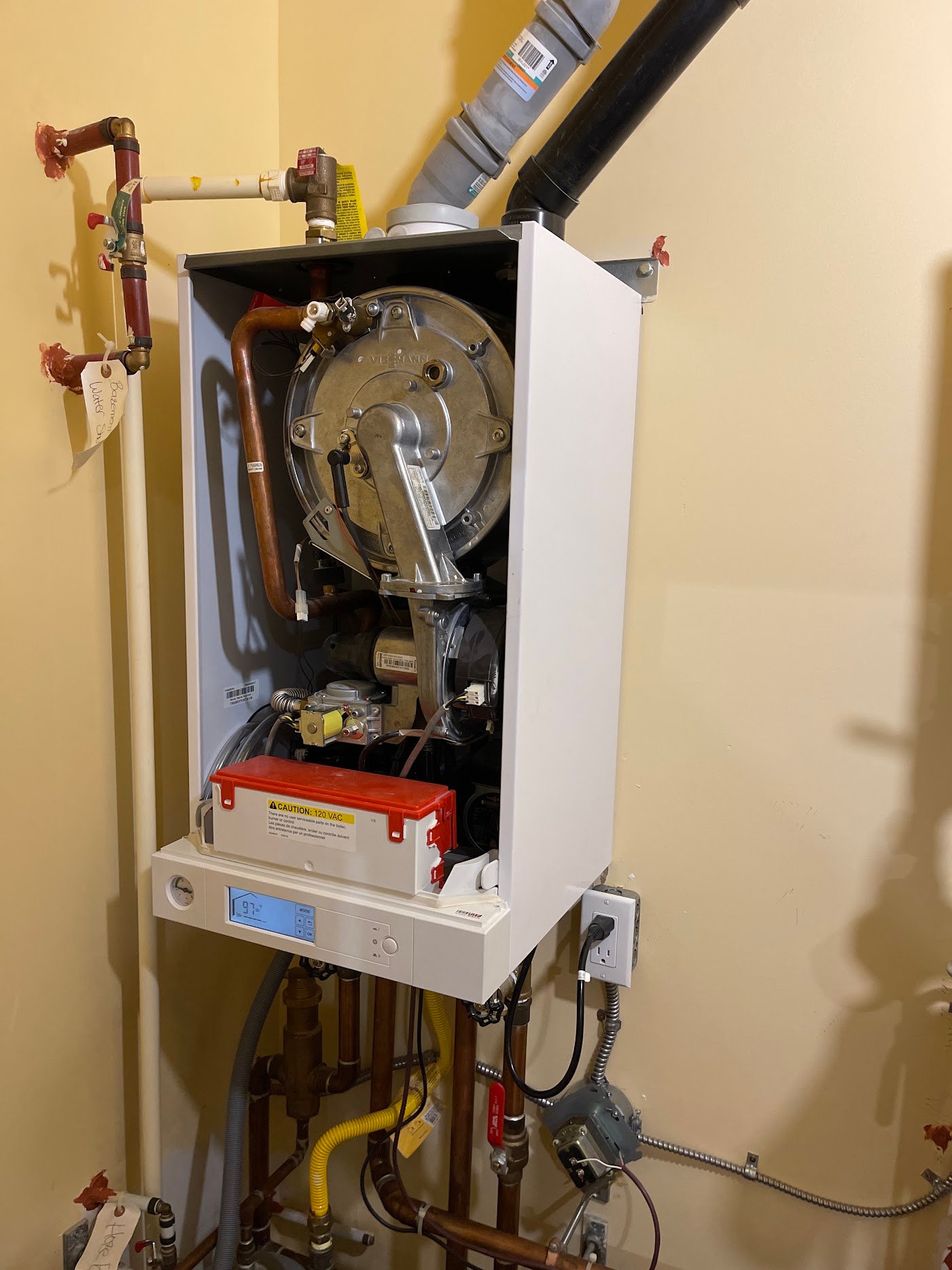
What an open boiler view helps explain
The cabinet, vent connections and lower pipework form different parts of the installation. Each belongs in the professional startup discussion.
- Inside the cabinet: appliance checks follow the selected model’s instructions.
- At the connections: the installer checks the completed gas, water, venting and electrical work as applicable.
- Beyond the appliance: heating zones and domestic hot water need their own operating checks.
Original company photo shown for technical context. A photograph alone cannot confirm commissioning results.
Ask how the proposal handles circulation and zone controls, expansion and system pressure, and air and dirt management. These components help explain why replacing the appliance alone does not complete every installation.
Circulation pumps and zone controls
The pump moves heating water; valves and controls direct heat where it is requested. At handover, ask which thermostat serves each area and whether each connected zone has been checked. A burner operating in the mechanical room does not demonstrate that every room is receiving heat.
Expansion tank and pressure provisions
Heating water expands as it warms. The expansion arrangement, system pressure and safety provisions need to suit the completed system. The proposal should identify what is retained and what is replaced, with the installer responsible for checking the arrangement against the selected equipment’s requirements.
Air removal, water condition and filtration
Refilling introduces air that needs to be addressed as part of startup. Existing heating water and deposits also deserve assessment when connecting a new heat source. Caleffi’s retrofit guidance discusses how debris and water condition can affect components. Cleaning and filtration should follow the assessed need and equipment requirements.
Ask for the operating instructions, model details, relevant startup records and a clear contact route for a post-installation concern. If the system heats a concrete floor slab, room recovery can lag behind boiler startup because the slab also needs to warm. Ask what response to expect from your particular system.
For ongoing care after the changeover, our boiler service in Tsawwassen page explains the maintenance discussion.
Planning an installation in your Tsawwassen neighbourhood
When you enquire, include your full address, neighbourhood and any access restrictions so the appointment can be planned around the actual property. Tsawwassen includes distinct residential areas, but a neighbourhood name does not establish the boiler type, pipe condition or time needed for a replacement.
For homes in Beach Grove, Boundary Bay or Southlands, include any suite, unit or shared-access details that help identify the installation location. If you are in Cliff Drive, English Bluff or Pebble Hill, mention the entrance the crew should use and where the equipment sits. The same details help with enquiries from Tsawwassen Central and Tsawwassen East.
An address on Tsawwassen First Nation lands needs its own jurisdiction check. Mention that when enquiring so service availability and the applicable approval route can be confirmed. TFN maintains its own permits and licences information; a Tsawwassen postal address alone should not be used to assume the approval authority.
If you found us while searching for a boiler installer near you, the useful next step is a conversation about your system and schedule. Tell us whether you currently have heat and hot water, what equipment you are replacing, and any dates when an interruption would be difficult.
Questions about living through a boiler replacement
Your installation plan should explain how the work fits around normal life, including access, water use, communication and the first heating cycle. These questions help close gaps before the appointment. Exact arrangements depend on the agreed scope and should be confirmed with the installer handling your project.
Can I stay at home while the boiler is being replaced?
Discuss this when arranging the work. The decision depends on access, the work area and how long essential services will be unavailable. Explain which rooms you need to use and whether an extended interruption would make staying home impractical. Do not assume an occupied home or an empty property is required for every job.
Will toilets and cold taps still work during the installation?
They depend on the domestic cold-water supply, not simply on whether the boiler is running. Some connections may require that supply to be shut off temporarily. Ask when cold water will be unavailable and when fixtures can be used again; a heating-only interruption and a whole-house water shutdown are different events.
Can the installation go ahead if I am away that day?
Agree this in advance. The installer needs authorised access, a reachable decision-maker and a way to explain the completed system. Confirm who can answer questions, approve agreed changes and receive the handover. A key arrangement alone may not cover all of those needs.
Who arranges temporary heat if the work continues overnight?
The written plan should identify whether temporary heat is included, what arrangements are suitable and who is responsible for the cost. Availability is project-specific. Raise the possibility before work starts if an overnight loss of heating would be difficult for your household.
When can I use the shower after the new boiler starts?
Wait until the installer confirms the domestic-hot-water side is ready for normal use. A boiler running for heating does not establish that tap water has been checked. An indirect storage tank also needs time to reheat; a combi has a different delivery arrangement. Ask for an expected usable-hot-water time.
Should I change my thermostat schedule before installation day?
Keep your usual settings unless the installer asks for a specific change. Share any programmed setbacks or rooms on separate schedules. The installer may temporarily call individual zones during testing and should explain the final settings, particularly if controls or heating-water temperatures have changed.
What if the replacement boiler has not arrived by the agreed date?
Contact the installer to confirm the revised plan before disconnection. If the existing equipment can remain safely in use, ask whether the changeover can be rescheduled around confirmed delivery. If it is already out of service, discuss interim arrangements and an updated restoration estimate instead of relying on the original date.
What should I do if one room is still cold after startup?
Contact the installer with the room, thermostat setting, approximate time since startup and any displayed message. Ask whether the response is expected for that zone or needs a return check. A floor slab can recover slowly, but a room that never responds should not be dismissed without checking circulation and controls.