
Updated: September 27, 2026
Boiler Installation Ladner: Start with the Right Assessment
For boiler installation in Ladner, start with your heating setup, hot water needs and the problem you want to solve. Efficient Heating Service can discuss your replacement and the assessment it needs. Call 778-798-4343 with your address, equipment details and a short description of your priorities.
Call 778-798-4343 Request a Ladner installation assessment
A useful proposal should explain which boiler fits, what happens to the existing tank and controls, what the installation includes, and which details still need checking. A few clear photographs can make that first conversation much more productive.
- Choosing a system: the options include a heating-only boiler, a boiler connected to an indirect hot water tank, or a combi that supplies space heating and domestic hot water.
- Understanding cost: equipment, piping, venting, drainage, controls and access all affect the installed price. Ask for the scope and any exclusions in writing.
- Deciding whether to replace: describe the fault first. A cold room or inconsistent shower does not, by itself, establish that the boiler needs replacement.
We provide boiler services in Ladner, including Ladner Village, Port Guichon, Hawthorne, Holly, Delta Manor and Neilsen Grove. Give us the property address so we can discuss access and the work involved. If the immediate need is a diagnosis, start with boiler repair in Ladner.
What information helps us understand your home?
Describe what the system does now and what you want it to do after replacement. The most useful starting details are the equipment model, heated areas, thermostat locations, hot water arrangement and any recurring problems. You do not need to identify every valve before contacting us.
Bring these points to the first conversation:
- Reason for the enquiry: a breakdown, repeated repairs, a renovation, difficulty getting comfortable, or planned replacement while the boiler still works.
- Heat distribution: water-filled baseboards, radiators, in-floor tubing or an air handler. Mention any combination of these.
- Areas served: which floors and rooms the boiler heats, and whether any spaces have a separate heating source.
- Controls: the number of thermostats you use and any rooms that respond differently from the rest of the home.
- Hot water use: whether there is a separate tank, whether it connects to the boiler, and which showers or other fixtures run together.
- Recent changes: new windows, insulation, an addition, a bathroom renovation or heating work completed by a previous owner.
An observation such as “the upstairs rooms warm up, but the kitchen stays cool even when its thermostat is calling” is more useful than guessing that the boiler is too small. It gives the assessment a specific problem to investigate.
If the equipment is working and your aim is ongoing care, boiler service in Ladner is the relevant starting point. Keep any recent service report available when discussing replacement.
Six photos that make a boiler estimate more useful
Take a wide view before close-ups. Photos should show the appliance, its readable external label, connected equipment, visible piping, access route and outdoor vent location when safely reachable. These images help identify questions for the visit; they cannot establish the condition of concealed pipework or confirm operating performance.
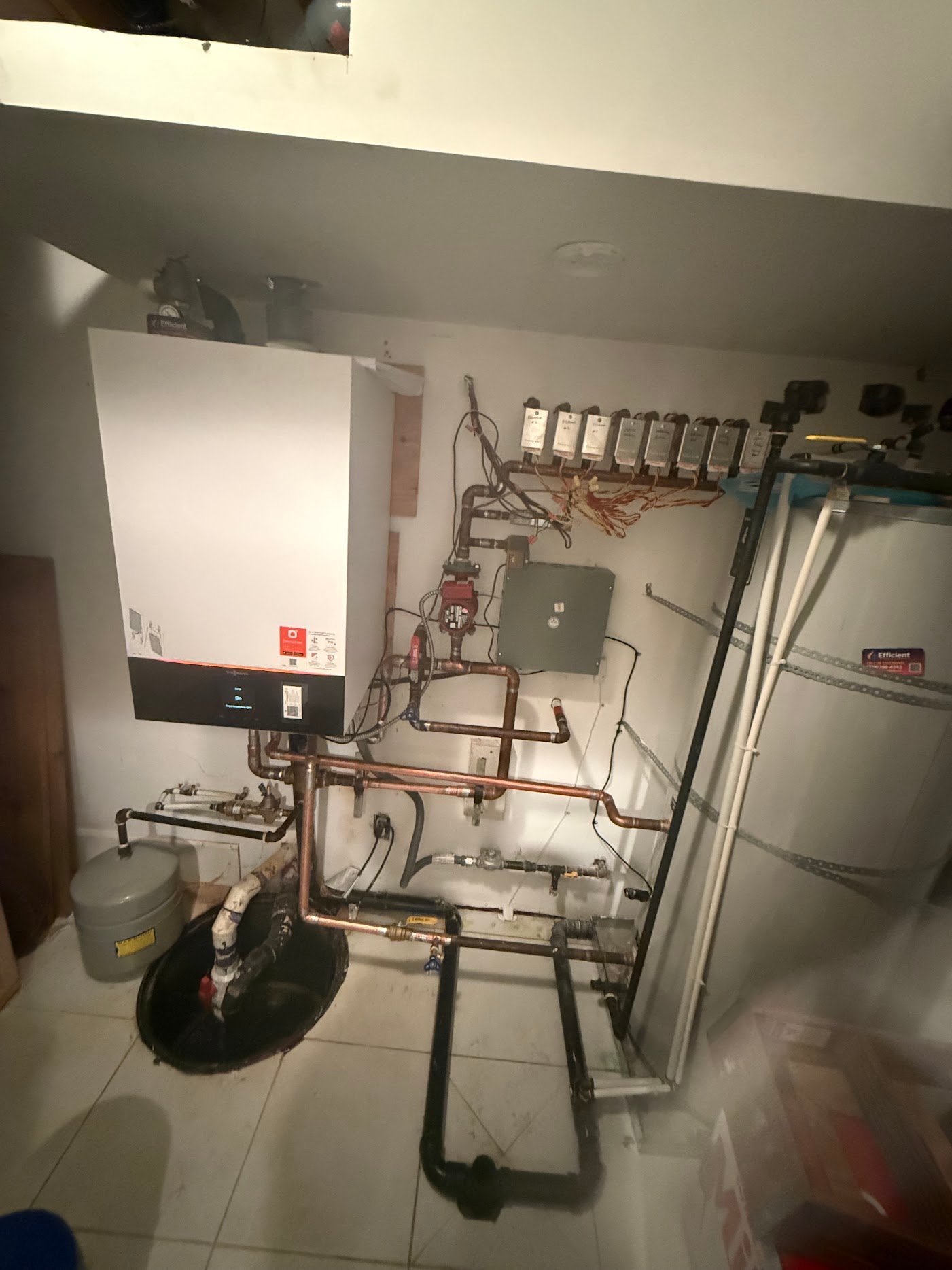
What a wide photo can show
This view shows more than the boiler casing. You can see the tank beside it, the controls along the wall and the connected pipework below.
For your assessment, include a view like this before taking label close-ups. It helps us ask about the whole installation. Connections still need tracing and checking on site.
| Photo | What to include | Why it helps |
|---|---|---|
| Whole installation | Boiler, nearby tank, floor and surrounding walls in one view | Shows how the equipment is arranged and where a closer inspection is needed |
| External equipment label | Brand, model and fuel information, if accessible without removing a cover | Helps locate the correct documentation and distinguish similar-looking appliances |
| Piping and controls | Visible pumps, valves, control boxes and pipe connections around the boiler | Helps identify the parts of the system that need to be traced on site |
| Hot water equipment | Tank or water heater, its label and visible connections | Helps establish whether domestic hot water is part of the replacement scope |
| Access to the equipment | Doorway, stairs, corridor and the working area around the appliance | Flags removal, delivery and service-access questions |
| Outdoor vent area | Visible termination and the surrounding wall, windows and other nearby features | Helps plan an on-site check of the vent route and proposed location |
Keep covers closed and leave wiring, gas fittings and hot components alone. If a label is hidden or the outside termination cannot be photographed from a safe position, simply tell us. There is no need to dismantle anything to request an estimate.
Use the contact form to describe the project and mention that photos are available. We can confirm how to provide them during the booking conversation. Include both a wide view and a close-up; a tight picture of the boiler front often leaves the surrounding work unclear.
What must be checked during a site visit?
A site assessment should connect the proposed boiler to the building and the existing heating system. That means checking the basis for sizing, water flow, controls, fuel supply, venting, drainage and service access. Some findings require measurements or separate diagnostic work, so confirm the visit’s scope when booking.
Heating demand and room performance
The old boiler label records the old appliance’s capacity. It does not prove the replacement should have the same output. The sizing discussion should account for the home’s present heating load and the heat emitters serving it. The US Department of Energy’s boiler guidance likewise links equipment and distribution sizing to the calculated heating load.
Ask how a room that currently struggles to heat will be assessed. Replacing the heat source alone may leave a circulation, control or emitter problem unresolved. The proposal should distinguish correcting that problem from replacing the boiler.
Circulators, zone valves and mixing controls
Visible pipework needs to be traced: which pump moves water through the boiler, which circuits serve the rooms, and which controls call for heat? Where floor heating and other emitters need different water temperatures, the mixing arrangement also matters. Caleffi’s guidance on systems with different temperatures explains why valve selection and piping must suit the application.
A replacement proposal should identify which circulators, zone valves and controls will remain, which will change, and how that decision was reached. A familiar-looking connection is not evidence that the component suits the new design.
Expansion vessel and system water
The expansion vessel, filling arrangement and water condition deserve attention alongside the new appliance. Repeated pressure loss, frequent topping up or known glycol in the heating circuit are useful details to report. They are reasons for investigation, not instructions for the homeowner to adjust the system.
Caleffi’s existing-system assessment guidance covers water chemistry and the flow requirements of modern heat sources. Ask whether the proposed work includes any required cleaning, treatment or component changes.
Venting, condensate and utilities
A photograph cannot confirm the complete vent length, hidden fittings or gas supply capacity. These details need checking against the selected model and the site. For a condensing boiler, the proposal also needs a workable condensate route. Ask which items are confirmed and which remain subject to further investigation.
Which boiler arrangement should the quote describe?
The quotation should name both the boiler and the way your home will receive hot water. A heating-only boiler, a boiler with an indirect cylinder, and a combi have different connections and responsibilities. Identifying that arrangement early makes it easier to compare proposals covering the same household needs.
| Arrangement | What the assessment needs to establish |
|---|---|
| Heating-only boiler with a separate water heater | Which appliance supplies the taps, and whether that water heater stays outside the boiler replacement scope |
| Boiler connected to an indirect hot water tank | Tank condition and compatibility, its connections and controls, and whether the tank will remain or be replaced |
| Combi boiler | Space-heating requirements, simultaneous hot water demand, incoming water conditions and the selected model’s capabilities |
| Existing conventional boiler changing to a condensing model | The complete installation changes required, including venting, drainage, piping and controls |
For a combi, describe actual use: two showers at once is a different requirement from one shower followed by another. Manufacturer hot water figures depend on stated conditions. For example, Navien’s NCB-H information specifies delivery at a defined temperature rise; a headline flow figure should not be treated as a promise for every installation.
If you want an electric boiler considered, mention that at the start. The assessment would also need to establish electrical supply requirements and how domestic hot water would be provided. That is a separate option to evaluate, with its own installation scope and operating-cost assumptions.
Which brands are worth discussing for your system?
Discuss the model family as well as the brand. IBC, Navien and Viessmann have boiler options worth reviewing against the required heating and hot water arrangement. Suitability depends on model specifications, installation conditions and support for that equipment; a familiar brand name alone cannot establish the right choice.
IBC: the SL G3 range and SFC combi range illustrate different system choices. IBC publishes model-specific heating, flow and venting data. Ask for the exact model in the proposal so those requirements can be checked against your installation.
Navien: NCB-H is a condensing combi family. For an existing Navien appliance, our Navien boiler repair page provides a related service route. A replacement discussion should still begin with the model label and the reason the current arrangement is being reconsidered.
Viessmann: the Vitodens 100-W B1HE/B1KE information distinguishes heating and combi versions. If you already have this brand, the Viessmann boiler repair and service page is also relevant to assessing the existing equipment.
You do not need to choose a brand before calling. A useful first question is: “Which arrangement meets our heating and hot water needs, and what would installing it involve?” Confirm current availability, warranty terms and the service requirements of any model proposed.
How is the installed price established?
An installed price becomes meaningful when the equipment and site work are defined. Ask which items have been inspected, which are allowances and which are excluded. Compare the cost of delivering the agreed heating and hot water arrangement, including supporting work, instead of comparing the appliance price alone.
Look for a proposal that identifies:
- The boiler model and the basis for its selection.
- Whether the hot water tank stays, changes or is removed.
- Work on pumps and zone controls, the expansion vessel and system water, and venting and condensate.
- Equipment removal, disposal and access arrangements.
- Required permits, electrical or other related work, and who is responsible for them.
- Startup checks, controls setup and the information you will receive at handover.
- Taxes, exclusions, any remaining investigations and how additional work would be agreed.
Gas equipment replacement requires the appropriate installation permit before work begins, as explained in Technical Safety BC’s alteration-permitting bulletin. Ask the contractor to identify the permit responsibilities in the proposal.
If an early estimate relies on assumptions, have those assumptions stated. For example, “existing tank retained, subject to compatibility and condition checks” gives you something specific to resolve at the visit. Ask whether any assessment or diagnostic fee applies before booking; an installation enquiry and a repair investigation may involve different work.
Our boiler installation overview explains the broader service. For your home, the next useful step is to define what needs inspecting.
Booking an assessment in Ladner’s neighbourhoods
Tell us your street address and neighbourhood when arranging an assessment in Ladner. Ladner Village, Port Guichon, Hawthorne, Holly, Delta Manor and Neilsen Grove are useful local references. The equipment and access at the actual property determine the work; the neighbourhood name does not determine the boiler type.
Ladner is a community within the City of Delta. The City’s Ladner page describes East Ladner as the part of the community east of Highway 17A. If you use that name, include the full address so the booking details are clear.
For a home near Ladner Village or in Port Guichon, Hawthorne or Delta Manor, note where the equipment is located and how it is reached. For a townhouse in Holly or Neilsen Grove, include the unit number and mention any shared access or approval requirements that apply to your property.
If the address is on Westham Island or in a rural part of Ladner, describe the property and equipment location when calling so we can confirm the scope and access. Mention a detached mechanical building, shared plant or unusual delivery route if one is present.
Ready to discuss your installation? Have your address, one wide photo and the main problem or goal ready. If you cannot collect the details yet, call anyway; we can start with what you know.
Call 778-798-4343 Request a Ladner boiler installation assessment
Questions before arranging a boiler assessment
You can arrange the first conversation without complete records or technical knowledge. Share what you know, explain what you cannot access and confirm what the appointment includes. These answers address practical preparation questions so you can request an assessment without taking equipment apart or collecting information that is unavailable.
What if I cannot find the boiler model label?
Send or describe the brand and take a clear photo of the appliance exterior if possible. Tell us that the label is missing, unreadable or inaccessible. Leave panels in place; equipment identification can be included in the on-site assessment.
Does the boiler need to be running during the visit?
Tell us whether it currently operates and why it is off if you know. Some performance checks require a working system, while access and layout can still be assessed without one. Do not restart equipment that has been shut down for a safety concern; confirm the visit’s scope first.
Can a tenant arrange the first assessment conversation?
Yes, a tenant can contact us to describe the situation. Explain who owns or manages the equipment and who can approve access, assessment charges and installation work. The relevant owner or manager should be involved before work is authorized.
Do I need floor plans before asking for an estimate?
No. Existing plans, addition drawings or an energy assessment can be helpful if you have them. If records are incomplete, say so. Ask what measurements or further information will be needed to establish the heating requirements before equipment is selected.
Are gas bills useful for the assessment?
They can provide background about consumption and seasonal changes, especially alongside occupancy and renovation information. A bill may also include cooking, fireplaces or hot water use. It should not be treated as a direct measurement of the boiler’s condition or the home’s peak heating requirement.
Should I remove boxing or shelving before the visit?
Describe any obstruction and provide a photo first. Clear movable belongings where it is safe, but do not dismantle fixed enclosures, pipework or electrical equipment. Ask whether further access will be needed and who would arrange it before that work is undertaken.
What happens if renovation plans change after the assessment?
Send the revised information before accepting the proposal or ordering equipment. Added floor area, changed heat emitters or a different hot water requirement can affect the design and scope. Ask whether the revised plan needs another visit and request an updated written proposal where needed.
Will an installation assessment also diagnose an intermittent fault?
Confirm that when booking. A replacement assessment may focus on design and installation scope; an intermittent fault can require additional testing or a separate repair appointment. Describe when the problem occurs so the right work can be arranged and any charge explained in advance.