
Richmond boiler replacement · Know what your quote includes
Choose the installation scope before you choose the price
Boiler installation Richmond starts with your heating load, hot-water use and existing pipework. Efficient Heating Service assesses what can stay, what needs replacing and which boiler arrangement fits your home, then explains the installation scope so you can compare the complete job.
Replacing a boiler is a chance to resolve the right problem. Tell us if you are dealing with repeated breakdowns, an aging tank, uneven floor heating or a renovation. Those lead to different equipment and installation decisions.
Efficient Heating Service · Licensed Class B Gas Fitter · Content updated September 27, 2026
What should a boiler installation quote include?
A useful quote identifies the boiler and the work needed to connect it to your home. Compare equipment, pipework, venting, controls, permits, removal and commissioning together. Ask what stays, what changes and what could cost extra before deciding that two installation prices cover the same job.
| Part of the quote | What to ask before approving |
|---|---|
| Boiler and hot water | What is the exact model? Is this heating only, a combi, or a boiler with an indirect tank? Is the tank included? |
| Existing components | Which pumps, zone valves, expansion tank and controls stay? Which replacements have been priced? |
| Venting and drainage | Does the price cover the proposed exhaust and intake route, termination, condensate connection and any required neutralization? |
| Labour and access | Are old-equipment removal, protection of the access route, electrical coordination and finish repairs included or excluded? |
| Completion and support | Which permits, commissioning records, control demonstration, manufacturer registration and labour-warranty terms are included? |
A wall-mounted boiler beside usable pipework is a different job from relocating equipment, replacing a tank and correcting several heating zones. We need to see those conditions before giving you a meaningful installation price. Equipment cost alone does not describe the finished system.
Ask for taxes, allowances and exclusions to be stated clearly. Do not subtract an advertised rebate from your budget until the current program, equipment and property eligibility have been checked for your project.
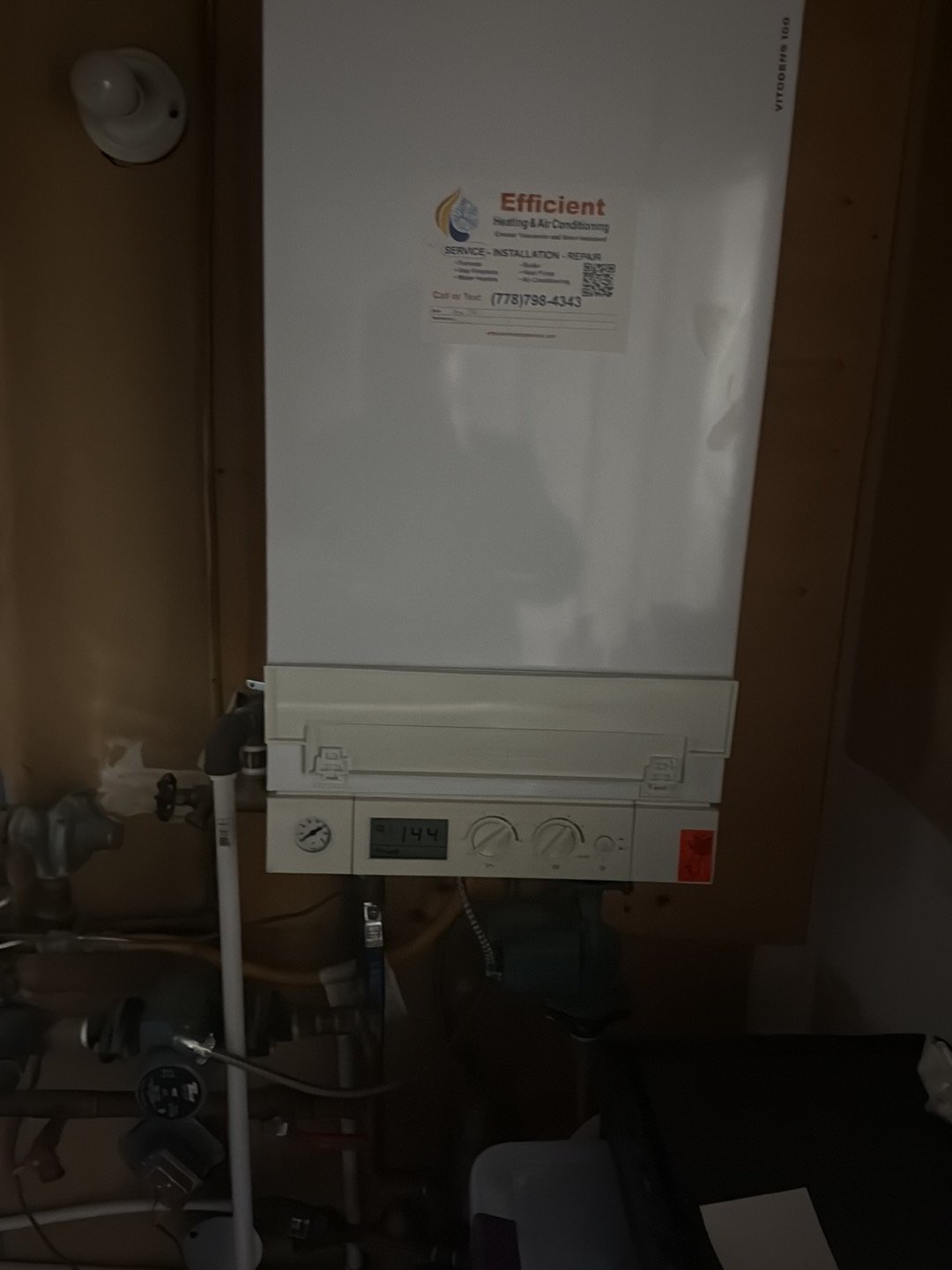
Look below the boiler cabinet before pricing a replacement
This original equipment photo shows why a replacement assessment includes the connections around the boiler. The cabinet is only one part of the job. Accessible pipework, circulation components and working space all need review before deciding what can remain and what the new installation must include.
What this photo helps you explain
A clear front view helps identify the appliance. A wider view of the pipework helps the installer plan the site assessment. Photograph the model label separately and include any tank or heating manifold connected to the system.
The visible pipework is a starting point for discussion, not proof that every component is suitable for reuse. Condition, capacity and compatibility need checking on site.
Keep the tank or change to a combi boiler?
The right hot-water arrangement depends on simultaneous demand, storage space and the condition of your current equipment. A combi combines heating and on-demand hot water; a boiler with an indirect tank stores hot water separately. Compare both against your household routine before removing a usable tank.
A combi when space matters
A combi can simplify the equipment arrangement when its hot-water output suits the home. We check the selected model against incoming water temperature and the fixtures you use together. Bathroom count on its own is not a sizing calculation.
Tell us if a shower, laundry and another bathroom often run at once. Some systems prioritize domestic hot water during a draw; the heating arrangement and household expectations need to suit that operation.
An indirect tank for stored hot water
An indirect tank uses the boiler to heat stored domestic water through a heat exchanger. Tank capacity, recovery and controls matter together. Keeping a sound, compatible tank can avoid replacing equipment unnecessarily.
A larger stored supply may suit peak use, but it needs space and an appropriate design. Ask whether the proposal includes a new tank, reuses the existing one or leaves an independent water heater untouched.
For example, a household that uses two showers at the same time needs a different discussion from one that uses a single shower in sequence. This is a sizing example, not a claim about every Richmond home. The manufacturer’s combi sizing guidance explains why water temperature and concurrent fixture flow matter.
Plan around your Richmond neighbourhood and property
We take installation enquiries across Richmond, including Steveston, Seafair, Broadmoor, Thompson, City Centre, Cambie and Hamilton. Give us your neighbourhood and property type when booking. The visit then focuses on your actual heating system, access and permissions rather than assuming nearby houses use the same boiler.
Steveston and Seafair
For a house or townhouse here, start with the boiler’s location and the route outside. Where side-yard access, an enclosed patio or an exterior finish affects vent placement, include that in the assessment. Existing radiators or floor loops need their own condition and temperature review.
Broadmoor, Blundell and South Arm
If your home has several thermostats, identify which rooms each controls. Tell us about additions and any mix of radiant floors, hydronic baseboards or fan coils. The proposal should account for the connected zones and domestic hot water, rather than copy the old boiler’s input rating.
Thompson and Terra Nova
For replacement planning, show the equipment space, tank and accessible manifolds. A compact new cabinet does not remove the need for future service access. Confirm that the proposed layout leaves room to reach filters, valves, controls and the components that need maintenance.
City Centre, Brighouse and West Cambie
For a condo or strata townhouse, establish whether you own a dedicated boiler or receive heat from shared equipment. Building access, authorization and exterior changes may need coordination. A cold suite connected to a shared plant does not automatically need its own boiler replacement.
East Cambie, Bridgeport and Hamilton
Send the equipment model and explain whether the job is a replacement or part of a renovation. Mechanical-room access, the condition of retained pipework and the intended hot-water arrangement help define the visit. We confirm appointment availability for your address when you contact us.
Shellmont, Ironwood and Sea Island
Include the property address and access details with your enquiry. A neighbourhood name helps us arrange the visit; it does not establish a permit authority or system type. The equipment and site conditions still need review before an installation recommendation.
Neighbourhood references follow Richmond’s area and sub-area plans. Equipment choices are assessed property by property.
Boiler options for radiant floors, baseboards and hot water
Start with the system you need to heat, then compare suitable models. Condensing gas boilers, combi boilers and boilers paired with indirect tanks solve different needs. Existing conventional boilers also need careful replacement planning because venting, water temperatures and controls may change with the new equipment.
Viessmann Vitodens
The Canadian range includes Vitodens 100-W B1HE/B1KE and Vitodens 200-W B2HE. B1KE provides a combi option. We compare the applicable model and control arrangement with your heating circuits, hot-water plan and service needs.
Navien combi options
NCB-H and NFC-H are distinct combi families. The model selection needs both a heating-load assessment and a hot-water assessment. A larger maximum rating does not automatically make a boiler a better match for small heating zones.
IBC heating boilers
IBC SL models are another option for hydronic heating. Where domestic hot water comes from an indirect tank, the complete boiler, tank and control design matters. Confirm the quoted model, local availability and maintenance access before ordering.
We also assess replacement enquiries involving existing equipment from other manufacturers. Send the model label instead of assuming the new boiler must be the same brand. These are options to evaluate, not a ranking of the most common brands in Richmond or a promise that every model fits your property.
A condensing boiler benefits from suitable system temperatures and controls. Viessmann’s explanation of condensing operation shows why the connected heating system affects performance. A high efficiency label is not a guarantee of a particular reduction in your gas bill.
What can remain when the old boiler comes out?
Existing radiators, floor loops, pumps and tanks may remain if their condition and compatibility support the new design. Inspect them before approving reuse. A boiler replacement should identify known distribution faults, suitable operating temperatures and service access so old problems do not follow the new appliance.
Heating circuits and controls
We ask which rooms heat slowly, which thermostats behave differently and whether a zone has stopped working. The installer needs to distinguish the boiler’s output from the circulation and control problem. A new appliance cannot repair a stuck zone valve elsewhere in the home.
Mixed floor heating and baseboards deserve particular attention to design temperatures and control coordination. List any required changes separately, so you can see what the replacement will address.
Pipework and service components
Expansion control, circulators, air and dirt separation, isolation valves and fill components need review as part of the proposed system. The scope should explain which items remain and why, including access for future service.
Any required cleaning or water treatment should follow the appliance and system requirements. It should not appear as an unexplained extra after the old boiler has already been removed.
If the boiler’s condition is still uncertain, start with boiler repair in Richmond. Diagnosis gives you a better basis for comparing a defined repair against replacement. Age alone does not tell you whether a particular repair is worthwhile.
Permits, strata coordination and installation day
Confirm the permit authority, approvals and access before scheduling the replacement. Richmond issues gas permits within its delegated jurisdiction; other work may fall under Technical Safety BC. Strata coordination is a separate step. Your written scope should identify who handles permits, inspections and the expected service interruption.
The applicable route depends on the address and installation. Technical Safety BC lists Richmond among municipalities with delegated gas authority and describes the limits of that authority. Review its jurisdiction guidance with the contractor for the proposed work.
- Before the date: confirm the model, availability, access route and approved work. Resolve strata requirements where applicable.
- Before shutdown: agree on the anticipated heating and hot-water interruption. A relocation or additional pipework can change the schedule.
- During installation: the agreed equipment and connections are installed, with any newly discovered condition explained before expanding the scope.
- At start-up: the installer completes applicable commissioning checks and confirms the connected controls and heating calls.
- At handover: receive operating guidance, equipment details, warranty information and the relevant installation records.
We do not promise every replacement will finish in one day. The useful commitment is a schedule based on the actual job, with a clear explanation of what could change it.
After installation: know what was tested and how to use it
A finished installation should leave you with working controls and a clear record of the equipment and checks completed. Ask for the model details, warranty terms and maintenance requirements. Keep those records together so a future service visit starts with the right information about your system.
Walk through the thermostat settings and hot-water operation with the installer. Identify which controls you should use and which settings belong to service work. Ask what to do if a fault appears and where the model information is located.
Manufacturer warranty and labour coverage are different. Confirm registration responsibilities, exclusions and the applicable maintenance schedule in writing. Arrange future boiler service in Richmond around the model’s requirements and the system’s operating condition.
Request a Richmond boiler installation assessment
Call or use our contact form to describe your boiler replacement. Include your neighbourhood, property type and the heating or hot-water concern. Have the model label and equipment photos ready. This helps us establish the assessment needed before recommending equipment or pricing the complete installation.
Tell us what you want to solve
Repeated repairs, changing household demand, a failing tank and a renovation each call for a different discussion. Mention your preferred timing and whether the existing system still runs.
Have these details ready
- Richmond neighbourhood and property type.
- Boiler make, model and approximate age.
- Existing tank or combi arrangement.
- Cold zones or hot-water complaints.
- Access and strata contact, if relevant.
You can also review our boiler installation overview for the wider service scope.
Richmond boiler installation questions
Before choosing a replacement, clarify the scope, hot-water capacity and responsibilities for the work. These answers address decisions that can change your quote or installation plan. Use them to prepare for the assessment, then confirm the details against your own equipment, property and written proposal.
Why can two Richmond boiler installation quotes differ so much?
Compare the exact model and the work around it. One quote may retain pumps and controls while another replaces them, changes the vent route or adds an indirect tank. Ask for equipment, labour, permits, disposal, commissioning, taxes and exclusions to be identified before comparing totals.
Can I replace my boiler and keep my existing hot-water tank?
Possibly. First establish whether the tank is an indirect cylinder heated by the boiler or an independent water heater. Its condition, coil capacity, controls and compatibility affect reuse. Ask the installer to show both the retained-tank scope and any recommended replacement as separate options.
Will a combi boiler cover two showers running together?
The answer depends on the exact model, incoming water temperature and combined fixture flow. Count simultaneous use, not just bathrooms. A combi may fit, or a boiler with an indirect tank may better suit peak demand. The recommendation should include the hot-water assessment.
Does a new boiler fix cold rooms in a Richmond townhouse?
Only if the boiler is the cause. A failed zone valve, restricted loop, air problem or control fault can remain after replacement. Identify the affected zones before approving the job, and include any distribution repairs in the written scope.
Can a new condensing boiler use the old chimney?
Do not assume the existing chimney or vent is suitable. The new appliance requires an approved venting arrangement that meets its instructions and applicable requirements. Route, termination, access and condensate disposal need assessment before the installation price is finalized.
Who handles gas permits for a Richmond replacement?
Richmond issues gas permits for work within its delegated jurisdiction. Other projects can fall under Technical Safety BC. The contractor should establish the correct authority for the address and equipment, identify required permits and explain the inspection process before work starts.
Should I choose the lowest price if the boiler model is identical?
Compare the whole installation first. Check which pumps, valves, controls and venting are included, how the system will be commissioned, and what labour warranty applies. A lower price can be reasonable when the scope is genuinely equivalent; a model number alone does not establish that.
What should I send to request an installation assessment?
Provide your Richmond neighbourhood, property type, boiler make and model, and whether the concern is heating, hot water or both. Have clear equipment and pipework photos ready. For strata property, identify the authorized contact and any access or approval requirements.