
Updated September 28, 2026
Boiler Installation West Vancouver: Will It Meet Your Hot Water Needs?
A boiler replacement should be planned around both room heating and the busiest period of hot water use. For your West Vancouver home, that means checking which showers and taps run together, how long they run, and how the proposed equipment will meet that demand.
Tell Efficient Heating Service what your household needs to run at the same time. We can discuss an installation assessment for your address, existing boiler and hot water equipment.
Call 778-798-4343 Request a West Vancouver installation assessment
- Which boiler type fits? A combi, a heating boiler with an indirect tank, or a boiler alongside independent water heating may suit different arrangements. Confirm the demand before selecting a model.
- What determines the price? The boiler and installation work, plus any changes to storage, water distribution and controls. Ask for a complete installed scope, including what remains in place.
- Can the existing tank stay? That needs an assessment of its condition, compatibility and heat-transfer capacity.
- What should you provide first? Your address, equipment model if known, and one example of the busiest hot water period, such as two showers before work.
If an existing fault needs diagnosis before you decide about replacement, use our West Vancouver boiler repair enquiry.
Describe your busiest hot water period before choosing equipment
The useful starting point is a short description of what happens together during your busiest routine. Record the fixtures, their flow rates where known, and how long they operate. Include a bath or another large draw immediately before the showers, because the starting conditions matter too.
Bathroom count gives an incomplete picture. A home with several bathrooms may rarely use more than one shower at a time. Another household may run two showers together every morning. The proposal should describe the routine it is designed to support.
| What to record | Useful detail | What it helps establish |
|---|---|---|
| Simultaneous fixtures | Two showers overlap for ten minutes | The peak flow requirement |
| Shower outlets | One head, or a head and body sprays together | Which outlets contribute to that flow |
| Duration | A short shower or an extended draw | How long capacity must be sustained |
| Earlier demand | A bath has just been filled | Whether stored hot water may already be partly used |
| Recovery opportunity | A gap between successive users | How much time is available to reheat stored water |
| Occasional demand | Overnight guests or a recurring family visit | A second scenario to price and compare |
You do not need to measure everything before calling. Fixture specifications and your description help start the assessment; the installer should verify the relevant conditions. Avoid estimating a shower’s flow from the size of its showerhead.
Label an occasional requirement clearly. For example: “Two showers normally; a third during weekend visits.” Ask whether the base proposal supports both routines or whether the second needs a different arrangement. This makes the trade-off visible before you buy.
Separate peak flow, total volume and recovery
Peak flow is the water needed at one moment; total volume adds up what is used over time. Recovery describes how quickly a storage system can restore usable hot water. These measures answer different questions, so a tank capacity or a maximum flow figure cannot describe everything.
Consider this illustrative calculation, using two showers that each deliver 8 litres per minute of mixed water at the shower outlet:
| Shower pattern | Peak mixed-water flow | Total time | Total mixed water used |
|---|---|---|---|
| Both run together for 15 minutes | 16 L/min | 15 minutes | 240 litres |
| Each runs for 15 minutes, one after the other | 8 L/min | 30 minutes | 240 litres |
The volume is identical, but the simultaneous pattern doubles the peak flow. The sequential pattern gives a storage system more elapsed time to recover while the water is being used.
The 240 litres is mixed water delivered at the fixtures. It is not a recommendation for a 240-litre tank. The amount supplied from the hot water source depends on the cold, hot and mixed-water temperatures. The example assumes fixed flows and does not select equipment for a real property.
Read the temperature conditions beside a flow rating
An instantaneous hot water rating belongs with its temperature rise: the difference between incoming water and the heated outlet water. Compare models at the same required conditions, including the colder incoming-water condition used for the design. Navien’s sizing guidance explains this relationship between flow and temperature rise.
Keep the measurement point clear too. Mixed flow at a shower and hot flow leaving the appliance are not automatically equal. Ask the proposal to state its inlet-temperature assumption, outlet condition and supported demand; “up to” a certain flow does not establish performance at every temperature rise.
Match the boiler model to the heating and hot water arrangement
The boiler needs to suit the home’s heating requirement as well as the chosen domestic hot water arrangement. Compare exact models, their documented performance and the accessories included in the proposal. A familiar brand name does not tell you how the complete installation will meet overlapping demand.
A heating boiler with independent water heating may leave an existing separate water heater serving the taps. An indirect tank receives heat from the boiler through a heat exchanger. A combi boiler produces space heating and domestic hot water within one appliance. Establish which arrangement you have and what the proposal changes.
| Equipment family to discuss | Documented arrangement | What to ask before accepting a proposal |
|---|---|---|
| IBC SL G3 | Heating boiler applications include indirect domestic hot water | Which tank, pump and control sequence are included or retained? |
| Viessmann Vitodens 100-W B1HE / B1KE | B1HE heating models and B1KE combi models have different domestic hot water arrangements | Which exact model is specified, and what supplies the household’s tap water? |
| Navien NCB-H | Combi models provide heating and domestic hot water, with ratings that vary by model | What hot water performance is available at the design temperature rise? |
The supporting manufacturer information is available in IBC’s SL G3 application drawings, Viessmann’s Canadian B1HE/B1KE specifications and Navien’s Canadian NCB-H range. These are assessment options, not a ranking of the brands installed in West Vancouver. Confirm the applicable Canadian model and availability when quoting.
The heating calculation still matters. Navien’s combi sizing guide treats space heating and domestic hot water as separate requirements to evaluate. A proposal should explain both, including how the selected boiler operates when only a small heating load is calling.
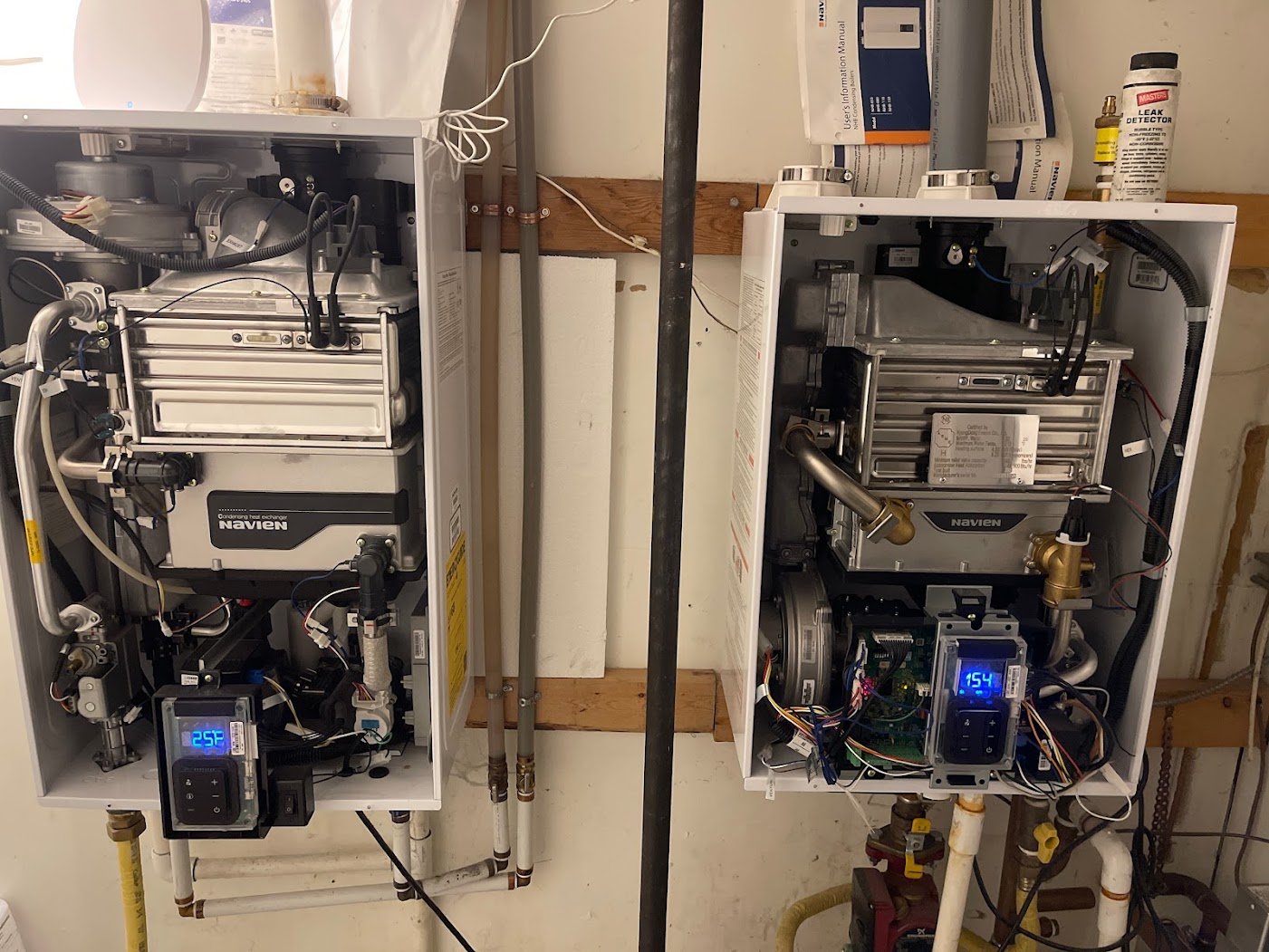
Identify every appliance before planning the replacement
This photograph from our work shows two Navien appliances with their covers removed. Before specifying a replacement, establish what each unit supplies and record its model.
The number of appliances does not establish their combined hot water capacity. The assessment should identify the connected duties and how the equipment operates.
If you are investigating an existing appliance first, our Viessmann boiler repair and Navien boiler repair pages provide the relevant enquiry routes.
Check the parts that affect storage recovery and delivery
Hot water performance depends on the connected equipment as well as the boiler. With an indirect tank, heat must pass through the tank’s coil; with a recirculation system, water must reach the intended outlets correctly. Identify these components so the quotation explains what stays and what changes.
Indirect tank, heat-exchanger coil and charging pump
The tank’s nominal volume describes storage, but it does not establish its recovery under every operating condition. Boiler output, the coil’s heat-transfer capability, boiler-water temperature and flow through the coil all affect the selection.
For example, Viessmann’s Vitocell 100-V technical data presents recovery and heat-up information against specified operating conditions. A rating should be read with those conditions; it is not a promise for any boiler connected to the tank.
If retaining a tank, ask for its model and condition to be recorded, together with the proposed pump and control arrangement. If its data cannot be established, the quotation should explain what remains uncertain and how that affects the recommendation.
Domestic water mixing and recirculation
A domestic water mixing valve blends hot and cold water for delivery. Recirculation moves water around a suitable distribution path to reduce delivery delay. These functions need compatible components and controls; adding a recirculation pump does not increase the boiler’s heat output.
Caleffi’s domestic hot water delivery guidance illustrates the relationship between mixing, circulation and distribution. Its larger-system examples are not a residential installation specification to copy.
Describe the symptom accurately: “The water takes a long time to arrive” is different from “It cools while both showers are running.” Ask the assessment to distinguish delivery delay, available flow and heat-production capacity before proposing changes. Leave temperature and valve adjustments to the installer.
Compare installation prices against the same hot water requirement
A useful price comparison starts with an agreed household demand and a clear list of included work. Otherwise, two quotations may describe different hot water outcomes despite naming similar boilers. Ask each proposal to identify the supported routine, retained equipment, installation changes and any conditions or exclusions.
There is no responsible fixed installation price for every property. Site conditions and the selected arrangement determine the work. Ask for the following differences to be visible in the written quote:
| Proposed scope | Detail needed to compare the price |
|---|---|
| Replace the heating boiler; retain independent water heating | What the boiler work includes and whether any hot water improvement is being proposed |
| Replace the boiler; retain an indirect tank | The compatibility assessment and any pump, sensor, valve or piping changes |
| Replace or redesign both heating and hot water equipment | Exact models, storage or instantaneous performance, distribution alterations and controls |
All proposals should also identify the applicable venting, gas supply, condensate drainage, electrical work and access requirements. Confirm removal of old equipment, work to finishes, commissioning, permit responsibilities, taxes and exclusions. Ask who supplies the written warranty terms for equipment and installation work.
For a system serving several loads, ask: “What happens to room heating while the tank reheats or hot water is being drawn?” Priority and simultaneous operation depend on the design. IBC’s application drawings, for example, include arrangements that give domestic hot water priority. The proposal should state the selected sequence rather than leave you to infer it.
Agree the expected heating and water interruption before booking. Our boiler installation overview explains the wider replacement process.
Agree how hot water performance will be checked at handover
Ask for the handover to connect the completed installation with the household routine used in its design. The installer should explain the relevant operating conditions, demonstrate the agreed functions and record applicable commissioning results. A brief warm-water draw alone does not demonstrate an extended period of overlapping use.
Before work starts, discuss a practical check based on your agreed scenario. For example, a proposal designed around two overlapping showers should explain how that duty will be verified without relying only on the boiler starting successfully.
Keep a short record covering:
- The agreed demand: which fixtures, expected overlap and duration were used for selection.
- Starting conditions: incoming-water condition and, where relevant, whether the tank began fully recovered.
- Observed operation: the outlets checked, flow and temperature observations, and response to overlapping calls.
- Control sequence: what happens to heating during domestic hot water operation and how normal operation resumes.
- Equipment and follow-up: installed model numbers, retained components, commissioning documents and any unresolved item.
The technical checks must follow the equipment manufacturer’s requirements. A homeowner demonstration helps explain use; it does not replace those checks. If test conditions differ from the design assumptions, ask the installer to record that difference and explain the basis for the expected performance.
Keep these documents for future boiler service in West Vancouver, especially if another technician later works on the tank, pump or hot water controls.
Request an assessment for your West Vancouver neighbourhood
Give your full street address and neighbourhood when requesting an assessment, along with the boiler and water-heating arrangement if known. The location helps plan the enquiry, while the property and household demand determine the installation. Include any access restrictions or shared-building responsibilities that may affect the visit.
For Ambleside, Dundarave and Altamont, name the neighbourhood and describe the current equipment. Do the same for British Properties and Chartwell; the address alone cannot establish how many fixtures run together or which boiler is appropriate.
Enquiries from Westmount, Bayridge and Caulfeild, and from Eagle Harbour, Gleneagles, Horseshoe Bay and Whytecliff, should include the full address as well. These neighbourhood names appear on the District of West Vancouver’s municipal map. They identify locations, not a presumed boiler brand, property type or hot water requirement.
If you searched for a boiler installer “near me,” the next useful step is a property-specific conversation. Send the address, a photo of the accessible equipment label if available, and the hot water routine you want the replacement to support. For shared equipment, identify who can authorize the work.
Planning two showers at once, an occasional guest load or a change to existing water heating? Include that detail when you contact Efficient Heating Service so it becomes part of the assessment discussion.
Call 778-798-4343 Discuss your West Vancouver boiler installation
Questions about hot water demand and boiler replacement
These questions address details that can change a hot water proposal, including multiple shower outlets, rating conditions and occasional demand. Use them to clarify the assumptions behind your quotation. The answers should ultimately relate to the selected equipment, the connected plumbing and your household’s expected use.
Does a shower with body sprays count as one fixture?
For demand planning, record the outlets that can operate together and their combined flow. A showerhead, handheld outlet and body sprays may create different operating combinations. Ask the installer to use the intended combination rather than treating the enclosure as a single standard shower.
Should my quotation use litres or gallons?
Either can work if the units are explicit and consistent. A US gallon and an Imperial gallon are different quantities. Ask for comparisons in litres per minute or clearly labelled US gallons per minute, with the relevant temperature rise shown alongside the flow rating.
Why can the same boiler have several hot water flow figures?
They may describe different temperature rises or different limits. For example, a maximum flow through a heat exchanger is not necessarily its continuous heated-water output at your required temperature rise. Ask which figure represents the proposed operating conditions and where it appears in the model documentation.
Can a restricted cold-water supply limit hot water performance?
Yes. Available supply flow and the connected piping can limit delivery independently of heating capacity. If flow is poor at several outlets, include that observation in the assessment. Selecting a higher-output boiler alone does not establish that the plumbing can supply the desired simultaneous flow.
Should occasional guest use be included in the calculation?
Tell the installer how often it occurs and what needs to run together. You can ask for a proposal supporting that demand and a separate comparison based on the normal household routine. Decide which level of performance you want before the equipment and scope are finalized.
Can I compare two indirect tanks using recovery rate alone?
Only after checking the stated conditions, and recovery is still just one part of the comparison. Boiler-water temperature, available heat input and flow can affect the rating. Compare usable storage and the expected draw pattern too, using data applicable to the proposed boiler-and-tank combination.
What if a bath is filled immediately before two showers?
Include that sequence explicitly. A storage system may begin the shower period partly depleted, while an instantaneous system must accommodate any overlapping draw. Ask the assessment to consider the bath’s volume, fill timing and any recovery interval, rather than assuming every busy period starts with full storage.
Should an existing recirculation schedule appear in the proposal?
Yes, if recirculation is being retained or changed. Record when it operates, the areas it serves and how it connects to the proposed equipment. Ask which controls remain and whether the new arrangement changes everyday operation. Include any persistent delivery delay in the assessment discussion.