
Updated: September 28, 2026
Boiler installation Anmore: what should a good proposal explain?
A good Anmore boiler installation proposal explains why the selected boiler, pumps, tank and controls belong together. You should understand the expected heating and hot water performance, the reason for any piping changes and the complete installed scope before you commit to a particular equipment package.
Call 778-798-4343 Discuss your Anmore boiler installation
Contact Efficient Heating Service with your address, boiler model and the problem you want the replacement to solve. Mention whether you have radiant floors, hydronic baseboards, radiators or an indirect hot water tank. A clear photograph of the equipment and surrounding pipework can help explain the starting point.
You do not need to understand a mechanical drawing before calling. You need answers to four practical questions:
- Which boiler arrangement fits? Compare a heating boiler, a heating boiler with an indirect tank, or a combi against your assessed requirements.
- Why are these components included? Each proposed pump, control or tank should have an explained function.
- What will the price cover? Ask for equipment, required connection changes, permits, commissioning and any exclusions in the written scope.
- Will it address the problem? A replacement heat source does not automatically correct an unresolved circulation or control fault.
If the current system has not been diagnosed, begin with boiler repair in Anmore. If you are ready to replace it, use the questions below to make the proposed design understandable before ordering equipment.
Which Anmore area should you include in your enquiry?
Give your full address and the residential area or street that best identifies it. Anmore Green Estates, Crystal Creek Estates and Bella Terra appear in Village records. For other properties, road names can locate your enquiry more accurately than a broad description such as near Buntzen.
The Village identifies Anmore Green Estates, Crystal Creek Estates and the Bella Terra development in its published information. These names describe location; they do not establish the boiler type or condition of a particular home.
The Village’s existing-road schedule also identifies Sunnyside Road, East Road, Uplands Drive, Anmore Creek Way, Crystal Creek Drive, Hummingbird Drive, Evergreen Crescent and Buntzen Creek Road. Include your house number and any access instructions when contacting us.
For a renovation, tell us whether the heating system is currently operating and whether other trades will be working in the equipment room. For a new home, explain the project stage and who is coordinating the mechanical work. Confirm the address, proposed service and appointment availability before arranging access.
Your neighbourhood is useful for booking. Equipment selection still starts with the building and its heating requirements.
Why does the proposal include each pump, tank and separator?
Ask the installer to connect every major component to a specific job in your system. Moving water, allowing for expansion, limiting pump interaction and storing heat are different functions. Similar-looking equipment can serve different purposes, so a parts list needs an explanation alongside the model numbers.
| Component you may see | Its role | A useful question to ask |
|---|---|---|
| Circulator pump | Move heating water through its assigned circuit | Which circuit does this pump serve, and what operating duty was used to select it? |
| Hydraulic separator or suitable primary-secondary piping | Limit unwanted interaction between circulators | Why does this arrangement suit the boiler and distribution circuits? |
| Buffer tank | Add thermal storage to the heating system | What operating condition requires the additional storage? |
| Expansion tank | Accommodate the change in heating-fluid volume as temperature changes | Has its suitability been checked for the completed system? |
| Indirect hot water tank | Store domestic hot water heated through a heat exchanger | Why is this storage arrangement appropriate for the household? |
| Zone valves and control panel | Direct and coordinate heating calls | Which controls operate which valves and pumps? |
A hydraulic separator and a buffer tank are not interchangeable descriptions. A suitably connected buffer tank can also provide hydraulic separation, but a compact separator does not automatically provide the storage volume of a buffer. Caleffi’s hydraulic separation guidance explains why the need for either depends on the system.
Ask to see the proposed water path from the boiler to the emitters and back. If one circulator serves the boiler while others serve the rooms, the installer should explain how those circuits work together. Caleffi’s zoning guidance describes several ways to limit interaction between pumps; a separate hydraulic separator is one option, not a universal answer.
An expansion tank needs its own assessment. Boiler capacity alone does not describe the amount of fluid or operating conditions throughout the installation. Caleffi’s system troubleshooting guidance specifically includes matching expansion-tank size to system volume and temperature range.
You are asking for the reasoning behind the design. You are not expected to select pump settings, tank precharge or valve positions yourself.
What can a system photograph tell you about the equipment package?
A photograph can help identify the boiler and the components connected around it. It gives an installer useful starting context for a replacement discussion, but it cannot establish sizing, internal condition or performance. Ask how each visible component relates to the functions your new installation needs.
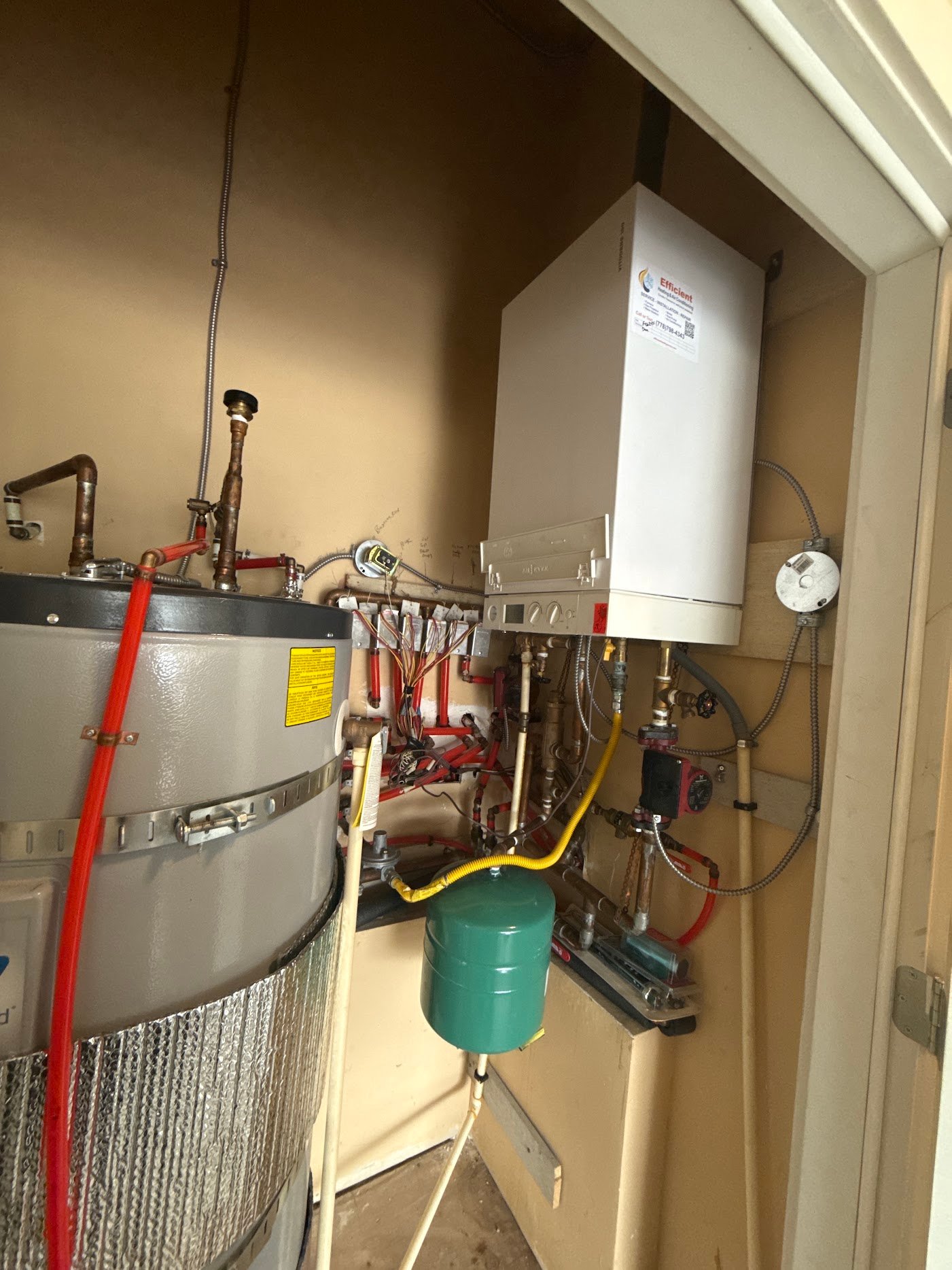
Use a wide view like this alongside a clear model-label photo when describing your existing system. The visible tank, external circulator and expansion vessel provide specific items to discuss: which will remain, which will change, and why? A photograph alone does not verify the design or confirm that commissioning checks have been completed.
Which boiler types and brands are worth comparing?
Compare the appliance’s function before comparing its badge. A heating boiler serves hydronic heating; an indirect tank can provide stored domestic hot water. A combi combines space heating and domestic hot water duties. The selected model must also suit the fuel, connections and proposed control arrangement.
“Condensing” describes a boiler’s use of heat recovered from combustion exhaust. “Combi” describes its heating and domestic hot water functions. A boiler can be both. Replacing a conventional boiler with a condensing model can involve changes beyond the appliance itself, including venting, drainage and near-boiler connections.
These manufacturer examples help you identify what a proposal is offering:
| Manufacturer example | What the product family identifies | What your proposal still needs to establish |
|---|---|---|
| IBC SFC Superflow | A combi boiler family with heating and domestic hot water specifications | Exact model and generation, applicable Canadian documentation and the installation arrangement |
| Viessmann Vitodens 100-W B1HE / B1KE | Heating and combi versions within the Vitodens range | Correct version for the agreed heating and water duties |
| Navien NHB-H / NCB-H | Heating-only and combi product families | Exact model, application, controls and any required external equipment |
IBC’s technical specification tables distinguish boiler-flow requirements from domestic hot water specifications. Viessmann’s Canadian Vitodens page and Navien’s NHB-H and NCB-H pages provide corresponding product information. Use the documentation for the exact model being offered, including its current installation instructions.
A familiar brand or a premium product description does not settle the design. Ask what makes the chosen model suitable for your heating emitters, hot water requirements and available installation space. Confirm availability and the proposed warranty terms in writing.
If you are comparing replacement with repair of an existing unit, our Viessmann repair page and Navien repair page provide the relevant service routes. Keep the full model and serial number available for that conversation.
How will the design move enough heat through the house?
The boiler’s heat output and the system’s ability to deliver that heat need separate checks. The installer should establish the heating demand, suitable emitter temperatures and required circulation. Selecting a larger boiler does not by itself establish that the existing pipes, pumps and controls can distribute its output.
Ask how the proposed circulator was selected. Its job depends on the flow required and the resistance of the circuit it serves. Caleffi’s explanation of hydraulic operating points shows why pump performance and circuit resistance must be considered together. A familiar model number is not a substitute for checking the application.
Controls matter as different rooms stop and start calling for heat. In a system using zone valves, the pump sees different conditions as valves open and close. Manufacturer guidance on valve-based zoning describes pump selection and control approaches that address those changing conditions. The appropriate choice depends on the piping arrangement.
Illustrative example: a proposal includes a new boiler but reconnects the existing distribution pump without explaining its suitability. The useful follow-up is: “What flow does the completed arrangement need, and how was this pump checked against it?” The old pump may be suitable. The missing information is the assessment, not proof that another purchase is necessary.
Also explain any existing comfort problem precisely. “The upstairs bedroom stays cool when the main floor is satisfied” gives the assessment a different starting point from “the whole house cannot reach temperature.” Ask whether diagnosing that symptom is included, and how the finding affects the installation design.
The aim is a proposal that connects the equipment choice to the result you need. Our boiler installation guide provides broader replacement-planning context.
Where can the installation be simpler without losing necessary functions?
A simpler installation can be appropriate when its components still meet the required duties and manufacturer instructions. Ask which existing functions must remain, which parts can be retained and which changes have a defined benefit. Removing equipment purely to lower the quoted total is not a design method.
There are three useful conversations to have:
- Retain with a reason. If a pump, tank or control remains, ask how its condition and compatibility will be assessed. A retained item should appear clearly in the scope.
- Replace with a reason. If the proposal removes functioning equipment, ask what makes it unsuitable for the new arrangement. The answer might concern capacity, control compatibility or condition.
- Combine functions with a reason. If one component takes over several duties, ask the installer to identify those duties and explain the associated connections and maintenance access.
Illustrative comparison: one design uses separate zone pumps. Another uses a distribution circulator with motorized zone valves. Either arrangement needs appropriate selection and controls. Counting pumps cannot tell you which proposal better suits the building. Ask each contractor to explain how their design handles the heating calls you need.
Use that explanation to compare cost. A proposal that changes the distribution arrangement may include additional labour and controls. Another may retain it after assessment. Ask for the difference in scope to be visible before treating the price difference as a difference in value.
The complete scope also needs the required fuel, electrical, venting and condensate connections, equipment removal and commissioning. Establish who obtains the applicable permits and coordinates any other trades. Technical Safety BC’s gas alteration guidance confirms that gas equipment replacement requires a permit from the applicable authority before work begins.
Return to the explanations of pumps and hydraulic separation or expansion and control components when a line item is unclear. Ask for the proposed function to be explained before accepting or deleting it.
What evidence should connect the proposed design to the finished installation?
Keep a short record linking the design decisions to the equipment and checks completed on site. It should identify what was installed, how it connects to the retained system and how the agreed functions were checked. That record also gives future servicing a more useful starting point.
| Design decision | Useful completion record |
|---|---|
| Selected boiler and configuration | Installed model and serial number, with the relevant manufacturer documents |
| Selected pumps and circuit arrangement | Component identification, circuit labels and the settings recorded by the installer |
| Heating and hot water control sequence | Explanation of what operates during each agreed type of heating call |
| Retained components | Identification of what remains and the checks performed on it |
| New connections and regulated work | Relevant permit information, commissioning records and outstanding items |
Ask the installer to demonstrate the user controls and explain which settings you should use for normal operation. A thermostat request, a pump running and heat arriving at the intended emitter are related observations, but they are not the same observation. The handover should make the sequence understandable.
For the appliance itself, commissioning should follow the selected model’s instructions. IBC’s SFC technical information portal, for example, separates installation manuals, specifications, wiring information and installation or service report forms. Keep the records that apply to your installed model rather than a generic brochure alone.
Ask who to contact if the system behaves differently from the agreed operation, and keep any unresolved item in writing. When arranging boiler service in Anmore, share those records so the service visit starts with the installed arrangement and relevant history.
For the wider installation process, see our boiler installation overview.
Ready to discuss a replacement? Send your address and equipment details, then describe the comfort or reliability issue you want solved. Efficient Heating Service can discuss the proposed work and the next assessment step with you.
Questions about equipment choices and installation proposals
These questions help you assess the reasoning behind an equipment package without having to design the system yourself. Use them when a component name, control feature or proposed substitution is unclear. The answers should relate to your installation and the exact equipment included in its scope.
Does a built-in boiler pump remove the need for external circulators?
Not automatically. The internal pump has a defined role and performance range. Whether it can serve the proposed distribution arrangement depends on the boiler instructions and circuit requirements. Ask which water path it serves and why any external circulator is included.
Does built-in zone control mean the zone hardware is included?
A control capability does not establish the contents of the installation package. Ask the quotation to identify the required valves, pumps, sensors, wiring and any external controls. The installer should distinguish features inside the appliance from equipment that must be supplied and connected separately.
Can pump wattage tell me whether a proposed design is better?
The electrical rating alone cannot establish whether a pump meets the required duty. Ask how its flow capability, circuit resistance and control mode suit the installation. Compare those selections and the expected operation before using power consumption as a deciding factor.
Is expansion-tank size based only on the boiler’s BTU rating?
No. The assessment must consider the heating system’s fluid volume and operating conditions, including temperature and pressure. Ask whether the selected or retained expansion tank has been checked for the completed installation, especially when the connected system is changing.
Can a replacement installation use fewer pumps than the old system?
It may, if a suitable alternative arrangement provides the required circulation and control. Ask the installer to explain how each zone will operate and which valves or controls support the change. Fewer pumps do not by themselves establish better performance or a complete scope.
What should “standard piping package” mean on my quote?
Ask for the included components and connection work to be listed, along with the intended arrangement. The phrase alone does not establish which pumps, separators, valves or controls you are buying. It should also identify what will remain from your current installation.
Is a similarly sized boiler an equivalent substitution after I order?
A similar heat rating does not make every connection, control or installation requirement identical. Ask for the exact replacement model and an explanation of any design, price or warranty changes before agreeing. The final documentation should match the equipment that is installed.
Is a photograph of the finished pipework enough for handover?
A photograph helps identify the layout, but it does not record every setting, test or hidden connection. Keep it alongside the equipment details and commissioning information. Ask the installer to explain the controls and label the relevant circuits so the image has useful context later.