
Local boiler diagnostics · Port Coquitlam, BC
Port Coquitlam Boiler Repair for Cold Rooms and Uneven Heat
A firing boiler and a warm home are not the same result. We trace the thermostat call, zone controls and water circulation to find why baseboards, radiant floors or individual rooms stay cold while the appliance continues to run.
A boiler specialist’s answer
Why Is My Boiler Running but My Home Still Cold?
If your boiler runs but the rooms stay cold, the fault may be in a thermostat, zone valve, circulator or air-bound heating loop rather than the burner. For boiler repair in Port Coquitlam, we check heat production and heat delivery separately, then investigate pressure changes, leaks or lockouts using the exact model and fault history. We explain the confirmed cause and repair price before approved work. Repair is worth considering when the fault is isolated and the rest of the system is sound. Replacement needs comparison when major defects or unavailable parts make repair impractical. Call Efficient Heating Service with the model, displayed code and which rooms or hot-water fixtures are affected.
Port Coquitlam diagnostic focus
Why Is the Boiler Hot but the Baseboards Are Cold?
If the boiler reaches temperature while a room or floor stays cold, heat is being produced but not delivered correctly. We trace the thermostat call through the control panel and then follow water movement through valves, pumps, air separators, manifolds and the affected loop.
Thermostat or relay never sends the call
A display can look normal while the zone panel never receives or passes the demand. We check the call at each stage instead of assuming the wall control is working.
Zone valve does not open
A failed motor, stuck valve body, end switch or wiring problem can block one circuit. Clicking from an actuator is not proof that the valve opened fully.
Circulator is powered but not moving water
A pump can hum, seize, cavitate or lose performance. Voltage, temperature change, flow evidence and system pressure help separate a pump fault from trapped air or a closed valve.
Air blocks the loop
Gurgling, uneven heat and a cold return can point toward air, but the source also matters. Automatic vents, fill pressure, expansion condition and recent draining should be reviewed.
Flow is restricted or unbalanced
Partially closed valves, debris, strainers, undersized piping or competing zones can starve a circuit. We compare supply and return temperatures rather than relying on touch alone.
Mixing or outdoor-reset control is wrong
Radiant floors and lower-temperature zones may use mixing controls. A sensor or setting problem can deliver water that is too cool even when the boiler itself runs normally.
A homeowner’s observation sheet
Map the Cold Rooms Before the Appointment
- Room or floor
- List the affected spaces together. Mark whether every room under one thermostat is cold or the pattern crosses several zones.
- Type of emitter
- Note whether each space has baseboards, radiators, a fan coil or floor heating. A photo is enough if you are unsure.
- What still works
- Mention other warm rooms and whether tap water remains stable. This helps us separate a common source problem from a single heating path.
- When it changes
- Record whether the fault appears after a shower, during several simultaneous calls or after recent plumbing work. Do not change boiler settings to produce a test.
Send this short record with the model label. It gives us a useful starting point without asking you to open the boiler or handle hot components.
Follow the affected circuit
From a Room Thermostat to Heat Delivery
- Confirm the room’s demandWe identify the thermostat and the circuit it controls. A display showing a target temperature does not establish that the call reaches the heating equipment.
- Check the valve or circulator responseWe test the commanded function and the conditions around it. A humming pump or clicking actuator is not proof that water moves through the intended loop.
- Compare the circuit’s water-side behaviourPressure, temperature change, air and restrictions help explain why one branch receives less heat than another. The observations must match the active demand.
- Verify the cold areaWe repeat the affected call after the repair, rather than checking the burner alone. Any remaining distribution issue is identified separately.
Water movement needs evidence
Measure the Circuit That Stays Cold
Compare the demand with the response
We check whether a valve or pump responds when its thermostat calls. This separates a missing command from a mechanical or water-side problem.
Compare supply with return
Temperature readings under the same operating condition help assess heat transfer and circulation. They need interpretation for that circuit, not a universal target gap.
Compare cold and hot pressure
The change over a heating cycle helps evaluate filling and expansion conditions. A single pressure value does not establish the cause of a cold room.
Compare before and after
The verification follows the same zone that failed. Heat at the boiler is not accepted as proof of heat delivery to every room.
Price the confirmed heat-delivery fault
A Zone Repair Is Different From a Boiler Replacement
If the boiler produces heat but one circuit fails to receive it, the repair scope may sit in a valve, pump, control or connected piping. We explain which function failed and what the proposed work will restore before you approve it.
What affects the diagnostic time
The number of connected zones, access to valves and controls, intermittent symptoms and undocumented alterations all affect the test path.
What belongs in the quote
The confirmed repair, required isolation or draining, compatible components and the return-to-operation checks should be clear. Another defective circuit is a separate finding.
Port Coquitlam service planning
Different Homes Create Different Hydronic Service Paths
Port Coquitlam combines established detached-home areas, newer townhomes, strata buildings and mixed-use growth. A neighbourhood never replaces a diagnosis. It helps us ask better questions about equipment age, access, zoning and who owns the heating system.
Mary Hill, Lower Mary Hill and Citadel
Established houses may have conventional baseboard systems, older cast-iron or copper-fin boilers, or later condensing upgrades connected to original piping. Tell us whether every loop is cold or only one level is affected.
Glenwood, Lincoln Park and Oxford Heights
Multi-zone baseboard layouts can involve several thermostats, relays, zone valves and pumps. A working burner does not prove that heat is circulating to the room that called.
Riverwood, Blakeburn and Dominion Triangle
Newer houses and townhomes may use wall-hung condensing or combination boilers. Separate the space-heating symptom from tap-water performance so we can follow the correct demand.
Fremont Village and the Pitt River area
Townhouse and strata visits can require parking, gate, mechanical-room or property-manager instructions. Confirm whether the appliance is in-suite, in a private garage, or part of common equipment.
Downtown PoCo and Central Port Coquitlam
Condos and mixed-use buildings may have individual boilers, shared domestic-hot-water equipment or a central plant. Ask the strata which equipment serves your unit before arranging a residential call.
Birchland Manor and Woodland Acres
Longer distribution paths, additions and mixed emitters can change flow requirements. Mark the cold rooms, the thermostat that controls them and whether the problem started after plumbing or control work.
We use the address for routing and access planning. The model label, operating sequence and live readings decide what the boiler needs.
Pressure is a symptom, not a diagnosis
Why Does Boiler Pressure Rise, Fall or Trigger the Relief Valve?
A closed hydronic system should not need routine refilling. Pressure that falls can relate to visible or concealed water loss, relief discharge, automatic vents, an incorrect fill setting or an expansion problem. Pressure that climbs sharply as the boiler heats can point toward lost expansion capacity, a waterlogged tank, fill-valve behaviour or a domestic-water crossover in some systems.
A dripping relief valve should not be capped or plugged. We check pressure through a full heating cycle, expansion-tank condition, automatic fill operation, relief discharge and the surrounding piping before identifying the correct scope.
Heating and hot water are separate tests
Why Does a Combi Boiler Heat the Home but Not the Tap Water?
A combi boiler must recognize domestic-water flow, give hot water priority and transfer burner output through its domestic-water circuit. If heating works but showers turn cold, the diagnostic path can include flow sensing, inlet filters, diverter operation, plate heat-exchanger condition, temperature sensors, control logic, gas input and the hot-water demand at the fixture.
Hot water starts, then fades
Record how long it stays hot and whether the boiler continues firing. That timing helps separate demand loss, restricted heat transfer and capacity or flow issues.
Temperature swings at one fixture
Compare another faucet. A local mixing cartridge or low-flow condition can imitate a boiler problem, while several affected fixtures point back toward the appliance or supply.
Heat stops during a shower
Temporary space-heating pause can be normal during domestic-hot-water priority. The key question is whether the boiler restores heat correctly after the tap closes.
Symptoms to discuss
Boiler Problems That Should Be Checked Before They Grow
No ignition or recurring lockout
The error identifies the stage that stopped. Ignition components, flame proof, gas delivery, venting, condensate and safety inputs still need model-specific testing.
Water under the boiler
Note whether water appears only while firing. Condensate, relief discharge, pumps, vents, fittings and heat exchangers leave different patterns.
Banging, whistling or gurgling
Sound can come from air, restricted flow, scale, pump cavitation, rapid temperature change or combustion. The location and timing narrow the test.
Frequent resets
A reset clears a lockout; it does not repair the reason it occurred. Stop repeated attempts if ignition is rough, gas is smelled or the code immediately returns.
Short cycling
Rapid firing and stopping can involve load, flow, control settings, sensor readings, zoning, pump operation or an oversized appliance. The connected system must be included.
Slow indirect-tank recovery
Tank demand, priority logic, aquastat or sensor, pump, zone valve and heat transfer can interrupt hot-water recovery while space heating looks normal.
Boiler and distribution types
Gas Boiler Systems Serviced in Port Coquitlam
Wall-hung condensing boiler
Service can cover ignition, flame signal, venting, condensate, combustion, sensors, pumps, heat-exchanger condition and control settings.
Combination boiler
Space heat and domestic hot water need separate demand tests, including flow sensing, diverter action and plate heat transfer.
Heat-only boiler with indirect tank
The boiler may be sound while the tank sensor, priority control, pump or zone valve prevents hot-water recovery.
Atmospheric or mid-efficiency unit
Burners, draft, chimney connection, gas control, safeties and combustion must be reviewed with the age and condition of the equipment.
Cast-iron sectional boiler
Repair viability depends on exchanger condition, venting, controls, combustion, compatible parts and the connected distribution system.
Copper-fin boiler
Flow, pump operation, scale and temperature rise matter when the heat exchanger becomes noisy, overheats or trips a limit.
Floor-standing condensing boiler
Larger systems may include low-loss headers, several pumps, mixing controls, outdoor reset and an indirect domestic-water tank.
Cascade or multi-boiler plant
Lead-lag staging, common sensors, communication, primary-secondary flow and building controls are checked when capacity disappears.
Baseboard, radiant and fan-coil distribution
Each emitter needs suitable water temperature and flow. Mixing, zoning and outdoor reset can change what reaches each room.
Current and legacy equipment in BC
Boiler Brands and Model Families We Prepare For
A brand name is not enough to choose a manual or part. Send the complete model and serial label because control boards, venting, fault logic and service procedures change between generations.
This is a broad list of major current and legacy boiler families found in British Columbia. It does not promise that every discontinued component remains available.
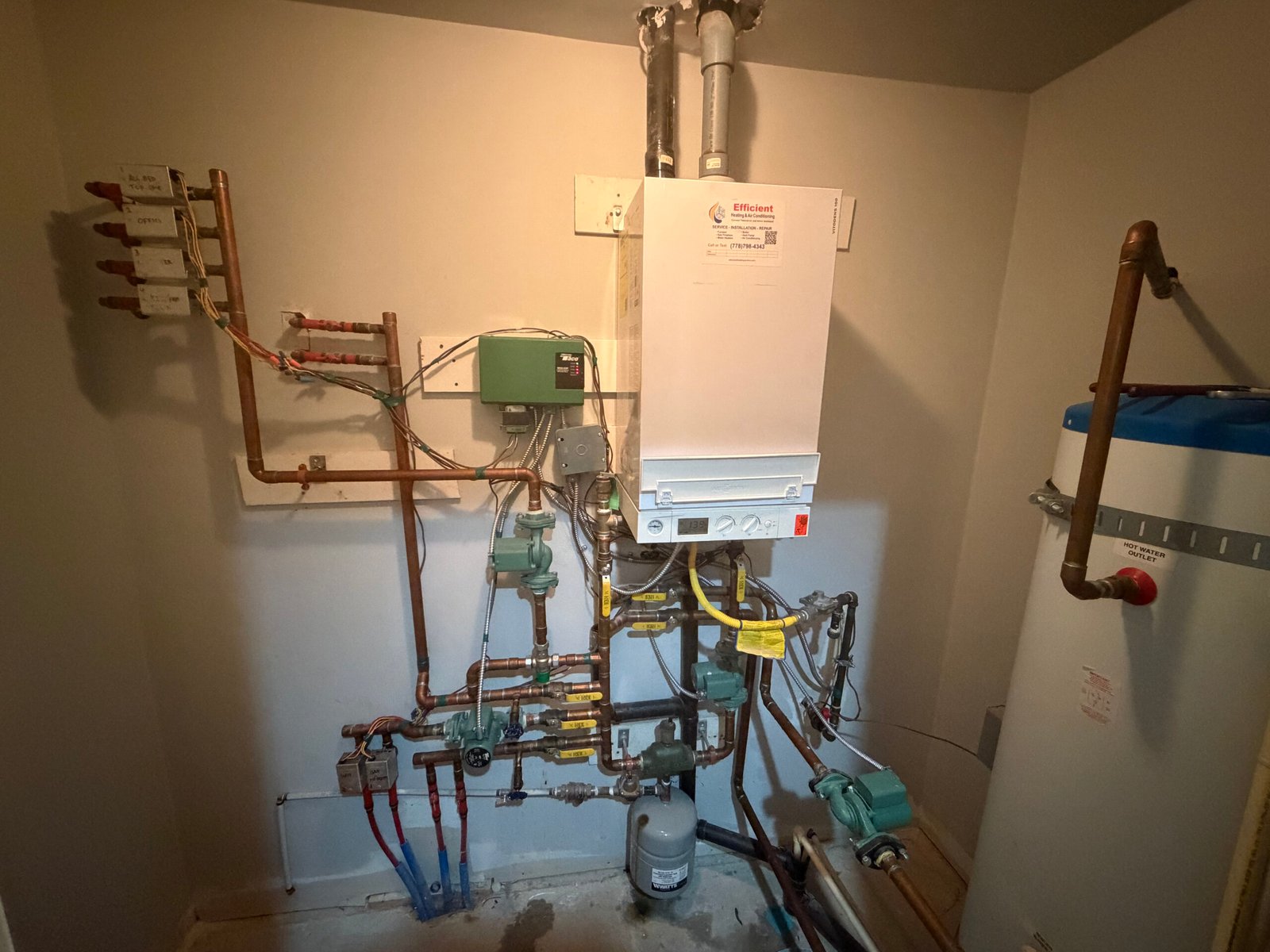
Prepare for the visit
What Should You Send Before the Appointment?
Match the service to the problem
Do You Need Repair, Maintenance or Replacement?
Diagnostic repair
Choose repair for no heat, cold zones, leaks, pressure changes, lockouts, unusual noise or unstable combi hot water.
Planned service
Choose maintenance for model-specific inspection, cleaning, operating checks and documentation before a failure interrupts heat.
Installation or replacement
Compare replacement when a major component is unsafe, unavailable or uneconomical, faults repeat, or the appliance no longer fits the connected load.
A decision based on condition
Should You Repair or Replace an Older Boiler?
Age alone does not decide. Compare the confirmed failure, heat-exchanger and venting condition, repair history, part availability, distribution performance and whether the boiler still matches the home’s heating and domestic-hot-water demand.
Repair can make sense when
- one correctable cause has been verified;
- the exchanger, venting and major safeties remain serviceable;
- a compatible component is available;
- the system is otherwise reliable and correctly sized.
Replacement deserves comparison when
- the heat exchanger or approved venting has a serious defect;
- an essential part is discontinued or the repair is uneconomical;
- major failures and service costs keep returning;
- the existing boiler cannot serve the required zones or hot-water demand.
Neighbourhood coverage
Boiler Repair Across Port Coquitlam
We arrange boiler diagnostic and repair visits in Citadel, Citadel Heights, Mary Hill, Lower Mary Hill, Glenwood, Lincoln Park, Oxford Heights, Birchland Manor, Woodland Acres, Riverwood, Blakeburn, Shaughnessy, Central Port Coquitlam, Downtown PoCo, Fremont Village, Dominion Triangle and nearby Pitt River residential areas.
Condos, townhouses and managed properties
What Should a Port Coquitlam Strata Owner Confirm?
Ask whether the boiler belongs to your unit or serves common property. Confirm mechanical-room authorization, parking or loading instructions, water shut-down rules, service hours and whether other units report the same loss of heat or hot water. Several affected homes can point toward shared equipment instead of an individual appliance.
Send a photo of the unit and surrounding mechanical area. That helps distinguish an in-suite residential boiler from a larger central plant that needs property-management coordination.
Urgent safety
Gas Odour, Carbon Monoxide Alarm or Water on Controls?
If you smell gas or a carbon monoxide alarm activates, move everyone away from the affected area. Do not operate switches, light a flame or keep resetting the boiler. Once safely away, call the appropriate gas or emergency number.
Do not touch equipment when water has reached wiring, a control board or the gas valve. Technical Safety BC explains that carbon monoxide cannot be seen or smelled and recommends annual inspection by a licensed contractor. Read its carbon monoxide safety guidance and annual gas-appliance servicing bulletin.
Choose the right service
Related Boiler and Heating Services
Questions specific to your repair
Port Coquitlam Cold-Zone and Circulation Questions
Why are the baseboards cold while the boiler is running?
The boiler may produce heat while a thermostat, zone valve, pump or water-side condition prevents delivery. We trace the affected circuit rather than assuming the burner is at fault.
The zone valve clicks. Does that prove it opened?
No. An electrical or mechanical response does not establish full valve movement or flow. The valve’s function and the connected circuit need verification.
The circulator hums. Is water definitely moving?
No. Sound does not prove the required flow. We assess the pump response with the surrounding pressure, temperature and circuit conditions.
Why does one floor warm up while another stays cold?
Separate thermostats, branches or zone controls may serve those floors. Mapping the cold rooms helps us identify which heating demand and circuit to test.
Is a heating pause during a shower always a fault?
Some combi systems give domestic hot water priority. The important questions are whether the behaviour matches the model and whether space heating resumes correctly when that demand ends.
What if the cold zone appeared after plumbing work?
Tell us what was drained or changed and whether the fault began immediately. Air, valve position, filling or control changes may be relevant, but testing establishes the cause.
Will replacing the boiler solve poor circulation?
Not if the cause remains in the connected distribution system. We identify the delivery fault and explain whether it requires a circuit repair, appliance work or both.
Experience and clear repair decisions
Why Choose Efficient Heating Service?
Licensed gas expertise
We bring Class B Gas Fitter qualifications and model-specific preparation to boiler diagnostic work.
12+ years of experience
Our field experience covers residential and light-commercial boilers and connected hydronic heating systems.
Viessmann trained
Manufacturer training completed in 2017 informs our model-specific approach to ignition, combustion and service checks.
Clear repair options
We connect the recommendation to tested findings and explain pricing before approved repair work.
Efficient Heating Service · Licensed Class B Gas Fitter · 12+ years of field experience.
Last updated September 21, 2026.
Need Boiler Help in Port Coquitlam?
Call with your boiler model, complete error code and the symptoms you can see. For non-urgent requests, send photos and access details through the contact page.