
Updated: September 28, 2026
Boiler installation Mission: what should you check first?
For boiler installation in Mission, confirm the available fuel, heating requirements and existing connections before choosing equipment. A useful proposal identifies the exact model, any supply upgrades and the work needed to bring it into service, so you can compare the complete project before committing.
Call 778-798-4343 Request a Mission installation assessment
Efficient Heating Service can discuss your replacement plans and arrange the next step. Start with your address, whether the home uses natural gas or propane, and what the boiler heats: rooms, domestic hot water, or both. You do not need to choose a model before calling.
- Already have a quotation? Ask whether fuel compatibility, supply capacity and required installation changes have been checked or remain assumptions.
- Planning a fuel change? Confirm the new supply and its schedule before arranging removal of the existing equipment.
- Heating has stopped? Begin with boiler repair in Mission if the cause has not been diagnosed. A breakdown alone does not establish that replacement is necessary.
The installed price depends on the selected equipment and the connections it needs. Ask for the appliance, installation work, outside contractor or fuel-provider work, and exclusions to be identified separately. That makes the next conversation specific: what is suitable, what is included, and what must happen before installation day?
Which Mission neighbourhoods should you include in your enquiry?
Include your full street address when enquiring from Mission Core, Cedar Valley, Hatzic or Silverdale. For Stave Falls, Steelhead, Ferndale, Keystone and Silverhill, provide the same address details and existing fuel information. A neighbourhood name helps locate the property; it does not establish the available supply.
The City identifies these areas in its planning material. Its Rural Mission Strategy also explains the importance of Mission’s rural communities. Their different locations make an address useful for arranging a visit, but they do not tell an installer which boiler is inside a particular home.
If you found us through a “boiler installer near me” search, send the property address and a brief description of the heating system. Include a gate or access instruction when relevant. A listing that uses “Mission” as a broad location label should still be checked against the actual property address.
Mention whether the enquiry concerns an occupied home, a renovation or a new installation. If another building shares the fuel supply, identify that too. These details help define the assessment without assuming that every property in the same neighbourhood has the same equipment or service arrangements.
Will the existing natural gas supply support the proposed boiler?
An existing gas connection does not establish capacity for every replacement boiler. Ask the gas fitter to assess the proposed appliance input alongside other connected equipment and the supply arrangement. If utility equipment needs changing, obtain the requirements and timing before finalizing the installation date.
Two figures answer different questions: the home’s heating requirement describes the heat it needs; the appliance’s gas input describes the fuel rate it can demand. Choosing equipment and checking its supply are connected tasks, but one calculation does not replace the other.
Give the installer a complete appliance list
Include the boiler, separate gas water heater, fireplace, range, dryer and any other equipment using the same supply. Note what will be removed and what will remain. The assessment should use actual appliance information, rather than a generic allowance based on the number of bedrooms.
FortisBC’s gas service upgrade guidance asks for the gas fitter’s details, required delivery pressure and total load when a meter or regulator change is needed. The utility determines its process and timing. A boiler quotation should make clear whether that coordination is included or still outstanding.
For a property without an existing connection, use FortisBC’s new gas service process to establish availability and next steps. A contractor connects the house and appliances after the utility’s supply work. Do not treat a proposed connection as an available fuel source until the arrangements are confirmed.
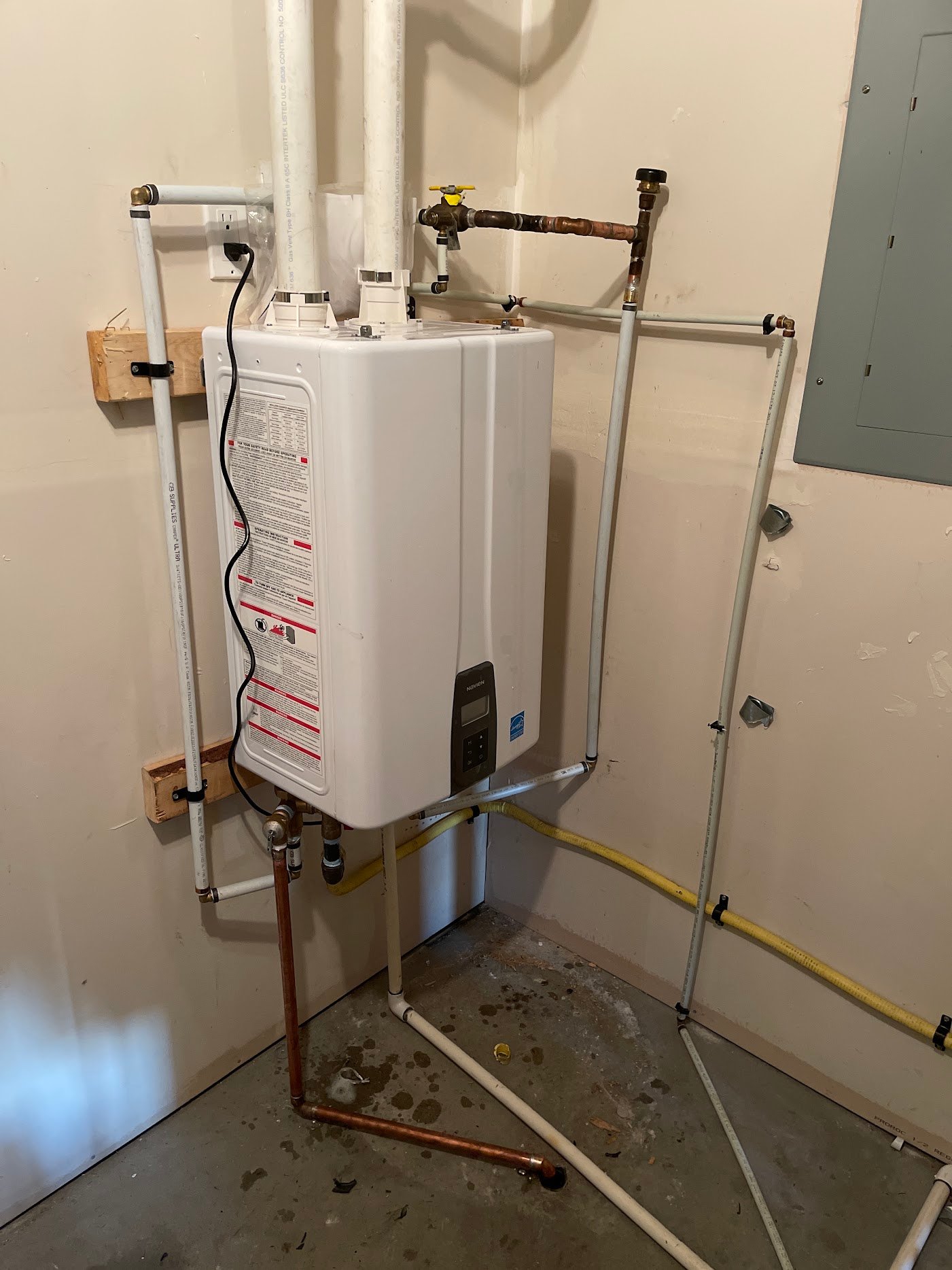
Include every connected appliance in the assessment
This original job photo shows a wall-mounted appliance with visible vent pipes, pipework and an electrical connection. The equipment list for your quotation should identify which appliances remain and which will be removed.
A photograph helps start that conversation. The exact model, fuel configuration and supply capacity still need verification at the property.
What changes when the home uses propane?
A propane installation needs an approved appliance configuration and a supply system suited to the connected demand. Check the exact model, manufacturer conversion requirements, tank arrangement and regulators with the qualified installer and fuel provider. A boiler advertised for gas use is not automatically ready for propane.
Check the appliance and the fuel supply separately
The appliance question is whether the exact model is approved for the intended fuel and how the manufacturer requires it to be configured. The supply question is whether the storage, regulators and piping can serve the proposed installation. A positive answer to one does not settle the other.
Propane storage capacity in litres is not the same as the rate at which a tank can supply vapour. Temperature and the amount of liquid remaining affect that rate, as explained in RegO’s technical manual. Have the provider and installer assess the actual arrangement for the expected conditions; a tank’s appearance is not a capacity check.
Before accepting a propane proposal, ask for three items in writing:
- The exact boiler model and the approved fuel configuration, including any required conversion components.
- Confirmation of who will evaluate the existing storage and supply equipment, and price any changes.
- The installation sequence if fuel-provider work, a delivery or a change to rented equipment is required.
Fuel conversion and regulator adjustment are professional work. Avoid ordering a conversion kit from a brand name alone. Product series and revisions matter, and the correct procedure includes the manufacturer’s required checks and identification.
Which boiler types and brands are worth comparing?
Compare the heating arrangement first, then the model and fuel configuration. A heating boiler can work with separate water heating or an indirect tank; a combi also produces domestic hot water within the appliance. Brand selection should follow those requirements, the existing system and available support.
“Condensing” describes how a boiler recovers heat from combustion gases. It is not a separate choice from “combi”: a combi can also be condensing. Likewise, a wall-mounted cabinet does not tell you whether an appliance heats rooms, tap water or both.
| Arrangement under consideration | What the proposal should explain |
|---|---|
| Heating boiler with independent water heater | Which appliance serves each duty, whether the water heater stays, and the resulting connected fuel demand |
| Heating boiler with an indirect hot water tank | How the selected boiler, tank coil, pump and controls work together; which existing parts remain |
| Condensing combi boiler | Suitability for both space heating and household hot water use, with the model’s separate operating ratings |
| Replacement of an older cast-iron boiler | Which existing system connections remain suitable and which need redesign for the proposed replacement |
Use model families as a starting point
Navien’s NHB-H heating boilers and NCB-H combi boilers illustrate different arrangements within one brand. Navien publishes an NHB-H propane conversion guide; the installer must use documentation matching the supplied product.
The Canadian Viessmann Vitodens 100-W range includes B1HE heating and B1KE combi models and supports natural gas or propane configurations. Its fuel setup differs from kit-based systems. Do not assume that a procedure or component used on one manufacturer’s boiler applies to another.
These are options to discuss, not a ranking of Mission’s most common boilers or confirmation of stock. Bring the full model number of any existing Navien, Viessmann, Bosch, Weil-McLain or other appliance. For a fault on existing equipment, the Navien repair and Viessmann repair pages provide the relevant enquiry routes.
For broader system planning, see the boiler installation guide. The property assessment should connect the selected equipment to the actual heating load and installation requirements.
Which existing connections and components need checking?
Fuel approval is only one part of installation readiness. The proposal should also address electrical power, venting, condensate disposal and the heating water connections. Existing pumps and controls need a stated role in the replacement design, rather than an assumption that everything beside the old boiler transfers unchanged.
Use this table to ask what has been checked and where the answer will appear in the proposal. It is an assessment checklist, not a parts list for every home.
| Item | Useful question before ordering |
|---|---|
| Electrical supply | What power and connection does the selected appliance require, and does any associated electrical work need arranging? |
| Venting and combustion air | Is the proposed route suitable for the exact model, and what existing material can remain? |
| Condensate connection | Where will condensate go, and what drainage or treatment provisions does the installation require? |
| Circulator pumps and zone controls | Which devices remain, what will each operate, and how will the new controls connect? |
| Expansion vessel and system protection | Has their suitability been assessed for the resulting heating system? |
| Indirect tank, if retained | Has compatibility with the proposed boiler and its control arrangement been established? |
A modern gas boiler still needs electricity for its operation. For example, Navien lists an electrical supply requirement for the NHB-H; the fuel source alone does not provide power to the controls and associated circulation equipment. Discuss backup needs before selecting equipment if continuity during an outage matters to the household.
The manufacturer’s current installation documents, such as Navien’s NHB-H documentation, govern the model-specific details. A photo can help identify the system for an enquiry, but it cannot establish hidden piping conditions, electrical suitability or measured operating performance.
How do you compare the full installed cost?
Compare quotations against the same agreed result and the same assumptions. Separate the boiler and installation price from any unresolved fuel supply or electrical work. Where a requirement is still unknown, ask who will investigate it, when the answer is due and how the price may change.
An example of a price difference that needs explaining
Consider two illustrative proposals for the same model. One says “use existing gas connection”; the other includes an assessment and an allowance for a possible change. Those totals are not directly comparable until the first contractor explains whether the connection was assessed and the second explains how the allowance is finalized.
Ask both contractors to describe the same scope before using the price difference to decide. Review the fuel conversion and regulator questions and the pump, control and connection checklist against each proposal.
| Decision before commitment | What to request |
|---|---|
| Equipment selection | Full model designation, fuel configuration and the reason it fits the agreed duties |
| Existing supply | Written assessment outcome or a clearly identified outstanding check |
| Work by another party | Description, responsible contact, price status and scheduling dependency |
| Retained equipment | Named items and any conditions attached to reuse |
| Installation completion | Commissioning, documentation and handover included in the quoted work |
Technical Safety BC states that regulated gas installations require permits and identifies where it issues them. Mission is outside its listed municipal exceptions. Ask the contractor to include the applicable gas installation permit arrangements and identify any other approvals needed for the actual work.
An itemized assessment gives you a basis for deciding. A single appliance price cannot establish the total for a property that may need additional work.
What should be confirmed before the old boiler is disconnected?
Before disconnection, confirm that the selected equipment and required components are available, necessary supply work is coordinated, and the installation scope is agreed. Also establish how heating and hot water will be restored and what records you will receive when the new system is commissioned.
Ask for a short readiness review with three outcomes: confirmed, still to be checked, or waiting on another party. An unresolved item should have an owner and a next step. This is especially useful when an installer, fuel provider and electrician have separate appointments.
At handover, request the exact model and serial number, confirmed fuel configuration, relevant conversion identification, and startup or commissioning records. The installer should explain the controls you will use, maintenance requirements and whom to contact if a problem appears.
Keep those records with the installation proposal. They give a future service technician a clearer starting point than the brand name alone. The Mission boiler service page covers the next maintenance enquiry.
Ready to discuss the project? Send the address, current fuel, what the boiler supplies and whether any supply work has already been proposed. We can start with those details and arrange the next step for your Mission home.
Questions about fuel and boiler replacement in Mission
The questions below address decisions that often sit between choosing a boiler and authorizing installation. Use them to clarify the fuel configuration, shared supply, outside appointments and handover requirements. The answers explain what to verify; the final design still depends on the property and exact equipment.
Is a gas main on my street enough to order a natural gas boiler?
No. Confirm the service arrangements for your specific property with the utility and installer. Nearby infrastructure does not establish a completed connection, its capacity, project cost or installation date. Keep the appliance purchase and supply schedule coordinated.
Can the propane conversion kit from my old boiler be reused?
Do not assume so, even when the brand is unchanged. The installer must identify the exact replacement model and follow its approved conversion requirements. Retaining a kit is not a default cost-saving measure; compatibility needs explicit manufacturer support.
Does it matter if my propane tank is rented?
Yes, it is a coordination question to resolve early. Tell the installer who owns the tank and contact the provider about access, permitted changes and any charges under your agreement. Do not assume a boiler installation price includes work on supplier-owned equipment.
Does a working gas fireplace prove the supply is adequate?
No. A working appliance does not establish capacity for a different connected load. Give the gas fitter the complete equipment list and identify what will remain after the replacement. Supply suitability needs assessment for the proposed arrangement.
Will a new gas boiler heat my home during a power outage?
Do not assume it will. Modern boilers and their associated controls and pumps need electrical power. If backup operation is a requirement, have the installer and electrician assess the complete system and a suitable backup arrangement before purchase.
Must the radiators change if I switch from propane to natural gas?
A fuel change does not by itself decide whether the radiators need replacing. Their condition and suitability for the proposed heating design need assessment separately. Ask the quotation to identify retained emitters and any changes to water temperatures, circulation or controls.
Does replacing two appliances with one combi reduce the required gas supply?
Not automatically. The number of cabinets is not a measure of gas demand. Compare the exact proposed model’s input ratings with the equipment being removed and retained, including its domestic hot water operation. The gas fitter must assess the resulting supply requirements.
Should a workshop heater be included if the house boiler is the only replacement?
Yes, tell the installer if it uses the same meter or propane supply. Equipment outside the house can still matter to the supply assessment. Identifying a shared load does not mean the workshop itself needs alteration; that is a separate scope decision.