
Boiler Installation North Vancouver: What Will the Replacement Include?
A boiler replacement should include a plan for the heating circuits it will supply. For a North Vancouver home with floor heating, radiators or hydronic baseboards, that means checking the required water temperatures, existing controls and hot water arrangement before choosing the equipment and installation scope.
Efficient Heating Service can help you plan the replacement around your existing heating system. Tell us which rooms use which type of heating, whether the boiler also heats your tap water, and what you want the installation to improve.
Call 778-798-4343 Request a North Vancouver installation assessment
- Can the existing heating stay? Compatible radiators, floor loops and distribution equipment may remain after assessment. The quote should identify what stays and what changes.
- What determines the price? The boiler, venting, gas and drainage work, plus any required changes to mixing valves, pumps and controls, and hot water equipment. Ask for the complete installed scope.
- Which boiler should you choose? Compare the proposed model with your heating demand and circuit arrangement. IBC, Navien and Viessmann offer different equipment and control options; the brand name alone does not settle the choice.
- What happens next? Provide your address, boiler model and a short description of the heating arrangement. Confirm the assessment appointment and expected heating or hot water interruption before scheduling installation.
If replacement has not been recommended and you need an existing fault diagnosed, start with boiler repair in North Vancouver.
Start with a room and circuit map
The useful starting point is a record of which thermostat controls which rooms, what delivers heat there, and how those rooms connect to the boiler. This helps an installer distinguish separate comfort zones from circuits that need different water temperatures, then describe the replacement accurately.
A homeowner’s room list can start the conversation. The installer should verify the pipework and controls before relying on old labels. A thermostat marked “downstairs” may not describe every room connected to that circuit after previous alterations.
| Record for the assessment | Example information to provide | Decision it helps explain |
|---|---|---|
| Rooms controlled together | Kitchen and dining room share a thermostat | Which spaces will continue to operate together |
| Heat emitters | Floor loops, panel radiators, hydronic baseboards or a fan coil | The output and water conditions each circuit requires |
| Existing controls | Manifold actuators, zone valves, pump relay or mixing control | What can be retained and integrated |
| Domestic hot water | Separate water heater, indirect tank or combi boiler | Whether the replacement also has a water heating duty |
| Your observations | A room has never reached its set temperature; a label seems wrong | What needs investigation before the scope is settled |
Bring the problem in plain language. “The bedroom thermostat also seems to heat the hallway” is useful information. You do not need to identify a valve or decide which component is responsible.
The assessment should connect this room map to the home’s heat requirement and the output of the installed emitters. Copying the old boiler’s rating leaves those questions unanswered. Equally, changing the boiler does not establish that every existing circuit is correctly arranged.
Give different heating circuits the right water conditions
Separate thermostats can request heat independently while their circuits still receive the same supply water temperature. Where emitters need different temperatures at the same time, the design must provide that function through suitable piping, mixing and controls. Zone count alone does not establish independent temperature control.
Caleffi’s explanation of multiple-temperature systems describes an arrangement where the heat source meets the higher temperature requirement and a mixing assembly reduces the temperature supplied to another circuit. That is one design approach, not a setting to copy into every home.
For example, an illustrative replacement might serve a radiant floor circuit and a separate radiator circuit. The assessment would establish what each needs before choosing how to supply them. It should not assume that all radiators require high temperatures or that every floor assembly has the same limits.
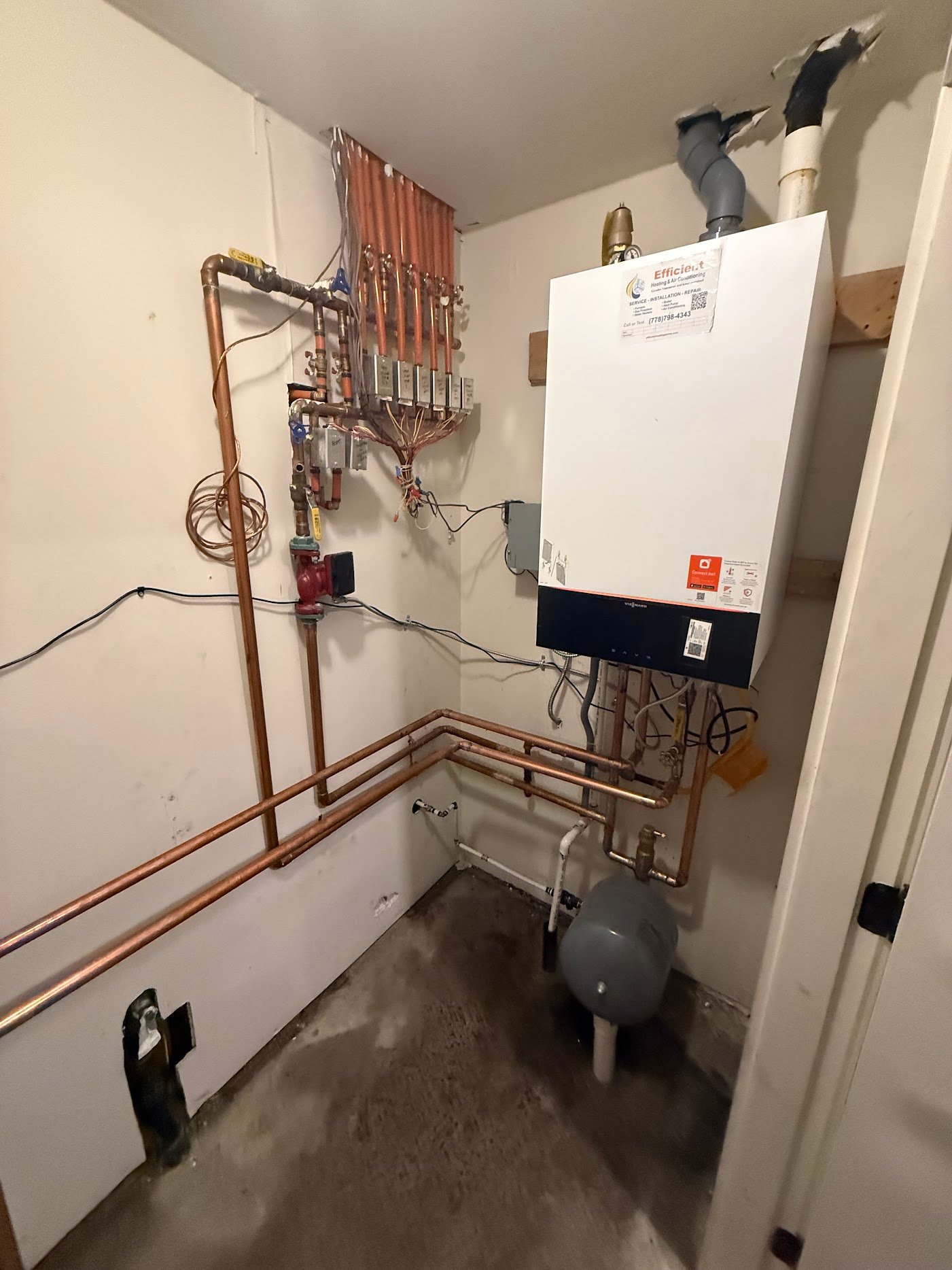
Include the controls outside the boiler
The boiler and the external distribution controls belong in the same installation assessment. Identify the circuits and record which components will remain.
This photograph shows the wall-mounted appliance beside a bank of external valves and a circulator. Ask how the proposed replacement will connect to that equipment and how each circuit will be identified at handover.
Mixing valves and temperature sensors
A mixing valve blends flows to produce the required supply temperature. A thermostatic valve and a motorized valve with an electronic controller are different arrangements. The proposal should identify which is intended, which circuit it serves and what sensors or additional controls are included.
Ask the installer to record the intended operating limits against the actual floor or emitter requirements. A dial position on an existing valve is not a documented design value. There is no universal floor-heating temperature suitable for every construction and floor covering.
Circulators, zone valves and hydraulic separation
Pumps move water; zone valves and manifold actuators open or close flow paths. Their roles differ from temperature mixing. A hydraulic separator addresses the interaction between connected flow circuits; its presence alone does not provide independently controlled water temperatures.
Ask how the proposed arrangement handles one circuit calling, several calling together, and a call ending. Caleffi’s hydronic system examples show why flow, mixing and control decisions belong in the same design discussion.
Keep these questions in the installation assessment. The homeowner handover should explain normal operation; technical adjustments to the mixing controls, wiring and boiler settings belong with the installer.
Compare the installation price by circuit, equipment and work
The cost depends on the equipment being installed and the work needed to connect it correctly to your home. A useful proposal separates the boiler replacement from circuit alterations, hot water changes and site work, so you can see what each price includes and excludes.
Two quotations for the same boiler can describe different outcomes. One may retain the existing mixing arrangement; another may replace it and add the sensors needed for a revised control strategy. Ask what finding justifies that difference.
| Quote item | What should be clear before approval |
|---|---|
| Boiler and accessories | Exact model, fuel, sizing basis and required installation accessories |
| Each heating circuit | Which pumps, valves, manifold parts and controls stay or change |
| Temperature control | Included mixing equipment, sensors and controller accessories |
| Hot water | Existing equipment retained, indirect tank connection or proposed combi arrangement |
| Site work | Venting, condensate drainage, gas supply, electrical work and making good |
| Completion | Commissioning, labels, handover documents and applicable permit or inspection responsibilities |
| Commercial terms | Total price, taxes, exclusions, payment terms and warranty responsibilities |
For work outside the boiler room, ask whether pipe access or opening and repairing finishes is included. If the condition of a concealed component remains unknown, the proposal should explain how additional work will be assessed and agreed.
The changeover plan matters too. Confirm which services will be unavailable, when the shutdown is expected and who will communicate changes. A completion date should follow the agreed scope and equipment availability.
You can also review our boiler installation overview before discussing the site-specific proposal.
Compare boiler types and controls before choosing a brand
Choose the heating and domestic hot water arrangement first, then compare specific boiler models and their required accessories. For a home with several heating circuits, the useful question is how the complete system will control them. A feature described as zoning does not explain every operating condition.
Three arrangements are worth distinguishing:
- Heating boiler with separate water heating: the new boiler serves space heating while an independent water heater supplies taps and showers.
- Heating boiler with an indirect tank: the boiler also supplies heat to a separate domestic hot water tank through its heat exchanger. The proposal should describe the connection and control arrangement.
- Combi boiler: one appliance provides space heating and domestic hot water. Selection must consider the household’s hot water demand as well as its heating requirements.
For an existing conventional gas boiler, the assessment should explain what a proposed condensing replacement changes in the installation. Existing venting, drainage and distribution connections need review against the selected model’s instructions.
| Model family to discuss | Documented feature or application | Question for the proposal |
|---|---|---|
| IBC SL G3 | IBC publishes application drawings covering radiant heating, baseboard and indirect hot water arrangements | Which approved application matches the proposed piping and load controls? |
| Navien NHB-H heating boilers | Built-in connections can control a boiler pump and three zone pumps or three zone valves | How will the selected control mode handle the required temperatures and simultaneous calls? |
| Viessmann Vitodens 200-W B2HE | Viessmann documents control of up to four heating circuits | Which circuit accessories, sensors and mixing components are included for this installation? |
The source documents are IBC’s SL G3 concept drawings, Navien’s Canadian NHB-H information and Viessmann’s B2HE product information. Final selection should use the applicable Canadian model documentation and current availability.
These are options for assessment, not a ranking of brands installed in North Vancouver. A published control capability also does not mean every accessory needed for your system comes inside the boiler box.
If you are arranging diagnosis of existing equipment first, our Navien repair page and Viessmann repair page provide the relevant enquiry routes.
Include your North Vancouver neighbourhood and property details
North Vancouver includes the City and the District, so provide your full address when requesting an installation assessment. Your neighbourhood helps identify the location; the actual property and heating arrangement determine the work. Also say whether you control an individual boiler or depend on shared building equipment.
For addresses in the City of North Vancouver, include the neighbourhood when you enquire: Lower Lonsdale, Central Lonsdale, Grand Boulevard or Moodyville, for example. These names help place the enquiry without assuming which boiler or type of home you have.
For the District of North Vancouver, relevant locations include Lynn Valley, Lynn Creek, Edgemont, Deep Cove, Maplewood, Parkgate, Queensdale and Lions Gate. Provide the street address as well, particularly where a broad neighbourhood description leaves the municipality unclear.
There is a local distinction worth checking before requesting a private boiler replacement: Lonsdale Energy supplies community energy to buildings in parts of the City, including Lower Lonsdale, Central Lonsdale and Moodyville. If your home uses shared or district energy, ask the building manager which equipment serves your unit and who is responsible for it. A room thermostat does not establish that you own an individual boiler.
The locality references are the City’s neighbourhood profile, the District’s town and village centres and Lonsdale Energy’s system information.
For a local installation enquiry, send the address, contact details, equipment model if known, and the best time to discuss access. We can then clarify the next step for that property.
Ask to see each circuit operate before handover
Commissioning should establish that the installed system responds correctly to its heating and hot water demands. Ask for each circuit to be identified and its intended operation explained, including what happens when several calls overlap. Keep the resulting settings and equipment record with the boiler’s operating documents.
The homeowner demonstration and the installer’s technical commissioning are related but different tasks. Watching a room thermostat call for heat helps you understand the controls. It does not replace the checks and measurements required by the equipment manufacturer.
Ask the handover to cover:
- Room-to-control identification: thermostat names, circuit labels and the rooms they serve agree.
- Operating sequence: you understand what should happen when the floor circuit, radiator circuit or hot water system requests heat.
- Installed components: the record identifies new equipment and any retained mixing valves, pumps or external controllers.
- Technical records: the installer records the applicable commissioning results and settings, with any follow-up work clearly noted.
- Everyday use: you know which user controls to operate, where the manuals are and how to report a concern.
Agree how any comfort assessment that depends on colder weather will be handled. A successful start-up on a mild day is useful evidence of operation, but it cannot reproduce every winter condition.
After installation, boiler service in North Vancouver provides the maintenance enquiry route. Bring the equipment and commissioning records so future work starts from the installed arrangement.
Ready to discuss the replacement? Tell us how your home is heated and which parts of the system you want the assessment to address.
Questions about mixed heating circuits and replacement work
The questions below cover details that can be easy to miss when comparing a boiler replacement proposal. They focus on identifying circuits, choosing the right control components and understanding the handover. Your installer should confirm the answers for the actual equipment and piping in your home.
Can the installer rely on the old manifold labels?
Labels are a useful starting point, but their accuracy should be checked against the connected rooms and controls. Previous alterations may have changed what a circuit serves. Ask for any corrected labels to match the final room and circuit record.
Does each room need its own mixing valve?
Not necessarily. Several room zones can share a supply temperature where their design requirements are compatible. Mixing is selected for the temperature requirement of the connected circuit or group of circuits. The room control arrangement and the temperature mixing arrangement should both be identified.
Does a hydraulic separator also provide temperature control?
A hydraulic separator helps manage flow interaction between connected circuits. It is not, by itself, a device that controls each circuit to an independent temperature target. If a proposal relies on separate temperatures, ask where the mixing or other temperature-control function is provided.
Must a working mixing valve be replaced with the boiler?
Replacement is not automatic. Its condition, flow capacity, operating range and compatibility with the proposed control arrangement need assessment. Ask the quotation to state whether it will remain and why, or to explain the requirement that a new valve will meet.
Is the mixing valve for tap water the same part as the heating mixing valve?
They serve different applications and should be identified separately. A domestic hot water mixing valve deals with water supplied to fixtures; a heating mixing assembly controls water supplied to heat emitters. Product suitability, approvals and settings must match the intended application. Do not treat them as interchangeable.
Can a towel radiator share the radiant floor circuit?
It may be possible if its required output and the circuit’s water conditions are compatible. The installer should check the towel radiator’s performance at the proposed temperatures and the connection arrangement. Its physical proximity to the floor manifold is not enough to establish suitability.
Should the handover include a circuit diagram?
Ask for a clear record of the installed arrangement, especially where several pumps, mixing controls or temperature circuits are involved. A labelled diagram can connect equipment names to rooms and controls. Confirm whether this documentation is included in the installation scope before work begins.
Do I need to wait for cold weather before installation can be completed?
Many installation and commissioning checks can be completed without winter conditions. The scope should distinguish those checks from any later comfort review that depends on outdoor temperature. If a return visit is proposed, agree what it covers, how it is arranged and whether it is included.
Updated September 28, 2026.