
Updated: September 29, 2026
Boiler Installation New Westminster: Start With the Existing Heating System
Boiler installation in New Westminster should start with the system already inside the home. The replacement must suit the building’s heat loss, radiators or floor-heating loops, domestic hot-water demand and available mechanical space. Efficient Heating Service defines those requirements before recommending a boiler or combi system.
The useful first question is not “Which brand is best?” It is “What does this home need the new boiler to do?” A good plan identifies what can stay, what must change and how the new appliance will work with the connected system.
Call 778-798-4343 or request an assessment if you are comparing replacement options. Share the existing model, the type of heat emitters, whether the boiler also produces domestic hot water and any comfort problem you want the project to solve.
Is Your Current Boiler the Problem, or Is the System Holding It Back?
A replacement boiler can improve reliability, controls and fuel use, but it cannot correct every circulation or distribution problem by itself. Before installation, check whether cold rooms, noise, pressure loss or slow warm-up come from the boiler, the connected zones or both. The scope should address the confirmed cause.
An old appliance may still be the right replacement target. The assessment should also look beyond its cabinet. Pumps, zone valves, expansion components and controls, together with system water, affect how the next boiler operates.
If the current unit has a repairable fault and the rest of the system is serviceable, review boiler repair in New Westminster before committing to replacement. If failures repeat or major work is approaching, compare the cost and limitations of repair with a defined installation proposal.
Clues that require a wider system check
- One zone stays cool while the other zones reach temperature.
- The boiler reaches temperature quickly, shuts down and restarts repeatedly.
- Pipes knock, gurgle or remain cold beyond a valve or circulator.
- Pressure changes between heating cycles or needs frequent correction.
- Domestic hot water is satisfactory, but space heating is uneven.
These clues do not diagnose the system from a webpage. They tell the installer what needs testing before equipment is selected.
What Changes When a Boiler Serves Older Radiators?
Older radiators can work with a modern boiler when their output, flow and required water temperature are considered in the design. Do not assume the radiators must be removed, and do not assume they are automatically compatible. The installer should assess the connected load, piping arrangement and control strategy first.
New Westminster has a documented heritage inventory across Queen’s Park, Brow of the Hill, Downtown, West End and Sapperton. That does not prove a particular home has an old hydronic system, but it makes building-specific assessment more useful than a generic square-foot estimate.
Large radiators may deliver comfortable heat at lower water temperatures in some homes. Other systems need hotter water during cold weather. This affects condensing operation, control setup and the expected performance of the proposed boiler. The goal is not to force every system into the same operating temperature.
If the house has been renovated, tell the installer which windows, insulation levels, additions or radiators changed. The original boiler may have been selected for a very different heat loss. Its rating is identification data, not the final sizing method for the replacement.
How Should a Boiler Be Sized for a Renovated or Heritage Home?
Size the heating side from a heat-loss assessment, then check the system’s emitter output and operating temperatures. For a combi, calculate domestic hot-water demand separately. Square footage and the old boiler label can inform the conversation, but neither captures insulation changes, room exposure, fixture overlap or distribution limits.
A practical assessment gathers more than one number:
On a small screen, swipe the table sideways to see every column.
| Input | Why it matters |
|---|---|
| Exterior surfaces, windows and insulation | Helps estimate heat leaving the building in design conditions |
| Radiators, baseboards or floor loops | Shows how heat is delivered and at what temperature |
| Number and size of zones | Affects minimum load, circulation and control choices |
| Recent gas use and operating history | Provides context when weather and other gas appliances are considered |
| Bathrooms and simultaneous fixtures | Defines the domestic hot-water task for a combi |
| Planned additions or renovations | Prevents the proposal from being based only on today’s layout |
Navien’s combi sizing guide also separates building heat demand from fixture flow and temperature rise. A qualified recommendation should explain how both sides were considered instead of presenting capacity as a guess.
New Westminster Neighbourhoods and the Boiler Systems We Assess
New Westminster’s neighbourhoods contain different building forms, so a local search should lead to a property-specific answer. Older detached homes may use cast-iron radiators or baseboards; townhomes and suites may use compact condensing boilers or combis. The address and connected system still decide the recommendation.
The City’s historic neighbourhood resources identify Queen’s Park, Brow of the Hill, Downtown, Glenbrooke North, McBride-Sapperton, Moody Park, Quayside, Queensborough, Uptown and the West End as distinct local contexts. We use the neighbourhood as useful background, not as a shortcut for choosing equipment.
On a small screen, swipe the table sideways to see every column.
| Local area and property context | Boiler systems that may need assessment | Installation question to answer |
|---|---|---|
| Queen’s Park and Brow of the Hill heritage or renovated homes | Older atmospheric or cast-iron boilers, radiator systems, modern heating-only condensing boilers | Can the existing emitters provide the required output at the proposed water temperature? |
| Sapperton, Glenbrooke North, Moody Park and the West End detached or converted homes | Baseboard, radiator, mixed-zone or indirect-tank systems | Which pumps, zones, controls and domestic-water components can remain? |
| Downtown, Uptown and Quayside strata homes | In-suite wall-hung boilers or combis, or a shared central system | Does the owner control the appliance, and which venting or piping elements are common property? |
| Queensborough townhomes and houses | Compact condensing boilers, combis, floor-heating or baseboard systems | Is the proposed capacity correct for both the heating load and peak hot-water use? |
| Connaught Heights and Victory Heights homes or infill projects | Heating-only boilers, boiler-and-tank combinations or renovated multi-zone systems | Has the current layout changed enough that the old boiler rating is no longer a useful guide? |
These examples describe equipment categories an installer may encounter; they are not statistics about brand share or proof that every property in a neighbourhood uses that system. Someone searching “boiler installation near me” still needs the same checks: building load, emitters, hot-water demand, access, gas supply, venting and approvals.
Combi Boiler or Boiler With an Indirect Tank?
A combi can save floor space and produce hot water on demand. A boiler paired with an indirect tank stores hot water and may suit households with larger overlapping demand. The right choice depends on fixture use, available space, existing equipment and your expectations during the busiest hot-water period.
Ask the installer to compare the arrangements around a real household scenario. “Three bathrooms” is not enough information. Two showers at once, a large bath fill or a busy morning routine creates a more useful design question.
On a small screen, swipe the table sideways to see every column.
| If this matters most | Compare this option | Check before deciding |
|---|---|---|
| Recovering mechanical-room floor space | Wall-hung combi | Hot-water output at the required temperature rise |
| Strong performance during overlapping fixture use | Boiler with indirect storage | Usable storage, recovery and tank location |
| Keeping a recent water heater | Heating-only boiler | Condition, controls and connection compatibility |
| Reducing changes during replacement | System closest to the current arrangement | Venting, piping and current-code requirements |
A combi’s domestic-water call commonly takes priority over space heating. That operating sequence is normal for many systems, but the selected model and household demand must be reviewed together. Storage also requires proper sizing and controls; a tank is not automatically the better option.
What Should Be Included in a New Westminster Installation Quote?
A useful quote identifies the equipment, retained components, required modifications, permit responsibilities and completion checks. It should separate base scope from optional upgrades and state important exclusions. That level of detail lets you compare proposals by installed result instead of comparing appliance prices that cover different amounts of work.
Look for these details in writing:
- Exact boiler or combi model and included controls.
- Removal and disposal of the old appliance.
- Venting, combustion-air and condensate work where applicable.
- Gas, hydronic, electrical and domestic-water connection changes.
- Pumps, valves, expansion components or tanks being reused or replaced.
- Permit, inspection and documentation responsibilities.
- Commissioning, control setup and homeowner handover.
- Access assumptions, wall repairs, tax and excluded trades.
Avoid using an online price range as a promise for your home. Competitor pages often publish broad figures, but vent routing, equipment access, water-heating scope and corrections to existing work can change the installed cost. A site assessment should turn those unknowns into a clearer scope.
Which Permits and Approvals May Apply?
Gas boiler work requires the appropriate gas permit, and hydronic or building changes may also trigger City requirements. Technical Safety BC issues gas installation permits in New Westminster, while the City publishes separate plumbing, building and hydronic-heating guidance. The contractor should identify the required approvals for the actual scope.
Technical Safety BC’s gas permit page lists the municipalities that issue their own gas permits; New Westminster is not among those exceptions. The City’s hydronic heating permit guide asks for project-specific documents such as heat-loss information and a boiler-room layout in covered applications.
Permit requirements can vary with the work. A straightforward appliance change and a project that adds new radiant panels, moves equipment or alters a multi-family building are not the same scope. The proposal should state who applies, who arranges inspections and which documents you receive at completion.
For strata property, confirm whether the appliance serves only your unit and whether venting, walls, shafts, roofs or shared piping are common property. Obtain required strata approval before treating a proposed route as available.
What Happens to the Old Vent, Chimney and Mechanical Room?
The new venting plan must follow the selected boiler’s instructions and the conditions at the property. An old chimney connection is not automatically reused for a condensing appliance. The installer should define the new route, termination, condensate disposal, service clearances and treatment of abandoned openings before work begins.
This is where many “same boiler, lower price” comparisons stop being equivalent. One quote may include a complete vent and condensate plan while another assumes an easy route that has not been confirmed.
Ask to see the intended equipment position. A wall-hung boiler still needs working clearance around serviceable components. Storage shelves, laundry equipment and future access all matter. Compact should mean organized, not inaccessible.
Where work could disturb older building materials, identify that risk before cutting or drilling. The boiler contractor should not make unsupported claims about what a wall or ceiling contains. If suspect material is present, the appropriate assessment belongs in the project plan before disturbance.
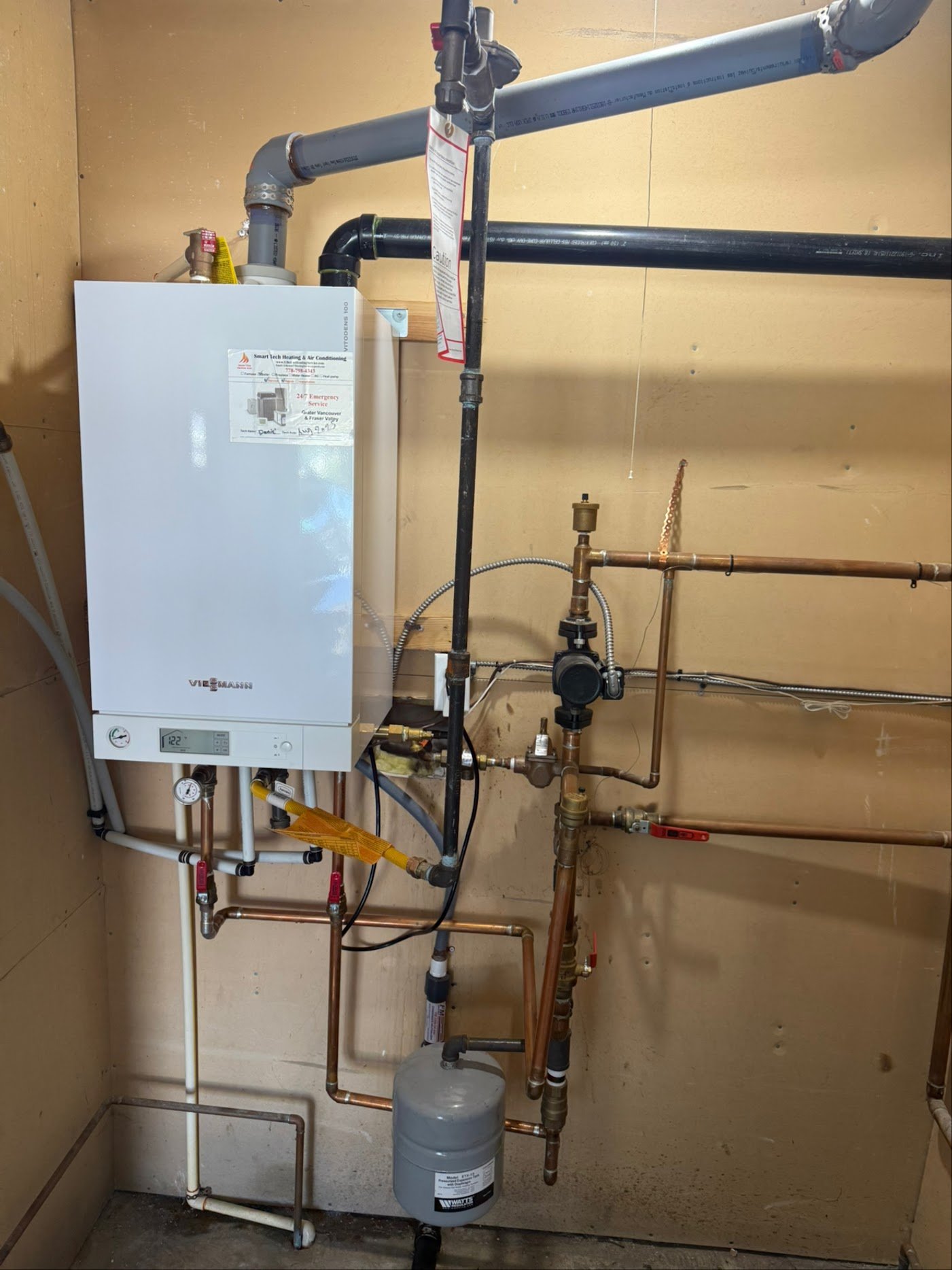
Look beyond the boiler cabinet
The Viessmann cabinet, copper pipework, external circulator and expansion vessel are visible in this photograph. Ask the proposal to identify which surrounding components will remain. Appearance alone cannot confirm their condition, capacity or suitability for the replacement; those decisions belong in the site assessment.
How Installation Day and Commissioning Should Work
Before installation day, confirm access, shutdown timing, equipment availability and the approved scope. After the physical work, the system must be filled, checked, started and configured for the connected zones. The handover should show normal operation and provide the records needed for permits, warranty and future service.
- Prepare: protect the work route, confirm the equipment and review the planned interruption.
- Remove: isolate and remove the agreed equipment without assuming every nearby component is being replaced.
- Connect: complete gas, venting, hydronic, condensate, electrical and water-heating work in the approved scope.
- Commission: perform the manufacturer-required setup and verify calls from the connected controls and zones.
- Hand over: explain normal controls, provide documents and identify follow-up or maintenance items.
Do not plan around a universal one-day promise. A like-for-like residential change may be simpler than a change of vent route, domestic-water arrangement or distribution equipment. The quote should give a realistic schedule for the known scope and explain how unexpected findings will be approved.
After installation, schedule maintenance around the equipment requirements and operating conditions. Our New Westminster boiler service page explains what routine inspection and maintenance should cover.
Compare Brands by the Proposed System, Not the Logo
Compare the actual model, capacity range, control compatibility, service access and hot-water arrangement. Viessmann, Navien and other manufacturers offer different boiler and combi configurations. A brand name alone cannot show whether a proposal fits the building, the emitters or the household’s domestic-water routine.
Ask each contractor to explain:
- Why the model suits the calculated heating demand.
- How it handles the smallest active zone.
- What water temperatures and control strategy are proposed.
- How domestic hot water will be produced and prioritized.
- Which parts of the existing system remain.
- What manufacturer registration and maintenance conditions apply.
If you are replacing Viessmann equipment, review our Viessmann boiler repair and model information for the brand-specific route. The recommendation should still be based on the home and connected system, not on the assumption that the previous brand or capacity must be repeated.
Plan a Boiler Installation Assessment in New Westminster
Efficient Heating Service can assess the boiler, connected heating system and domestic hot-water requirements before preparing a proposal. The aim is a clear installed scope: what remains, what changes, how the system will operate and what you receive at completion. Call 778-798-4343 to begin.
We accept enquiries from Queen’s Park, Sapperton, Glenbrooke North, Brow of the Hill, Uptown, Downtown, West End, Connaught Heights, Victory Heights, Quayside and Queensborough. The City’s heritage resources confirm that these neighbourhoods contain different building histories, so recommendations should stay property-specific.
Read the boiler installation overview for the broader replacement process. Then bring the details that affect your own home: comfort problems, planned renovations, hot-water routine, access limits and any strata or heritage considerations.
Call 778-798-4343 or request a boiler installation assessment.
Boiler Installation Questions From New Westminster Homeowners
Homeowners usually want to know what must change, how long heat and hot water will be interrupted and whether older radiators can remain. These answers help you prepare for an assessment. Final equipment selection, price and permit scope still depend on the property and the installation being proposed.
Can I keep my cast-iron radiators with a condensing boiler?
Often they can remain, but the installer should assess their output, condition, flow and required water temperature. A modern boiler can serve older radiators when the system design and controls suit them. Replacement should not be recommended from age alone.
Does a high-efficiency boiler always condense in an old radiator system?
Condensing performance depends strongly on return-water temperature and operating conditions. The installer should explain the proposed temperature strategy and how the connected emitters behave during different weather, rather than promising one efficiency result for every home.
Can I keep a recently installed indirect tank?
Possibly. Its condition, coil capacity, controls and connection arrangement need review. Ask for the retained-tank option to be priced separately if it can meet the intended hot-water demand and the new boiler manufacturer’s requirements.
Will the new boiler fix one cold bedroom?
Only if the boiler was the cause. A closed valve, restricted circuit, undersized emitter, control problem or building heat loss can leave one room cold. Include that symptom in the assessment so the quote addresses the real limitation.
Do I need strata permission for an in-suite boiler replacement?
You may. Ownership of the appliance does not automatically grant approval to alter common walls, exterior terminations, shared piping or service spaces. Review the strata plan and approval process before the installation route is finalized.
How long will the home be without heat or hot water?
The answer depends on what the old boiler supplies and how much work changes. Ask for the planned shutdown window after the scope is confirmed. Tell the contractor about medical, accessibility or occupancy needs before scheduling.
Should I replace pumps and zone valves at the same time?
Not automatically. Their condition, suitability and control arrangement should be checked. The quote should name the components being retained and replaced, with a reason for each decision, instead of bundling every nearby part into the project.
Can you provide a firm quote from photos?
Photos help identify equipment and access, but they may not show vent routing, gas capacity, hidden piping or connected loads. They can support the first conversation. A firm installation scope normally needs a property assessment and confirmation of the proposed system.