
Updated: September 28, 2026
Boiler installation Abbotsford: what should your quote cover?
Your new boiler should be selected for the spaces and hot water duties it will serve. An Abbotsford installation quote should identify those duties, the equipment being retained, required connection changes and startup checks. Begin with that scope before comparing model names or headline prices.
Call 778-798-4343 Discuss your Abbotsford installation
Contact Efficient Heating Service with your address, current boiler model and a short description of what needs heating. Mention a garage, detached workshop or other building at the first enquiry, even if you are unsure whether it shares the house system. Confirm the proposed work and appointment availability before making arrangements.
- Choosing equipment: compare a heating boiler, a boiler with an indirect hot water tank, or a combi after checking heating and household water requirements.
- Understanding cost: ask for the complete installed scope, including necessary piping, controls, venting, drainage, permits and commissioning. The appliance price alone cannot establish the project total.
- Keeping existing equipment: identify which radiators, floor loops, tanks and controls remain, and what must be checked before reconnection.
- Planning disruption: establish which rooms and hot water services will stop, and when each can return to use.
If a fault has not yet been diagnosed, start with boiler repair in Abbotsford. A failed component or circulation problem needs an assessment before replacement becomes the agreed solution.
Which boiler arrangement fits the job?
A heating boiler supplies the heating circuits; an indirect tank can add stored domestic hot water. A combi provides space heating and on-demand domestic hot water within one appliance. Choose between these arrangements by checking the required duties, usable space and expected hot water demand.
“Condensing” describes heat recovery from the combustion exhaust. It does not tell you whether the boiler supplies taps. A wall-mounted appliance may be a heating boiler, a combi or a tankless water heater; the model label establishes what it is designed to do.
| Arrangement to discuss | Intended role | Decision to settle before ordering |
|---|---|---|
| Heating-only condensing boiler | Supply hydronic radiators, baseboards, floor loops or compatible fan coils | Which circuits are included, and how will their required flow and temperature be provided? |
| Heating boiler with an indirect tank | Serve heating plus a separate stored domestic hot water supply | Is the tank included, retained or replaced, and how will its heating call be controlled? |
| Combi boiler | Provide space heating and on-demand domestic hot water | Does the selected model meet the assessed heating and tap-water requirements? |
| Existing conventional boiler replacement | Replace the heat source within an established system | Which installation changes are required for the proposed replacement technology? |
For identifiable product examples, Viessmann’s Canadian Vitodens 100-W range distinguishes B1HE heating models from B1KE combi models. Navien offers the NHB-H heating range and NCB-H combi range. These are comparison starting points; the exact model, fuel configuration and application need verification.
Brand recognition cannot establish suitability for an added building or a business process. If you are still deciding whether an existing unit needs replacement, see the relevant Viessmann repair information or Navien repair information and arrange diagnosis using the full model number.
How will each space be used during the week?
Tell the installer when each space must be comfortable, not just its floor area. A continuously occupied home and a workshop used for a few hours can need different control strategies. The assessment should distinguish maintaining a temperature from warming a cold space for use.
Start with a practical description: “The house is occupied all day; the workshop is used on Saturday mornings.” Add the desired comfort level, whether large doors open frequently and whether the space contains plumbing or materials that need protection during unoccupied periods.
The heating assessment must consider the building itself. Insulation, windows, air leakage and changes to the heated area affect demand. The old boiler’s rating is useful identification information, but it does not prove the replacement capacity. Natural Resources Canada’s home heating guidance notes that energy retrofits can reduce the heating capacity a home needs.
Illustrative example: a homeowner expects a cold workshop with a concrete heated floor to become comfortable shortly after turning up the thermostat. The proposal should address the floor’s response time and operating schedule. Simply requesting a larger boiler leaves that expectation unresolved. The installer needs to assess both heat production and delivery into the space.
Caleffi’s hydronic design guidance explains the slower response associated with high-mass heat emitters and the faster response of low-mass emitters. Ask how the proposed controls suit your actual pattern of use, and record any warm-up assumptions in the proposal.
For a broader explanation of replacement planning, see our boiler installation guide.
Can the existing pipes and heating fluid stay connected?
Existing pipework needs a compatibility check before it is connected to a replacement boiler. The installer should identify circuit materials, fluid condition and any antifreeze already present. A system that has operated for years can still need preparation or separation to suit the new equipment.
Fluid separation needs a specific reason. An external heat exchanger transfers heat between circuits while keeping their fluids separate. It may form part of a design where retained circuits have different fluid requirements. Its presence also means the associated circulation and controls must be included in the design.
One manufacturer-specific example is underfloor tubing without an oxygen diffusion barrier. Viessmann’s Vitodens B1HE/B1KE installation documentation recommends separating such tubing from the boiler with a heat exchanger. That is a reason to identify retained tubing, not a reason to assume every older floor needs replacement.
Existing glycol affects the design. A water-glycol mixture has different flow properties from water alone. Caleffi’s hydronic fluid guidance explains that these mixtures have higher viscosity, which affects resistance to flow. Ask the installer to identify and assess the fluid against the selected equipment’s requirements before deciding whether it can remain.
Useful questions for the assessment include:
- Can the retained circuits be identified from accessible labels, records or inspection?
- Is the existing fluid known, and are its condition and compatibility documented?
- Does the scope include necessary cleaning, flushing or treatment, with the reason stated?
- Which pumps, valves and control connections will be reused, and which require changes?
Do not add treatment chemicals or antifreeze based on a generic internet recommendation. The selected product, concentration and procedure must suit the complete system and manufacturer instructions.
What should you photograph before discussing retained connections?
Photograph the complete boiler area, including the pipes, pumps, tanks and control boxes around the appliance. This helps identify what needs closer assessment during replacement planning. Add model labels and any existing circuit labels, but do not assume a photograph shows where every connected pipe goes.
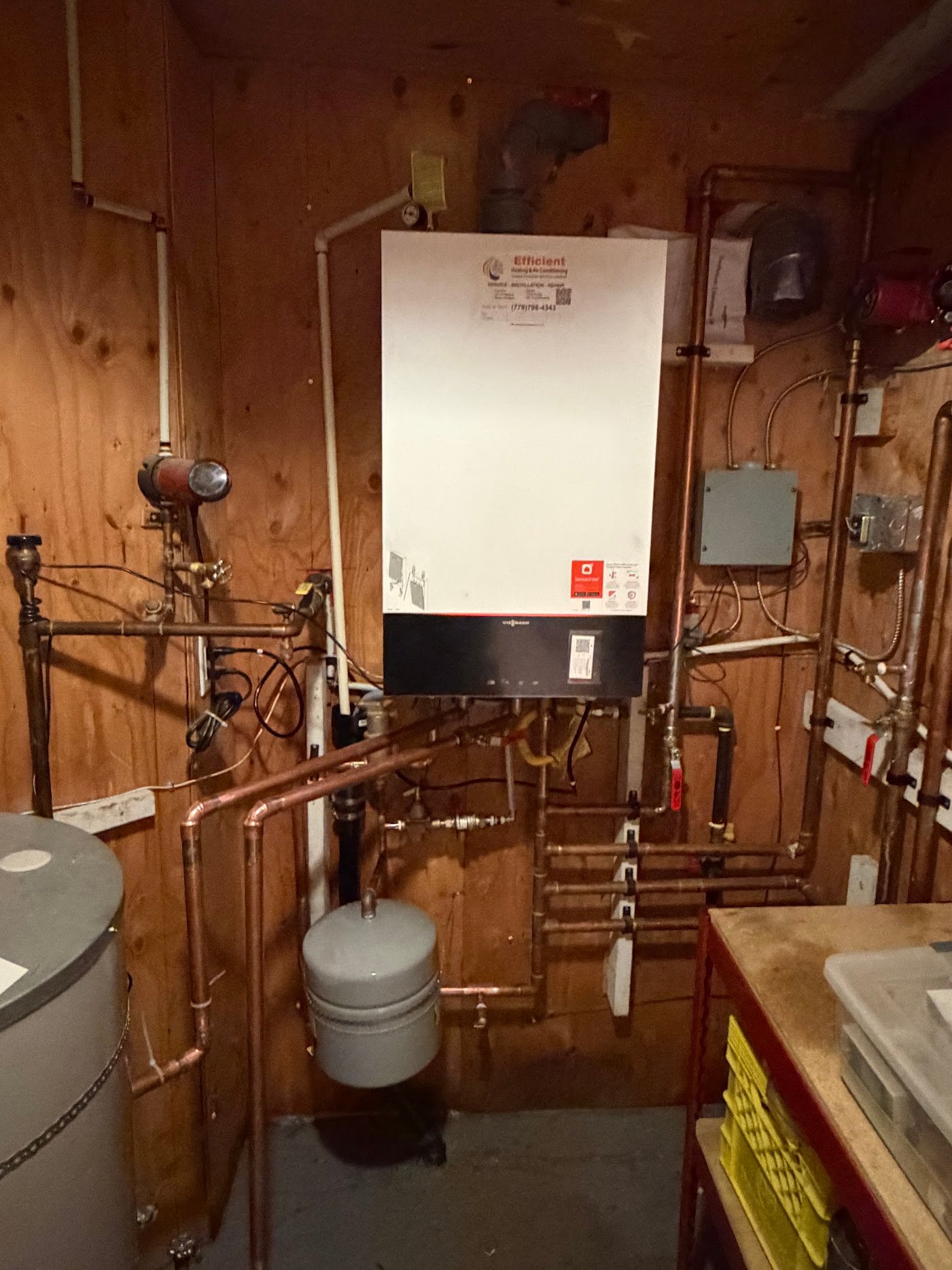
The visible pipework and external components provide a starting list for the installer: identify each connection, establish its duty and decide what the replacement scope includes. Ask which circuits will remain connected and how they will be checked. The photo cannot identify concealed pipe routes, confirm the fluid inside them or replace operating tests.
Does a workshop or business use change the installation scope?
A detached workshop, commercial tenancy or process load should be described before the installation is quoted. Heating people, supplying domestic hot water and supporting a business process are different duties. The contractor must confirm the application, service scope and applicable approvals before promising a suitable system.
An address can include more than one use. Explain whether a space is part of the home, a private hobby area, a separately occupied unit or a business premises. Also distinguish space heating from equipment that needs heated water for its own operation. A residential boiler recommendation should not silently include every activity at the property.
For a separate building, identify any existing connecting pipework and whether the proposal includes inspecting, retaining or replacing it. If a new underground route is being considered, clarify who is responsible for assessing the route, excavation and reinstatement. A boiler quotation should make those boundaries visible.
Technical Safety BC’s gas alteration bulletin states that gas equipment replacements require an installation permit from the applicable authority before work begins. Additional approvals depend on the work. Its heating plant guidance also distinguishes requirements and exemptions for boiler systems.
Give the responsible contractor the actual building use and proposed equipment details so the correct requirements can be established. For workshop, commercial or process-related enquiries, ask Efficient Heating Service to confirm whether the project falls within the work it can undertake before relying on a residential estimate.
What should you compare in the installation price?
Compare quotations against the same list of spaces, hot water duties and retained equipment. A lower total may cover a smaller project rather than a different price for equivalent work. Ask each contractor to identify inclusions, exclusions and unresolved items before you compare the final figures.
| Quote item | Ask the proposal to identify | Why it affects the comparison |
|---|---|---|
| Defined heating duties | Buildings, rooms, circuits and domestic hot water included | “Boiler replacement” alone leaves the expected result unclear |
| Equipment | Exact boiler model and any separate tank or heat exchanger | Different arrangements include different components |
| Retained system preparation | Assessment and necessary fluid, piping or control work | A new appliance may need work beyond its immediate connections |
| Supply and discharge connections | Required gas, electrical, venting and condensate work | Existing connections cannot be assumed suitable without checking |
| Separate-building work | Responsibility for connecting lines, access and any excavation | The boiler price may exclude the route that delivers heat |
| Completion | Permits, commissioning, owner instruction and records | The equipment must be integrated and checked after installation |
Illustrative comparison: one proposal replaces the house boiler and reconnects the house circuits. A second also includes assessing an existing workshop connection, providing a separate control arrangement and testing that circuit. Those totals do not describe the same job. Ask for the house replacement and the additional work to be itemized so you can make an informed choice.
When an item is awaiting inspection, ask what information will settle it and when its price will be confirmed. “Existing pipework by others” should identify who will arrange that work and what must be ready before the new boiler can be commissioned.
Component names in a quotation should connect to a purpose. The sections on heat exchangers and fluid separation and pumps, glycol and circuit controls explain questions worth resolving before accepting those line items.
Where in Abbotsford is the property?
Include your neighbourhood and full address when asking about an installation. Clearbrook, Historic Downtown, Clayburn and Matsqui Prairie help locate an enquiry, but an area name does not identify the heating system. Access, connected buildings and equipment details still need to be checked for the property.
The City’s Quality of Life Survey neighbourhood map provides locally recognized area names. Use the name that best identifies your location when you contact us.
| Local area names you can include | Useful booking detail |
|---|---|
| City Centre, Historic Downtown, Clearbrook, South Clearbrook and Townline | Full address, unit number where relevant, and access to the equipment |
| Clayburn, McKee, Whatcom and Sumas Mountain | Full address and whether the work concerns the main home or another space |
| Bradner–Mt. Lehman, Matsqui Prairie, Sumas Prairie, Aberdeen and West Abbotsford | Full address and identification of each building included in the enquiry |
These names help describe location; they do not establish service availability, fuel supply or a preferred boiler brand. Confirm the address and proposed work when booking. There is no need to select equipment simply because a neighbouring property uses the same make.
How will you know the agreed work is complete?
Before work begins, agree how each included heating duty will be demonstrated at handover. The record should identify the installed equipment, retained connections, relevant settings and outstanding items. Starting the burner is one step; the agreed rooms and hot water functions also need appropriate operational checks.
Ask the installer to walk through the scope with you: which thermostat serves each space, what happens when domestic hot water is requested and whether any circuit has a different operating schedule. Where a heat exchanger or separate control panel is installed, have its purpose explained in ordinary language.
Keep the model and serial numbers, manufacturer literature, permit information and commissioning records together. Ask which maintenance tasks apply to the boiler and which relate to retained tanks, pumps or treated heating fluid. The service plan should reflect the equipment that remains connected.
If a particular comfort condition cannot be demonstrated at handover, record the limitation and any agreed follow-up. For example, a brief test can show that a workshop circuit responds to its control, but it does not by itself establish how quickly a cold building will reach the intended temperature.
For continuing care after installation, see boiler service in Abbotsford.
Ready to discuss a replacement? Tell Efficient Heating Service what the boiler serves today, what you want it to serve next and which issue is driving the decision. That gives the first conversation a clear starting point.
Call 778-798-4343 Request an Abbotsford installation assessment
Questions about planning an Abbotsford boiler installation
The questions below address boundaries that can be missed when a replacement is described only by boiler size or brand. Use them to clarify separate buildings, retained fluids and operating expectations. Their purpose is to help define the proposal before equipment is ordered or connections changed.
Is a boiler labelled “residential” suitable for any building on my property?
The label alone cannot answer that. Suitability depends on the manufacturer’s permitted applications, the required duty and the applicable installation requirements. Tell the contractor how each building is used, including any business activity or process equipment, and ask for confirmation of the proposed application.
Can I leave an unused workshop unheated if its pipes share the house system?
Do not assume the house boiler protects every connected pipe while that space is unheated. The assessment must consider the pipe route, exposure, circulation and chosen freeze-protection approach. Ask for an operating plan for unoccupied periods before changing the workshop’s heating schedule.
Will a new boiler warm a cold concrete floor immediately?
A concrete floor stores heat and takes time to change temperature. Replacing the heat source does not remove that response time. Discuss your expected arrival time, comfort level and operating schedule so the design can address how the space will be used.
Does old glycol have to be discarded when the boiler changes?
Replacement is not decided by age or colour alone. The installer should identify the fluid and assess its condition and compatibility with the proposed equipment. Ask the quotation to state whether testing, treatment, replacement and disposal are included where needed.
Does a heat exchanger mean my old floor tubing is unusable?
No. Separation may allow suitable retained tubing to serve the heating system while meeting the boiler manufacturer’s requirements. The tubing condition still needs assessment. Ask what problem the exchanger addresses and what associated pumping or control work is included.
Does the installer need access to a separate space if the boiler is in my house?
Arrange access to every space included in the assessment and commissioning scope. The boiler room alone may not show the condition or operation of remote emitters and controls. If another occupant holds the keys, coordinate access before the visit so that required checks can be completed.
Does one thermostat show how much heat each building uses?
A thermostat controls a heating request; it does not by itself establish separate energy use for each building. If cost allocation or monitoring matters, explain that before design. Ask what measurement would be required and whether it is included in the proposal.
What happens to a redundant connection after the replacement?
Have the contractor identify unused equipment and connections in the removal scope, including how they will be safely disconnected or left for an agreed future purpose. Keep that record with the installation documents so a later contractor does not have to guess what an old connection served.