
Boiler installation Surrey · Heating and hot water planned together
Plan the right boiler for your home
Efficient Heating Service plans Surrey boiler installations around your heating zones, hot-water demand and existing equipment. We assess whether repair still makes sense, compare suitable replacement arrangements and explain what the job includes. Call with your neighbourhood, boiler model and the problem you want solved.
Which system?A heating-only boiler can retain separate hot water. A combi combines both. A boiler with an indirect tank stores hot water for peak use; capacity still needs checking.
What will it cost?The model, vent route, gas supply, tank, pumps and controls determine the scope. Get an itemized quote after assessment, with retained equipment and extras clearly identified.
Must everything be replaced?No. Compatible, serviceable components may stay. Cold rooms, pressure loss and hot-water complaints need diagnosis so an existing fault is not carried into the new system.
When can the work happen?Timing depends on equipment, access and the agreed work. Confirm the heating and hot-water shutdown plan before booking, especially if a suite shares the system.
Tell us if the boiler serves one household or a main home and suite. That changes the questions we need to ask.
Efficient Heating Service · Content reviewed September 27, 2026
Combi, heating-only or an indirect tank: what fits your household?
Choose the heating and hot-water arrangement before comparing brand names. A heating-only boiler serves the hydronic system; a combi also produces domestic hot water on demand. An indirect tank stores water heated by the boiler. Each option needs separate checks for heating load and household use.
| Arrangement | When to discuss it | What must be checked |
|---|---|---|
| Heating-only boiler | You want to replace the boiler while keeping a separate, working water heater. | Heating load, radiator or floor-loop requirements, minimum output and control compatibility. |
| Combi boiler | You want heating and on-demand domestic hot water from one appliance, with less equipment taking up space. | Simultaneous fixture demand, incoming water temperature, available flow and model-specific hot-water performance. |
| Boiler with an indirect tank | You want stored hot water or are assessing whether an existing indirect tank can stay. | Usable storage, recovery, coil compatibility, tank condition and space for service. |
“Condensing” describes how a boiler recovers heat from its exhaust. “Combi” describes its heating and hot-water functions. A condensing boiler can be heating-only or a combi; those words are not interchangeable. A tankless water heater is also not automatically a replacement for a space-heating boiler.
For a main home and basement suite, describe the busiest hour
List the fixtures that actually run together. For example, one shower upstairs, one downstairs and kitchen use during the same morning period create a different requirement from sequential showers. This is a planning example, not a claim about a completed local job.
Ask the installer to evaluate that routine against the selected model’s performance at the expected incoming water temperature. Heating demand also needs its own calculation; copying the old boiler’s rating or choosing by floor area alone can miss the real load. Navien’s sizing guidance explains these separate considerations.
Six checks that make a Surrey installation quote useful
A meaningful installation price covers the finished system, including the connections and controls needed to make it work. Ask for six items to be explicit: equipment, retained parts, venting and drainage, gas and electrical work, permissions and removal, and commissioning with support. Compare totals only after comparing scope.
| Quote check | What should be clear in writing |
|---|---|
| 1. Equipment and sizing | Exact boiler model, heating output, hot-water arrangement and any tank included. Ask what household demand the selection is intended to meet. |
| 2. Parts that stay or change | Which pumps, valves and controls, and expansion vessel are retained, replaced or subject to further testing. Separate necessary repairs from optional upgrades. |
| 3. Venting and condensate | Intake and exhaust route, termination, access, drainage and any required neutralization. An old vent is not automatically compatible with a new appliance. |
| 4. Gas and electrical scope | Whether supply changes, wiring or coordination with another trade are included, with any exclusions identified. |
| 5. Permissions and removal | Required permits, any owner or strata approval, old-equipment disposal, protection of access routes and responsibility for wall repairs. |
| 6. Commissioning and support | Operating checks, zone and hot-water testing, handover, registration responsibilities and separate equipment and labour warranty terms. |
A replacement in the same location with usable connections is a different job from moving the boiler, changing the tank and rebuilding zone pipework. We need to assess those differences before quoting your installation. Confirm taxes, allowances and possible extra work rather than treating an equipment-only price as the complete job.
Do not budget around an advertised rebate until the current program and the exact equipment, property and applicant eligibility have been checked. Ask for the pre-rebate total and any eligible incentive to be shown separately.
Which pumps, valves and controls can stay?
Existing components can sometimes be retained, but their condition and compatibility need checking against the new design. The assessment should cover circulation, zoning, expansion control and water quality as well as the appliance. Replacing the boiler alone will not correct every cold room, pressure problem or control fault.
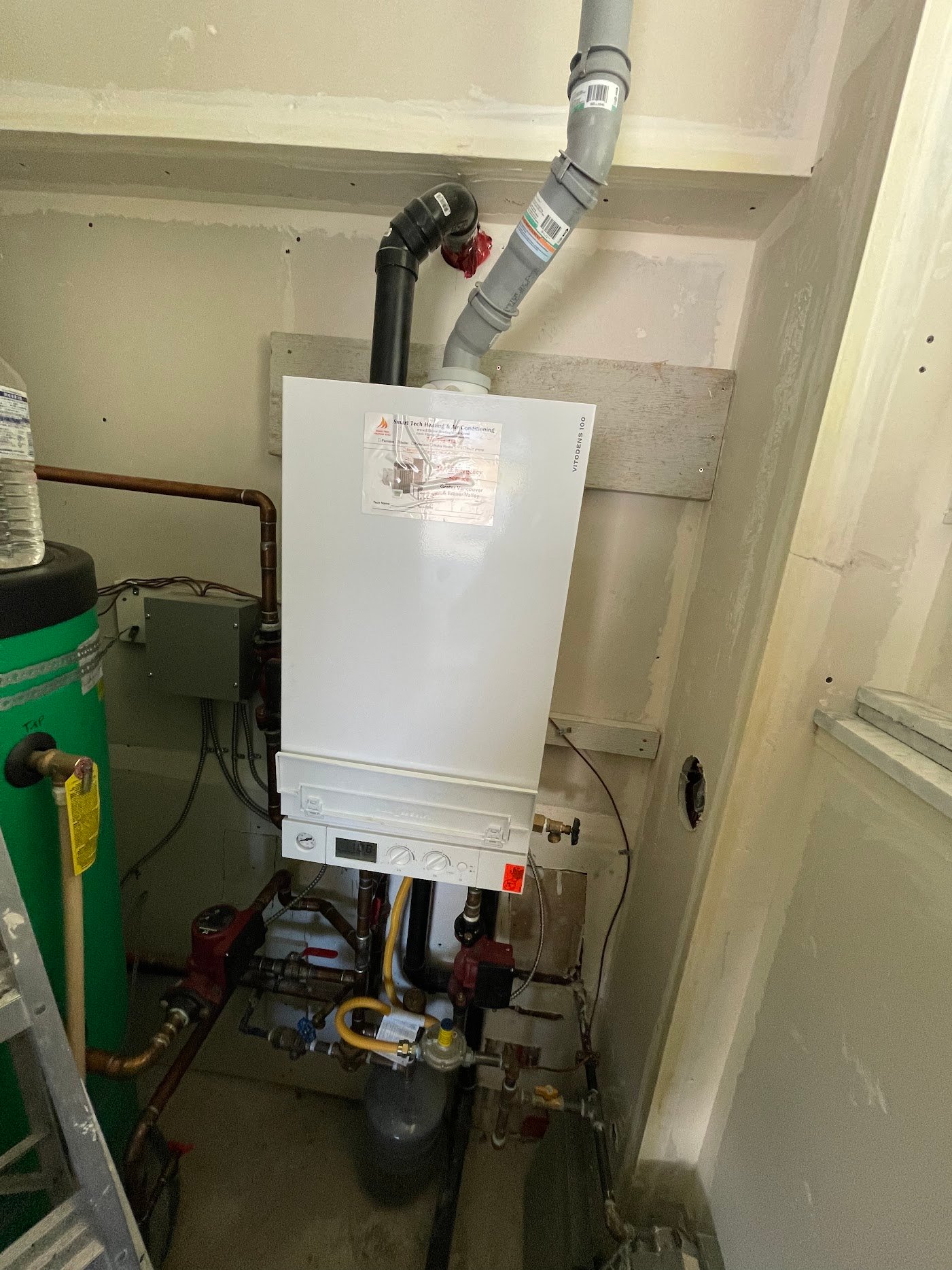
Read the system around the appliance
The photo shows limited working space, overhead vent connections and equipment beside and below the boiler. A wider equipment view like this helps prepare for a site visit. It cannot establish internal condition, correct sizing or whether an installation complies with current requirements.
- Circulator pumps: check the flow needed through the boiler and each circuit, along with the existing pump’s condition and suitability.
- Zone valves and controls: identify which thermostat serves each floor or suite and check that the intended circuit responds.
- Expansion tank: assess condition, sizing and connection to the proposed heating system.
- System water and separation: assess debris, air removal and the manufacturer’s cleaning and water-quality requirements before connecting new equipment.
These are assessment points for the technician. You do not need to remove covers or adjust service settings to request a quote. Have a model-label photo and a clear view of accessible equipment ready.
If the immediate problem is one cold floor, a recurring code or loss of pressure, start with boiler fault diagnosis in Surrey. A confirmed repair can be a better decision than replacing an otherwise serviceable appliance.
Which boiler brands should you compare in Surrey?
Viessmann, Navien and IBC appear among boiler options offered by contractors serving Surrey. That shows local availability of expertise, not which brand occupies the most homes. Compare the exact appliance, sizing, installation requirements, service access and support. A familiar brand name does not establish suitability for your system.
Viessmann: identify the exact Vitodens version
The Vitodens 100-W range includes B1HE heating boilers and B1KE combi versions. That distinction matters when deciding whether to retain a tank. Read our Viessmann repair, service and installation guide for the brand-specific service context, and compare the proposed model against the manufacturer’s current range.
Navien and other proposed options
For a Navien combi proposal, ask for the model’s hot-water performance under your expected conditions, not just its maximum input rating. If you already own one and are weighing a repair, our Navien fault and replacement-parts guide explains the diagnostic work.
If an IBC or another make is proposed, request the same heating, hot-water and serviceability checks. Confirm supply and support for the exact model before committing.
An older conventional boiler, a wall-mounted condensing unit and a combi can require different replacement work. Send the full model information; a logo or cabinet colour cannot tell us the appliance’s complete specification. For planning, the exact model and connected equipment are more useful than a general recommendation for the area.
Boiler Installation Surrey: neighbourhoods and property checks
We take installation enquiries across Surrey’s six communities: Cloverdale, Fleetwood, Guildford, Newton, South Surrey and Whalley, including City Centre. Share your neighbourhood and property type when booking. The installation plan depends on the actual boiler, heating circuits, hot-water use and access, rather than assumptions about nearby homes.
Newton, Sullivan and Panorama
Tell us whether the boiler serves the whole property or a home and suite. Include which thermostats control each area and whether domestic hot water is shared. This helps separate comfort complaints from capacity and control questions.
Guildford and Fraser Heights
For a replacement assessment, describe any retained tank, floor-heating manifold or radiator circuits. If the equipment sits in a garage or utility room, include the available working space and the route needed to remove it.
Cloverdale, Clayton and Fleetwood
For a townhouse or strata property, establish who owns the appliance and who can approve exterior vent changes. For a detached home, identify any renovation that has changed the heated area or household demand.
South Surrey and Whalley / City Centre
South Surrey enquiries include Ocean Park, Crescent Beach, Grandview Heights and Rosemary Heights. In any Surrey neighbourhood, confirm whether your appliance is privately owned or part of a shared building system before requesting a replacement quote.
Looking for a boiler installer near you? Provide the address and access details when contacting us so the assessment and scheduling can be confirmed. The City’s community directory and South Surrey overview help identify your area when arranging a visit.
Plan permits, access and the heating shutdown before installation
Agree on who handles permits, property permissions and access before scheduling the replacement. The proposal should also explain when heating and hot water will be unavailable. For a shared home or strata property, coordinate the affected occupants and authorized contact so the installation can proceed with clear responsibilities.
Gas permits and property approvals are separate
Technical Safety BC generally issues gas installation permits for Surrey; Surrey’s delegated authority listed by TSBC covers electrical work. The contractor should confirm the applicable permit process for the address and scope, together with any municipal requirements. Strata consent does not replace technical permits. See TSBC’s gas installation permit guidance and its jurisdiction list.
Ask for a project-specific schedule
Confirm equipment availability, access to every affected zone, the expected shutdown and what could extend it. Vent alterations, supply upgrades or additional repairs can change the work. A general “one-day installation” statement is not a schedule for your property.
If a main home and suite share hot water, make sure both households know the interruption window. Discuss any essential heating or hot-water needs before the appointment so the plan accounts for them.
What should you receive when the installation is complete?
At handover, ask for the equipment details, the checks completed and a demonstration of normal controls. Heating zones and hot-water operation should be assessed as part of commissioning. Keep the installation record, warranty terms and maintenance requirements together so future service starts with an accurate picture of the system.
- Equipment and scope: record the boiler and tank models, and identify retained components.
- Operating checks: ask what was verified for combustion, circulation, pressure, condensate drainage and controls according to the appliance instructions.
- Household operation: confirm which thermostat serves each zone and how domestic hot-water settings are used.
- Follow-up: keep the service contact, fault-reporting instructions and equipment and labour warranty terms.
Arrange boiler maintenance in Surrey around the manufacturer’s requirements and the system’s condition. A new appliance still needs appropriate care, and a stored installation record makes later troubleshooting more efficient.
Start with the problem you want your new boiler to solve
Call Efficient Heating Service or use the contact form to request a Surrey installation assessment. Tell us what is happening now and what you want to improve. Include your neighbourhood, equipment details, household hot-water routine and any suite or strata considerations so the next step is relevant.
Useful details for the first conversation
- Make, model and approximate age.
- Heating, hot water or both affected.
- Separate tank, indirect tank or combi.
- Fixtures used at the same time.
- Access, authorized contact and preferred timing.
Get a clear route from assessment to quote
We can discuss whether diagnosis should come first and what needs to be assessed for a replacement. Have equipment and pipework photos ready; they help explain the arrangement before the visit.
For the wider service scope, see our boiler installation overview.
Surrey boiler replacement: questions before you commit
Questions about a shared home, comfort controls and installation responsibilities can change the right replacement choice. These answers help you prepare for the assessment and avoid assumptions about capacity or retained equipment. Confirm the final arrangement, timing and included work against the written proposal for your property.
Can the main home and basement suite keep separate thermostats?
Often they can, if the heating circuits and controls support separate zones. The installer needs to identify the pipework and test how each thermostat operates. Separate temperature control does not make the heat source independent, and it does not automatically provide separate utility billing.
What happens if one combi serves both households and breaks down?
An appliance fault can interrupt both space heating and domestic hot water for everyone it serves. Consider that dependency when comparing one combi with arrangements that keep domestic hot water separate. The right choice also depends on demand, space and installation scope.
Will a larger boiler make hot water arrive faster at a distant bathroom?
Not necessarily. Waiting time can come from the length and volume of the hot-water pipe, while delivery capacity is a separate issue. Describe where the delay occurs and whether temperature remains steady afterward. The installer can assess whether a compatible recirculation arrangement or another plumbing change is appropriate.
Should an old boiler be replaced just because of its age?
Age is one factor, alongside condition, fault history, parts support and whether the system meets your needs. A diagnosed repair may still be worthwhile. Compare that scope with replacement costs and expected support rather than using an arbitrary age cutoff on its own.
Can one new boiler serve floor heating and radiators?
It can be designed to serve different circuits, but their temperature and flow requirements must be considered. Existing mixing controls, pumps and zoning may need adaptation. Include every circuit in the assessment; the appliance’s maximum output alone does not establish that the arrangement will work.
Does a Surrey strata need to approve a private boiler replacement?
Check the strata’s bylaws and approval process before work is booked, particularly if vents, exterior walls or common property are involved. Confirm ownership of the appliance and who can authorize the work. The contractor must separately establish the applicable technical permits and installation requirements.
Can I choose a boiler now if I plan to add a suite later?
Discuss the proposed change before selecting equipment. Future heating and hot-water needs should be evaluated alongside current operation, including low-load performance. Do not simply choose the largest boiler; document the intended circuits, occupancy and plumbing changes so the design can account for them.
Are new pumps and an expansion tank always included in a replacement?
No; that depends on the agreed scope. A proposal may reuse suitable components or include replacements after assessment. Ask for each retained and replaced item to be identified, with any additional testing or optional work clearly separated from the base installation price.