
Updated: September 29, 2026
Boiler Installation Port Moody: Plan Your Heat and Hot Water Together
Boiler installation in Port Moody should begin with two questions: how much heat does your home need, and how do you use hot water? Efficient Heating Service helps you compare replacement options, understand the work involved, and choose a system around everyday comfort rather than a nameplate alone.
A larger boiler does not automatically solve a disappointing shower or a cold bedroom. Those symptoms can have different causes. Before recommending equipment, we look at the heating arrangement, your current water heater, the space available and the changes you want to make.
Looking for a replacement quote? Tell us whether the existing boiler also supplies your taps, how many bathrooms are used together, and what has changed since the system was installed. Call 778-798-4343 to discuss an assessment.
Should You Replace the Boiler, the Water Heater, or Both?
Replace both appliances only when their condition, performance and the proposed system justify it. A sound water heater may remain alongside a new heating boiler. If you want one appliance to do both jobs, compare a combi with a boiler and storage tank before committing to the change.
Start by separating three concerns: a heating fault, insufficient hot water, and an ageing appliance. Replacing everything can be unnecessary when one component is responsible. Equally, installing a new boiler without discussing an unreliable tank may leave the original household frustration unresolved.
- Heating works poorly but hot water is satisfactory: investigate circulation, controls and the boiler before changing the domestic water arrangement.
- Hot water runs out during busy periods: compare usable storage, recovery and simultaneous demand.
- You want more mechanical-room space: assess a combi, including its service clearances and connection requirements.
- You are renovating bathrooms: discuss the intended fixtures before choosing equipment, even if the plumbing work comes later.
If a repair could reasonably restore the existing system, our Port Moody boiler repair page explains the diagnostic route. Installation planning should make the repair-versus-replacement decision clearer.
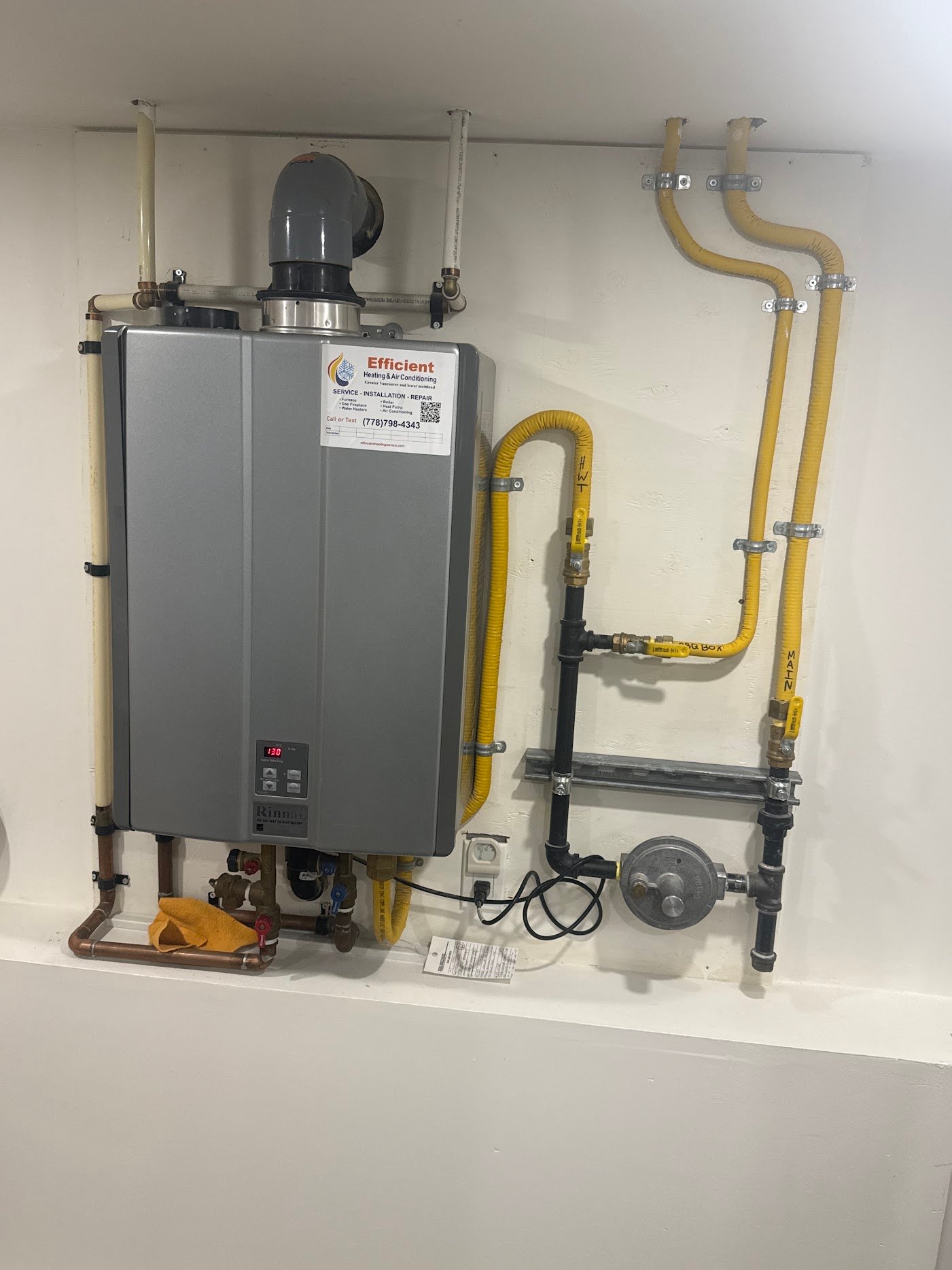
Show each appliance before deciding what to replace
An appliance’s shape does not tell us everything it supplies. This photograph shows a wall-mounted Rinnai unit and the connections around it. Send a wider view of every appliance and a separate model-label photo, so the assessment can distinguish space heating, domestic hot water and equipment you want to keep.
Combi or Stored Hot Water: Which Suits Your Routine?
A combi heats domestic water on demand, while a boiler with an indirect tank stores hot water for use. The choice depends on overlapping fixtures, bath filling, available space and the equipment combination. Compare performance for your household’s busiest period rather than selecting by bathroom count alone.
On a small screen, swipe the table sideways to see every column.
| Your priority | Arrangement worth comparing | Question to resolve |
|---|---|---|
| Free up floor space | Wall-hung combi | Does its rated hot-water delivery meet the simultaneous demand? |
| Fill a large bath while another fixture runs | Boiler with a properly selected storage tank | What usable volume and recovery are available? |
| Keep a recently installed water heater | Heating-only boiler with the separate water heater retained | Are the connections, clearances and remaining condition suitable? |
| Plan for a bathroom renovation | Compare present and planned demand | Which fixtures will operate together after the changes? |
For example, two households with two bathrooms can need different arrangements. One might stagger showers; another might fill a bath while someone showers. Describe that routine during the assessment. This is a planning example, not a claim about a particular Port Moody property.
On many combis, a domestic-water call temporarily takes priority over space heating. Ask how the selected model handles that changeover and whether your usage pattern suits it. A storage tank also needs a considered control strategy; adding storage is not a substitute for designing the system.
How We Establish the Right Boiler Size
The heating load and hot-water requirement need separate checks before selecting a boiler. We consider the building’s heat loss, the connected heating system and the proposed water-heating arrangement. The old boiler rating is useful identification, but it is not enough evidence to choose the next appliance.
Bring details of insulation or window upgrades, additions and any rooms that remain uncomfortable. Where a combi is being considered, fixture flow and incoming-water temperature affect achievable hot-water delivery. Navien’s combi sizing guidance explains why both heating and domestic-water demand matter.
The recommendation should identify the selected model and the basis for its capacity. If you are comparing quotes, ask whether the installer assessed your actual requirements or simply matched the old label. A future addition should be discussed as a defined change, not an unspecified reason to select a larger appliance.
What Determines Your Installation Quote?
Your quote depends on the appliance, the existing connections and the work needed to deliver the agreed result. Venting, gas supply, drainage, controls and water-heating changes can affect the scope. A useful written estimate separates necessary work, optional improvements and exclusions so you can compare proposals fairly.
Ask for these items to be made explicit:
- Equipment model, included controls and any domestic hot-water tank.
- Removal and disposal of the equipment being replaced.
- Pipework, valves, pumps and other components being retained or changed.
- Venting route, condensate disposal and electrical work where applicable.
- Permit responsibilities, start-up checks and homeowner handover.
- Access assumptions, finishing repairs, tax and any excluded work.
A headline equipment price cannot tell you the installed cost for your home. Nor should a lower quote be dismissed without checking its scope. If two proposals differ, compare the retained components, water-heating arrangement and completion requirements first. Request written approval of any additional work discovered after the initial assessment.
Keep Useful Components, Check the Whole Connection
Existing radiators, floor-heating circuits and some controls may remain, but compatibility and condition must be checked. The installation plan should explain which components are reused and why. Replacing the boiler alone does not prove that existing pumps, valves, expansion arrangements or water quality are suitable for the new equipment.
Tell the technician about noisy circulation, repeated pressure changes or rooms that have never heated evenly. These are assessment clues, not automatic reasons to replace every part. The new installation should account for the connected system and the manufacturer’s requirements rather than treating the appliance as an isolated box.
Service access matters too. A compact installation still needs room to reach components, isolate the appliance and maintain it. Ask to see the proposed position and explain any storage or access restrictions before the layout is agreed.
Compare Boiler Models, Support and Warranty
Choose a boiler by the suitability of the model, support arrangements and installation requirements, rather than assumed local popularity. Viessmann and Navien offer different product options, but the useful comparison is between the actual proposed systems. Ask what each option changes for your hot water, controls, maintenance and budget.
If you already own Viessmann equipment, our Viessmann boiler support page provides a starting point for discussing the existing unit. Keeping the same brand is one option; it is not proof that the same size or layout remains appropriate.
Request the written manufacturer warranty for the proposed model and clarify the installer’s workmanship coverage separately. Check registration requirements, maintenance expectations and exclusions. Avoid treating a long headline warranty as a promise that every future part, labour charge or service visit is covered.
Permits, Strata Approval and Access Before Installation
Confirm the permit route and any property approvals before scheduling the installation. Gas work, changes to the building and strata-controlled areas may involve different responsibilities. The written scope should identify who handles each requirement, while the access plan should cover the equipment route, work area and any affected occupants.
Technical Safety BC’s gas installation permit guidance lists its jurisdiction and the municipalities that issue their own permits. Port Moody is not listed among those exceptions. The contractor should confirm the applicable gas permit and any separate municipal requirements for the proposed work.
For a strata property, establish whether the boiler serves only your home or is part of a shared system. Proposed work through an exterior wall or common property needs the appropriate approval before it is treated as an available installation route. A replacement for an individual home and a central plant project are different scopes.
Installation Day and Handover: Know What Will Happen
Agree on the expected heating and hot-water interruption before work starts, then allow time for commissioning and explanation after installation. Completion means more than mounting the appliance. The final handover should cover normal operation, the agreed system checks, documentation and who to contact if something does not behave as expected.
- Before shutdown: confirm equipment availability, access, the approved scope and your household’s essential hot-water needs.
- During the changeover: remove the agreed equipment, complete the connections and address any scope changes with you.
- Before handover: perform the checks required for the appliance and installation, then verify the connected heating and hot-water functions.
- At handover: explain user controls, provide the relevant records and identify the maintenance arrangements.
Do not plan around a universal one-day promise. The expected duration should reflect the actual work and any approvals or remedial changes involved. Tell us in advance if an interruption would create particular difficulties for anyone living in the home.
After installation, use boiler service in Port Moody to plan ongoing care according to the equipment requirements. Installation, fault repair and routine servicing are separate tasks, even when the same company provides all three.
Arrange Your Port Moody Boiler Assessment
Contact Efficient Heating Service with your address, existing boiler details and the change you want to achieve. We can start with your heating and hot-water priorities, then establish what needs checking at the property. A clear assessment gives you a better basis for comparing equipment and approving the installation scope.
For enquiries in Moody Centre, College Park, Glenayre, Heritage Mountain, Inlet Centre or Pleasantside, include the property type and any access or strata restrictions. Tell us whether you are planning ahead or responding to an existing failure so the conversation starts with the right problem.
You can also read our boiler installation overview for the broader process. For your own home, the next useful step is a defined scope: what stays, what changes, how hot water will be provided and what completion includes.
Questions About Replacing a Boiler in Port Moody
The most useful installation questions concern your household’s routine, the existing equipment and what the quote includes. These answers help you prepare for an assessment, but they cannot determine a model or final price remotely. Bring any unusual hot-water use, access restrictions or planned renovations into the discussion early.
Can I keep the water heater I installed recently?
Possibly. Its condition, type and connection arrangement need checking, but a boiler replacement does not automatically require a separate water heater to be replaced. Ask for the retained-equipment option to be included in the comparison if it suits your goals.
Will a combi fix the long wait for hot water at my upstairs tap?
Not necessarily. Water already in the pipe must still move before hot water reaches a distant tap. Ask the installer to assess the distribution arrangement as well as the appliance; changing the heat source alone may leave the wait largely unchanged.
Can a new system fill the bath while someone showers?
That should be assessed from the intended simultaneous flow, temperature requirement and selected equipment. Tell us which fixtures overlap and whether bath-filling time matters to you. A bathroom count alone cannot answer that question reliably.
Should I mention a bathroom renovation planned for next year?
Yes. Share the proposed fixtures and likely overlapping use before equipment is ordered. This allows present and future requirements to be compared without making an undefined allowance for extra capacity.
Will the gas meter need changing?
It cannot be determined from the boiler brand alone. The proposed appliance input and the other gas loads need to be considered with the supply arrangement. Any required utility coordination should be identified before the installation date is agreed.
Can you quote from a photo of the boiler label?
A clear label photo helps identify the appliance, but it does not show the whole installation. Photos of the equipment area and accessible connections can support an initial conversation; an assessment is still needed to confirm the scope and final proposal.
Can an owner replace a boiler inside a strata townhouse?
First establish ownership and responsibility for the appliance and any affected common property. Confirm the strata process and relevant permits before work is scheduled. The fact that equipment is inside the home does not settle every approval question.
What should I report after the first cold spell?
Describe which rooms are affected, the thermostat settings and when the issue occurs. Note any displayed message without changing installer settings. That information helps distinguish an adjustment or existing distribution issue from an appliance fault and makes the follow-up more useful.